“We're back in the 2000s.” Director Tudor Giurgiu, reaction after the Recorder documentary “Captured Justice”. He recalls a notorious case


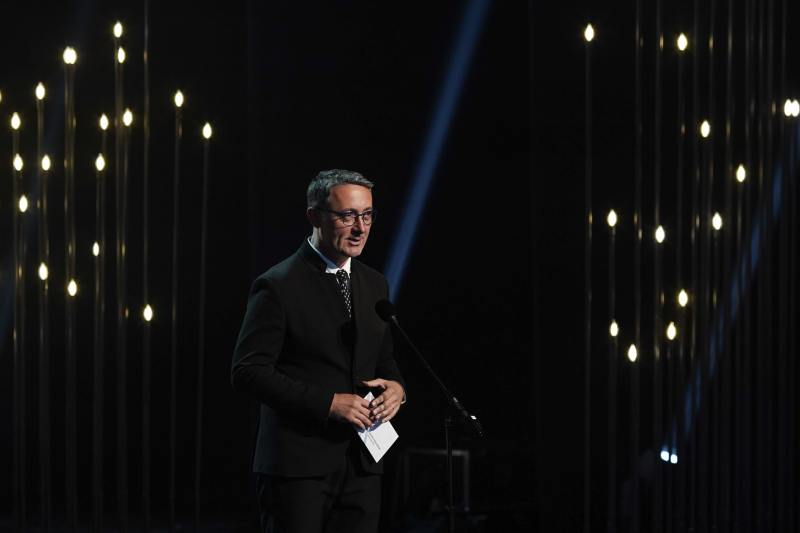
Director Tudor Giurgiu, photographed on the stage of the 2024 UNITER Awards Gala, PHOTO: Inquam Photos / Saul Pop
The Recorder documentary “Captured Justice” is also praised by Tudor Giurgiu, one of the most successful Romanian directors, who says that Romania has evolved over 20 years in terms of justice and recalls the case of prosecutor Panait, about whom he made a film.
“In justice, we went back to the 2000s. After watching the excellent Recorder documentary about captured justice, it's clear that we went back in time. About 25 years ago,” wrote Tudor Giurgiu in a message shared on his Facebook page on Wednesday.
He claims he made the film why me from 2015, inspired by the suicide of the young prosecutor Panait in 2002, “after a long documentary” which he says gave him the chance to understand how the judicial system worked then and the complicity with the politician.
Cristian Panait was a Romanian prosecutor who committed suicide in 2002 at the age of 29, his death causing numerous controversies and being widely publicized due to suspicions that he took his own life due to the pressure he was subjected to by his superiors.
The director takes a hard x-ray of the judicial system after the appearance of the Recorder documentary
“There are no big differences between what was happening then and now, although, apparently, you would say that the system has changed from the ground up. In the old days, the bosses entered with a bulldozer, to intimidate the young magistrates. Today, they work with gloves, gently, in silence. You can understand”, emphasizes Tudor Giurgiu, and continues:
- Now – the independence of the judiciary is null and void, I could clearly see in the film.
- Then – the General Prosecutor removed from the Prosecutor's Office the young prosecutors (Budușan, Dobocan) who were disturbing by working on the files of the political friends of the Iliescu regime or the FNI file
- Now – judges are moved / delegated / transferred by the bosses before the settlement of important cases with major damages. And the file starts from scratch and procrastinates.
- At that time – young prosecutors eager for confirmation were brought to the Prosecutor's Office on 2-month assignments, which were then extended with the consent of the parties, under the constant threat that you could return to where you came from if you did not allow yourself to be used by the devilish spirit of the bosses in the Prosecutor's Office.
“How different is the mafia practiced today by Ms. Savonea & her gang from the Court of Appeal? Not at all,” emphasizes Tudor Giurgiu.
Tudor Giurgiu makes a bridge overtime after the appearance of the documentary “Captured Justice”
The Romanian director says that in 2001, the prosecutor Panait received “precious instructions” from various persons under investigation to leave alone the file of judge Tatulescu, protégé of the former head of the CSM Lupașcu. “Furthermore, he was threatened that he would be moved to another section of the Prosecutor's Office or his file would be taken away.”
“Back then, there were only reports of subordination. Any prosecutor knew that the hierarchical boss could deny your order, the given solution. You depended on the boss. Who could take your file at any time. Today, the system is just as controlled. DNA prosecutors are flown out of the institution, their files are taken and covered up. The management of the Court of Appeal finds all the tricks to reach prescriptions in the case of high corruption cases”, he also writes the director who recently returned to theaters with the film The spruce forest about the White Fountain Massacre.
He recalls in the Facebook message that after Panait's suicide, a fellow prosecutor, anonymous, launched a blog (Project Procuror Panait) and says that he found a text on it that “haunted” him for a while:
“Justice has no heroes. It has no strong characters, exceptional destinies, people determined to call things freely. Prosecutors and judges indulge in the bland convenience of a profession that ensures their security against any external factor. Such as for example against society, that is, people, who from time to time raise the question of responsibility and accountability. We cannot have heroes, because the system attacks them and forces them to become martyrs. We know how ugly are the things seen from within”.
“Take your time and watch the movie, it's worth the 2 hours”
However, Giurgiu writes that “seeing in the documentary those who agreed to speak frankly about the mess around you, you start to believe that there is still hope”.
However, the Romanian director believes that the salvation of justice will not come from Nicușor Dan or Ilie Bolojan, “as many write in the comments”, but from “the many in the system who no longer have to accept the control and capture of justice”.
“And from all of us, who must show, once for good, that this is no longer possible. Camil Petrescu used to write: 'Apart from conscience, everything is bestiality'. Take your time and see the film, it's worth the 2 hours”, concludes Tudor Giurgiu.