High energy prices on purpose? What an expert says about the state's strategy and the real costs for the population


Energy and gas bills don't just pay for the consumption at the socket or the stove: your money is divided between the actual cost of the energy or gas consumed, the energy “highways” that transport it, the local networks that distribute it to your home, the taxes and mechanisms through which the state finances green energy and cogeneration, plus administrative costs and the supplier's profit.
Energy bills also contain more taxes and fees. Photo by Shutterstock
Every kilowatt-hour or cubic meter you use sets in motion an entire chain — from production and import, to transportation, distribution, billing and taxes — and the final bill is the result of the accumulation of all these components.
“The destination of the money paid for gas and electricity bills comprises 4 components: the energy itself, the transport tariffs, the administrative costs and the supplier's profit and the taxes or other obligations imposed by the state”, states Dumitru Chisăliță, president of the Intelligent Energy Association (AEI), explaining how the money you pay on these bills is distributed:
1. Energy cost (electricity component or commodity gas)
This reflects the energy or gas actually consumed in your home and includes:
For electricity:
• the production cost of electricity (hydro, nuclear, wind, solar, etc.)
• the cost of imported energy due to the production deficit
• the cost of electricity purchased at peak consumption
For natural gas:
• the cost of gas from domestic production or import
• storage costs
This is the element that varies the most depending on consumption.
2. Transport of energy
Energy transport is the “energy highway” that makes electricity and natural gas reach the “gateway of the localities”.
For electricity:
• energy is transported on high voltage lines between producers/importers and consumption areas.
For natural gas:
• gas is transported through main pipelines between producers/importers and consumption areas.
The costs cover the construction, depreciation, repair, electricity or natural gas needed to compress the natural gas, and the rates are regulated by ANRE.
3. Energy distribution
Energy distribution is the “street network” through which energy gets from the “city gate” to your home.
The costs cover the construction, depreciation, repair, electricity or natural gas needed to compress the natural gas, and the rates are regulated by ANRE.
4. Taxes, excises, certificates, contributions and support mechanisms
In Romania we find the following components:
• Excise taxes applied to electricity supplied to the population, do not apply to natural gas supplied to the population
• Green certificates (electricity) – support the production of renewable energy
• Cogeneration contributions – support the efficient production of electricity + thermal energy
These are set by national rules and do not depend on the provider.
5. Administrative costs and provider's profit
A very large part of the bill covers the following costs:
• issuing and managing invoices,
• the operation of customer relations services,
• computer systems,
• interests, credits
• call-center, applications and technical support.
They enable the operation of the entire supply chain (acquisition, transport, distribution, storage, balancing, supply of electricity or natural gas).
Concretely, in October 2025, on a natural gas bill for a domestic consumer, only half actually goes to the commodity gas component, a quarter to tariffs and a fifth to taxes paid directly by consumers.
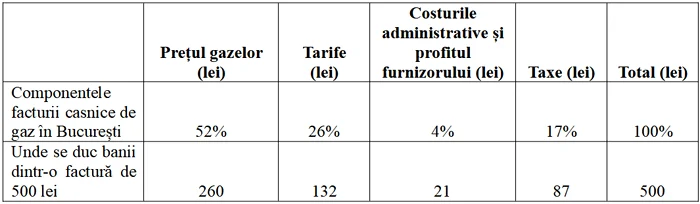
In other words, from a gas bill of 500 lei, the actual cost of natural gas is only 260 lei, the rest being other components.
In October 2025, on an electricity bill for a household consumer, 40% effectively represents the commodity energy component, a quarter on taxes and other obligations imposed by the state at sight, a quarter on tariffs and a tenth for the supplier.
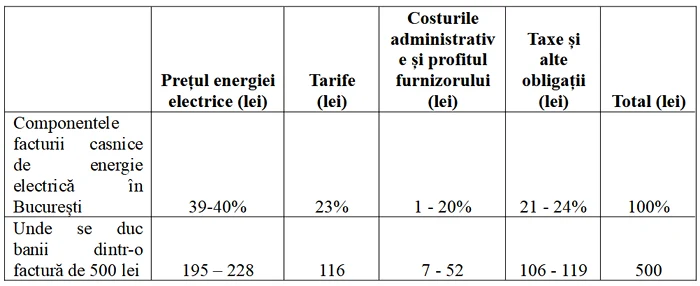
In other words, from an electricity bill of 500 lei, the actual cost of electricity is about 200 lei, the rest being other components.
The state wants energy prices to stay high
The energy expert Dumitru Chisăliță warns that, although the trend of the price of electricity on the Romanian market is to decrease for the coming years, it will not decrease, because the Romanians have been taught to wait for the “state” to come and solve their problems.
“But the state is interested in high prices, in order to benefit from more money for the budget”, Chisalita said.
According to him, the average weighted prices of electricity trading on OPCOM have a tendency to decrease for the next 2 years. “In the situation where we add the tariffs, the commercial margin at the level of the one regulated during the price cap and the specific taxes for a consumer in Bucharest, the prices that consumers should pay should also be decreasing. Thus, the average prices in an optimistic scenario could be 1.2 lei/KWh including VAT from 1 July 2026 and 1.15 lei/kWh including VAT from 1 July 2027“, he explained, adding that since household prices are the prices set by suppliers, in the absence of pressure created by consumers, they will charge prices higher than the fair electricity price.
The average price of electricity for the top 20 offers according to the ANRE Comparator has decreased in the last 5 months, by 6% with the intensification of competition.
Too few Romanians changed their supplier, looking for a lower price
According to the energy expert, consumers who wanted to leave their current supplier in recent months were also the consumers who benefited from lower electricity prices. Competition, where it occurred, led to lower electricity prices.
“It's just that the number of household consumers who put pressure was very small, but even so they benefited from lower prices.
Most of the consumers did not do anything, which makes the price paid by the largest number of domestic consumers in Romania to be at an average level of about 1.45 lei/kWh with VAT included. This price will be applied at least until July 2026. In the situation where a consumer who owns a 2-room apartment would choose the lowest offer on the ANRE price comparator, he would obtain a savings of about 500 lei between November 2025 and July 2026.” Chisalita explained.
In his opinion, it is worrying that at the last Energy Security Barometer, carried out by INSCOP in October 2025, 61.4% of Romanians said that they consider the possibility of changing their current electricity supplier, but only if they receive a better offer from another supplier, while 37.5% reject this possibility. This position expressed by the Romanians will ensure that electricity prices will not decrease in the next period.
“The only ones who can help us are ourselves: continuously changing suppliers when there is a better price in the market, continuously holding the current energy supplier to account, publicly asking for help from the political class, not for capping (because whenever we got a capped price, after that period we received prices that “hooked” us), but to eliminate the causes that determine the price increase”explained Dumitru Chisăliță.