This is not about a classic war. The Kremlin has other ways to mark its presence in Europe. A sociologist warns against a worst-case scenario [OPINIA]

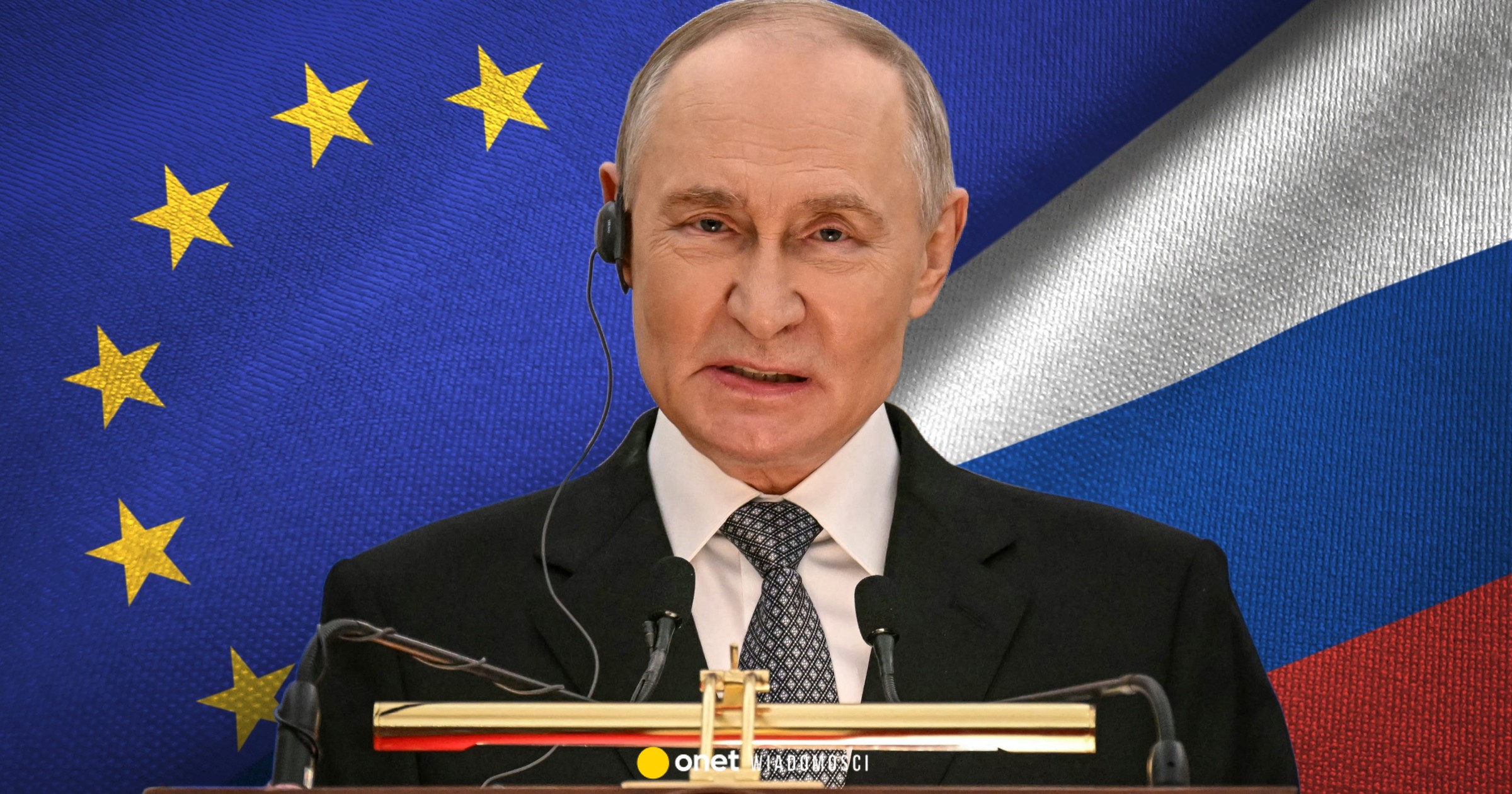
Putin's words that “Russia is always ready for war with Europe” were not accidental. They cannot be interpreted as a mere ploy before talks with the American delegation, or as part of his own self-indulgence.
The war that Putin is probably talking about it is not war in the sense that the average citizen has.
Yes, Russia today is unable to move seven tank fronts against the Baltic states or penetrate the land corridor to Königsberg.
It has, however a much more diverse arsenal of warfarewhich may be particularly painful for Europeans.
It started with provocations in the airspace, jamming the GPS signal on civilian ships and sabotaging underwater communication cables. Over time, however, Russia began to test kinetic methods of operation that also pose a real threat to the civilian population.
One of the most famous attempts was the operation involving self-igniting parcels sent via DHL. In the summer of 2024, it was revealed that Russian services had sent parcels through international companies, which caught fire in various places in Europe: at an airport in Germany, in a British DHL warehouse and in a Polish DPD branch.
The goal was not only to sow chaos within the EU – although that was important – but also to see if civilian casualties could be caused. At the same time, Russia was also preparing attacks targeting key people in the European arms industry. This was the case of the planned assassination of Armin Papperger, president of the German concern Rheinmetall AG.
There are many indications that the Russian services are already preparing further operations – or are just finalizing them and are just waiting for a signal to act.
We can only guess how wide their reach will be. However, it is worth paying attention to the process that we can observe – although fragmentarily – the fight to extradite Jarosław Mikhailov. He is a Russian citizen suspected of direct involvement in the operation involving self-igniting packages. He fled the EU but was detained in Azerbaijan.
We don't leave our own?
The enormous importance that Moscow attaches to the fate of Yaroslav Mikhailov shows that he is crucial for subsequent kinetic operations in Europe. There is probably no Russian service that would not be involved in his release today – both the GRU, the FSB, and the SWR operate there [służba wnieszniej razwiedki].
On the other hand, the same proves Mikhailov's value to the injured countries: Poland, Great Britain and other European countries. Their services are seeking extradition to Europe and are conducting talks with the Azerbaijani authorities on this matter.
It is extremely important for the Kremlin to show that “you don't abandon your own people”. Especially since Mikhailov is not a professional officer.
After the mass expulsions of Russian diplomats and agents, the Kremlin must look for new methods of operational work and is increasingly entrusting it to people from outside its structures – to those who are simply ready to do the job.
Russia promises professional officers that if they are detained abroad, even for murder, Moscow will exchange them, because they can always be exchanged for one of the Russian prisoners or hostages. The Krasików case proved this.
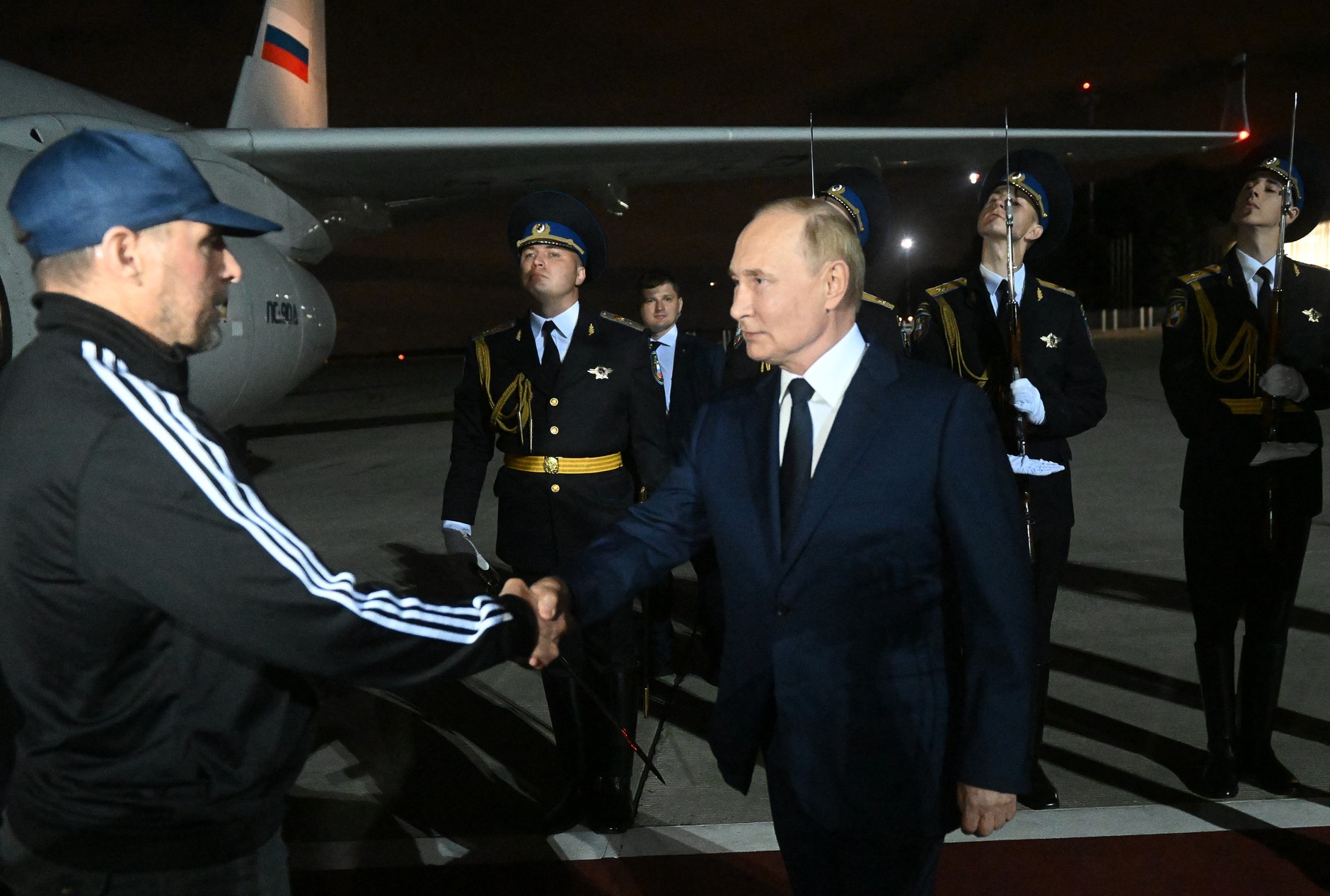
Russian President Vladimir Putin greets Vadim Krasikov, freed in a major prisoner exchange with the West, at Vnukovo airport, Moscow, Russia, August 1, 2024.Mikhail VOSKRESENSKIY / POOL / AFP / AFP
However, times have changed. Today the “Krasikovs” have been replaced by the “Mikhailovs”. And new times require new rules: it is necessary to convincingly demonstrate the same guarantees also for non-professional contractors, which Russia intends to use en masse in asymmetric activities in Europe. The outcome of the Mikhailov case will determine whether it will be easier for Russia to recruit similar people in the future.
Regardless of the outcome, one thing is certain: the Kremlin does not intend to give up offensive actions of a real, physical nature, possible mass civilian casualties, political assassinations or sabotage of critical infrastructure of EU countries and the UK.
Where does this rhetoric lead?
Russian propaganda has long set the stage for justifying such operations – from Dmitry Medvedev's extreme, even hysterical tweets to everyday narratives about “a war not with Ukraine, but with the entire collective West.” After Donald Trump's victory in the US presidential election and Moscow's hopes for a “grand bargain”, the focus has shifted to specific European countries, the UK and the EU as a whole.
Therefore, since the beginning of 2025, Russian propaganda has been particularly intensively trying to justify the need to sabotage these countries.
At the same time, Putin's rhetoric towards Europe is increasingly starting to resemble that of late 2021 — a few months before the invasion of Ukraine. Propagandists repeat his words like a mantra, amplify and transform them so that aggression seems obvious, even a universally known fact.
Putin uses a well-known trick again: dehumanizes and deprives subjectivity a new opponent – this time the European Union, just as he had done with Ukraine before. Just a few years ago this would have been unthinkable, even from an authoritarian leader.
He is again convinced that his opponent – now the EU – is weak and will give in at the very thought of an open military confrontation with Russia. All you need to do is give it “proof” on European territory. And such evidence will emerge with the escalation and routinization of kinetic operations – such as the mysterious drones flying over airports and military bases to which Europe has already become accustomed.
Europe still has time
Putin's sense of confidence is also fueled by the actions of several EU governments, which give the impression that they want to please the Kremlin. The European Union itself is not helping either, as it is sometimes unable to agree on even such key issues as financial aid for struggling Ukraine. This is reminiscent of Putin's belief from before 2022 that Ukraine is a weak state, incapable of mobilization and defense.
It is hardly surprising that European citizens are reluctant to check whether they would actually succumb to blackmail after a Russian attack on one or more countries. Unlike 2022, however, they have Ukraine – the country that binds most of Russia's forces – and time to understand what they may soon face.
Moreover, a united Europe still has some time to significantly reduce the risk of a major war on the continent. Everyone knows what steps need to be taken. All that remains is to do them, no matter how tempting the illusion is that “everything will somehow work itself out.” Exactly as people were deceived until almost the last moment – until 4 a.m. on February 24, 2022.