One of the most poorly inspired territorial exchanges in history. How New York was built on an island 13 kilometers long


In the year 1667, the most damaging known exchange of territories in history took place. After the Second Anglo-Dutch War, the people of the “Land of Tulips” thought they had struck the blow of the century by exchanging Manhattan for a small island in the Indonesian archipelago.
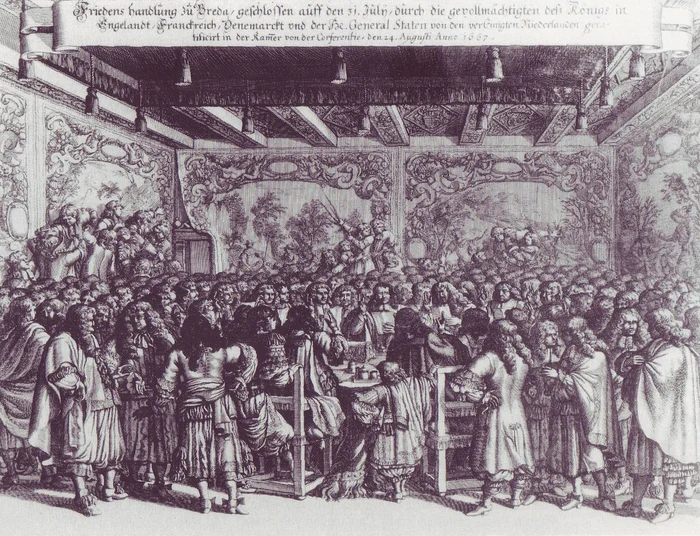
Congress from Breda PHOTO wikipedia
Throughout history during peace negotiations, after wars have ended, there have been tough negotiations and exchanges between the parties involved. Each tried to obtain as many advantages as possible with the help of diplomacy. This is what happened in Breda in 1667, after the second Anglo-Dutch war, where the most damaging exchange of territories in the known history of Europe was initialed. Not realizing the long-term impact, one side gave up an area that would become one of the world's most influential cities in exchange for a 13 square kilometer strip of land located off the Indonesian archipelago.
The gold of spices and the desire for power
In the 17th century the great European colonial empires were warring for supremacy throughout the Planetary Ocean. Ba in the Americas, ba in the Indies, ba on the shores of the Old Continent. Spain, England, France and Holland dreamed of grabbing as many resource-rich territories as possible, at the expense of the natives, and turning them into sources of production of huge sums of money. The most coveted were territories rich in spices or where spices could be grown, but also areas with great commercial and industrial potential (especially those on the American coast).
In the middle of the 17th century, two of the four great powers that plied the oceans with their merchant and warships came into open conflict. The Dutch and English faced off in four major naval wars born out of commercial rivalry. These wars only strengthened the status of the British as a great naval power. The Second Anglo-Dutch War is perhaps the most fascinating of the four conflicts fought between England and the Netherlands. This one broke out only a year after the end of the first and lasted until 1667.
It was literally a spice war. The Dutch wanted to control the entire trade in the precious spices of Southeast Asia, while the British wanted to drive the Dutch off the coasts of North America. Moreover, both great colonial powers had mutually captured territories from one to the other. England declared war in March 1665 and scored a decisive victory over the Dutch off Lowestoft in June. After the destruction of the Dutch flagship, only a providential action by Vice-Admiral Cornelis Tromp prevented the defeat at Lowestoft from turning into a total disaster for the Dutch. The English failed to capitalize on the initial success, however, and most subsequent battles fought the following year were won by the Dutch.
England's ally, the Principality of Münster, sent troops into Dutch territory in 1665, but was forced out of the war the following year by France, which sided with the Dutch in January 1666. A plague epidemic in 1665 and the Great Fire of London in 1666 weakened the English. It was against this background that the Dutch invasion of the Thames and the destruction of the British fleet at Chatham took place in June 1667. The war ended the following month with the Treaty of Breda.
Spice Paradise and “New Amsterdam”
During the negotiations in the congress that preceded the conclusion of the Treaty of Breda in 1667, both sides were hunting for a certain territory. For example, the Dutch wanted to keep Run Island, while the British dreamed of Manhattan, an island close to the eastern shore of the North American continent. The Dutch wanted Run Island to have a monopoly on nutmeg, a spice that was produced in abundance in the Indonesian archipelago. Nutmeg was valued as one of the most valuable commodities in the world. A pearl of the spice trade, worth almost as much as gold. Nutmeg was used for medicinal purposes, to treat diseases and cure stomach ailments.
The spice could be used as a meat preservative and many people considered nutmeg, similar to cloves and cardamom, to be a luxury essence for giving food a special taste. And the place where these nutmeg trees were found in abundance, and moreover where they grew best, was called the Spice Islands of the Great Banda. In the middle of the 17th century, nutmeg was cultivated almost exclusively in the islands of the Great Banda. The Dutch held most of the islands and established a nutmeg monopoly that made them rich. Less Run Island or Pulo Run in the Maluku Islands archipelago. This island was ruled by the British. And that's because the locals put themselves under the protection of the English out of fear of those from the Netherlands. Understandably so, nutmeg was both a blessing and a curse for the people of Banda.
The nutmeg tree, once discovered, totally changed the destiny of these areas in Indonesia. Dutch soldiers, supported by Japanese mercenaries, massacred, enslaved and exiled most of the islands' population. Many of them were replaced by settlers or slaves from other neighboring islands to cultivate and harvest nutmeg. In 1616, fearing the Dutch, the natives of Run Island swore allegiance to the employees of the English East India Company, who accepted it on behalf of the British Crown. In order to have a complete monopoly on nutmeg, the Dutch wanted to control Run Island as well. On the other side, the British set their sights on Manhattan Island, where in 1624 the Dutch founded a settlement specializing in the fur trade, called “New Amsterdam”. Besides, the English had conquered it in response to the occupation of the Run Islands by the Dutch.
One of the most damaging territorial exchanges in history
This is how it came to the situation where both powers had conquered what they wanted, but they were convinced that without a treaty to establish these aspects there would always have been attempts to reconquer. The Peace of Breda after the Second Anglo-Dutch War was the perfect opportunity for an official exchange of territories. The Dutch actually asked for Run Island and got it, along with Suriname (in the northeast corner of South America).
On the other hand, the British chose New Netherland on the east coast of North America, i.e. including “New Amsterdam”, New Jersey, Delaware and Pennsylvania. It seemed that the Dutch had drawn the winning lot and that they had made the deal of the century. They had practically come to hold a total monopoly on the nutmeg trade, as well as numerous other economic benefits in the Spice Islands area. In the long run, however, it turned out to be one of the most damaging territorial exchanges in history. “New Amsterdam” renamed “New York” by the British will become one of the most powerful commercial cities on the east coast of North America.
Instead the Dutch will end up losing their monopoly on the nutmeg trade anyway. The British had taken nutmeg seeds from Run Island and cultivated it successfully in the Caribbean, especially on Granada Island. From Granada the plantations were also extended to India or Sri Lanka, both British possessions. In other words, without realizing it at the time, the Dutch traded an area with huge economic potential like “New Amsterdam” (New York) on a 13 square kilometer island that they later abandoned after their nutmeg monopoly was broken.