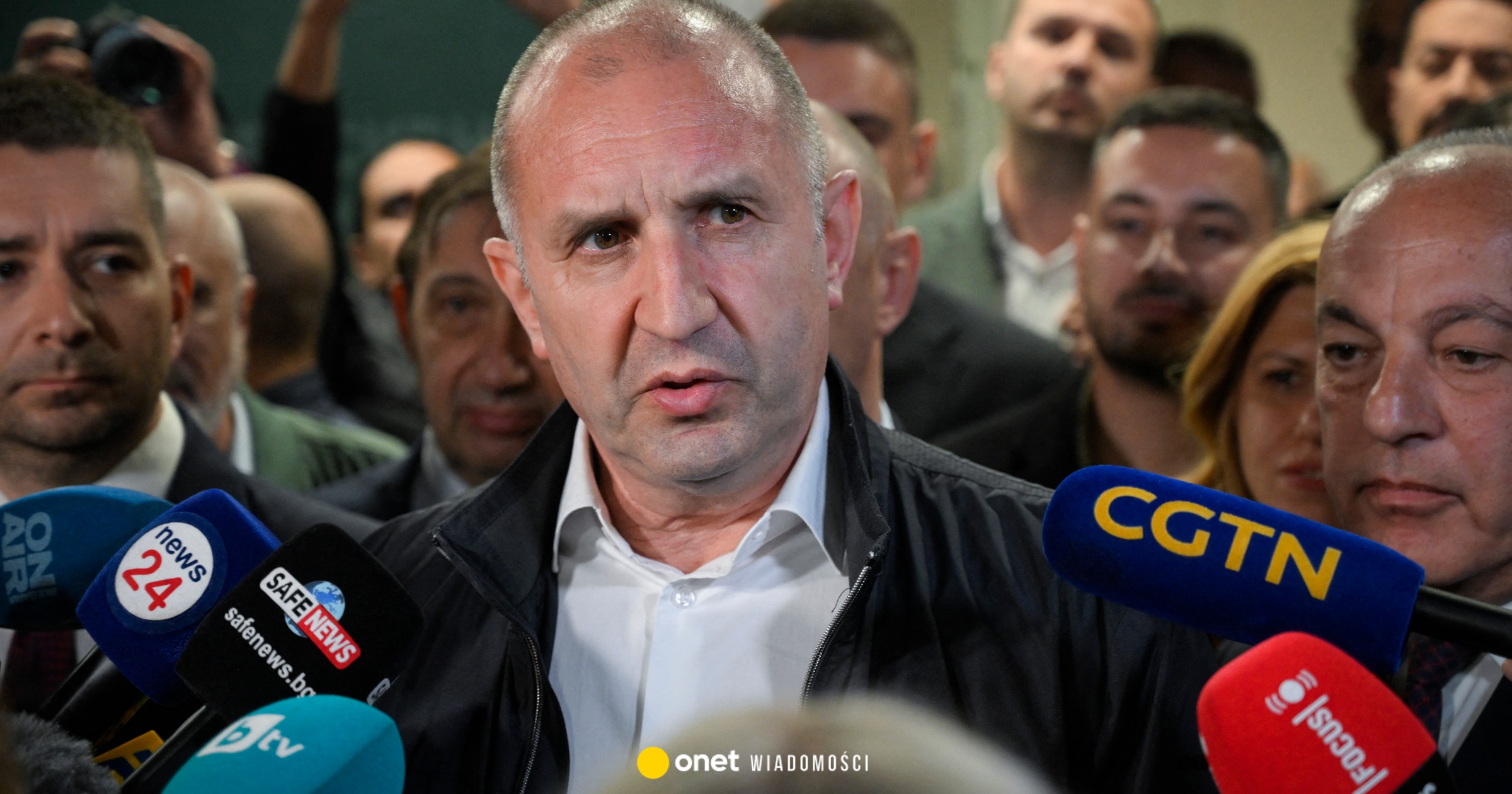
The future Prime Minister of Bulgaria, Rumen Radev, took a risk while still president and it paid off. Resigning from the mainly ceremonial function of president to then take up the position of prime minister with real political powers was a bold move that surprised his opponents. Because who simply resigns as a top government official?
It is possible that thanks to Radev, the era of political instability that led to eight parliamentary elections in the country in five years will end. This is good news for Bulgaria, but the EU perceives Radev primarily as a politician who questions the need to support Ukraine and believes that it is necessary to talk to Russia even after it has scandalously violated international law and is trying to forcefully change the borders in Europe.
This may pose a problem for the EU — but not as big as Russian President Vladimir Putin would like.
Fortunately, from the Kremlin's point of view, Radev shows up at five minutes past twelve. Bulgaria has recently managed to introduce the euro, which is a significant step deepening the country's integration with the EU. At the same time, it is traditionally the poorest EU country and is already in an economic situation similar to Hungary after 16 years of Viktor Orban's rule. Sofia cannot afford to lose EU development funds.
Therefore, there is a reasonable hypothesis that Radev will not risk bringing Bulgaria closer to Russia, eliminating democratic mechanisms and vetoing economic aid to Ukraine, because he would suffer the fate of the former Hungarian prime minister. Freezing development funds it would mean an economic disaster for Bulgaria.
Positive signals that Sofia will not break up the EU
And the first signs after his crushing victory indicate that the new Bulgarian prime minister is aware of this. As noted by renowned expert Veselin Vackov, journalist and director of the Strategeo think tank based in Prague, after the announcement of the results, Radev organized a special conference for foreign journalists and spent 10 minutes, using decent English, convincing a journalist from the Associated Press about his pro-European views.
The article continues below the video
And her colleague's report, subsequently published by the AP, contained precisely these arguments. Radev claims that he will be committed to continuing Bulgaria's pro-European path, but he does not want to give up his pragmatism. Even after Russia's aggression against Ukraine, he seriously believes that it is necessary to negotiate with the Kremlin and is unaware of the risk of energy dependence on a country that openly threatens EU capitals with a nuclear attack.
Another argument for EU reform
From the EU's point of view, however, it makes almost no difference whether Radew sincerely believes in his words or is just playing on emotions, like Robert Fico. If Fico, Babis, and now also Radev want to discuss the need for sanctions against Moscow at every EU summit – even if they do not ultimately block its decision – this will inevitably slow down the EU's decision-making process.
Radew's victory is therefore another argument for EU reform and moving away from the need to unanimously approve decisions to making them by a simple majority of votes.
If these three problematic prime ministers burden the EU with endless, unnecessary proposals for a more favorable position towards Putin, they will create the ground for a potential anti-European winner from an economically strong country to spearhead their actions and Ultimately, it will not hesitate to veto anti-Russian EU sanctions. AfD, Bardella and Le Pen are just waiting for it.
It would be good if, by then, the toughest possible stance towards the Kremlin had been irreversibly integrated into the EU's DNA and its decision-making mechanisms. Russia wants to destroy us, we cannot waste our time and energy trying to convince those who do not understand this. Let them either join the Union or let them leave.
I’m Ashley Davis as an editor, I’m committed to upholding the highest standards of integrity and accuracy in every piece we publish. My work is driven by curiosity, a passion for truth, and a belief that journalism plays a crucial role in shaping public discourse. I strive to tell stories that not only inform but also inspire action and conversation.