Washington harnessed the full force of American diplomacy to promote “patriotic” parties, limit migration, eliminate “censorship” and save “civilization” from collapse.
“If current trends continue, the continent will be unrecognizable in 20 years or less,” the document says. “It is therefore not obvious whether some European countries will have a strong enough economy and military to remain reliable allies.”
The recommendations that follow this statement essentially boil down to the need for a change of power in Europe.
“Our goal should be to help Europe correct its current direction,” the strategy document says. According to the Americans, this will require “cultivating resistance” in European countries.
In case there is any doubt about the political nature of this message, the White House document praises the “growing influence of patriotic European parties.”
In the context of declining birth rates and rising immigration, it is difficult to ignore the racial dimensions of the White House rhetoric. It will be known to voters in Hungary, Italy, the Netherlands and Germany, where far-right politicians advocate the so-called great replacement theory. It is a racist conspiracy theory that falsely claims that elites are part of a conspiracy to weaken the white population and reduce its influence. “We want Europe to remain European,” the document reads.
“In the long term, it is more than likely that within a few decades at the latest some NATO members will become predominantly non-European,” the document says. According to the Americans, it remains an “open question” whether such countries will still be able to maintain an alliance with the US.
Since Trump returned to the White House in January, European leaders have demonstrated a remarkable ability to remain calm in the face of his provocations, thus far avoiding open conflict that would completely disrupt transatlantic relations.
But for centrist leaders currently in power — such as Emmanuel Macron in Paris, Keir Starmer in London and Friedrich Merz in Germany — Trump's new doctrine poses a challenge so existential that they may be forced into direct confrontation.
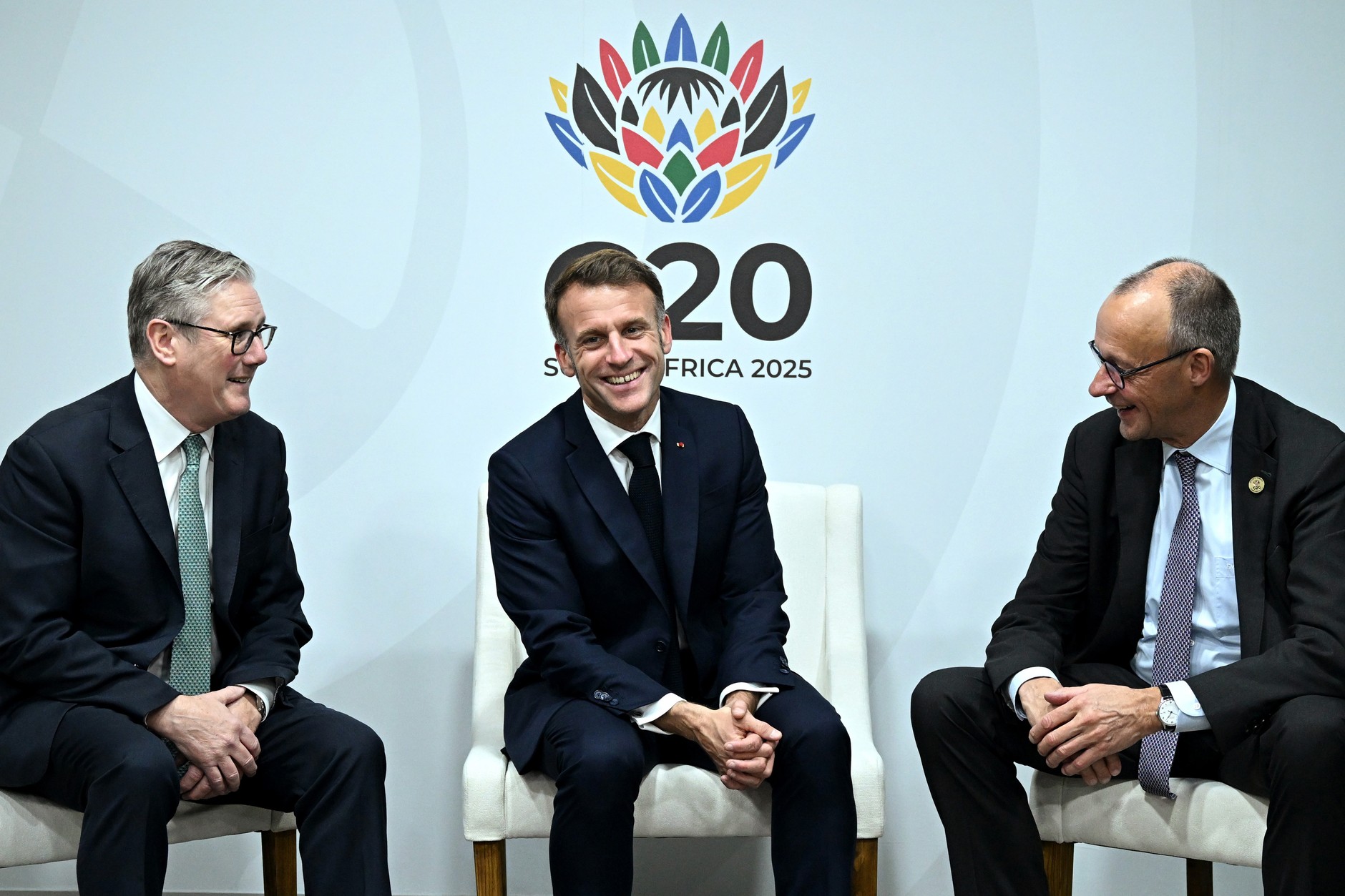
British Prime Minister Keir Starmer, French President Emmanuel Macron and German Chancellor Friedrich MerzLeon Neal / Staff / Getty Images
This confrontation could come sooner rather than later, given important elections in parts of the UK and Germany next year and the possibility of early national elections in France.
In each of these cases, pro-MAGA parties—Reform UK, Alternative for Germany, and National Rally—are poised to benefit at the expense of establishment centrists currently in power. It is now clear that the United States can intervene to help the forces it supports.
“A large number of voters want their own European MAGA movement”
The European Commission recently announced its plans for a “democracy shield” to protect elections against disinformation and foreign interference. Michael McGrath, the commissioner responsible for the policy, recently told POLITICO that the shield should have a broad scope because Russia “is not the only entity” that may have an “interest” in influencing elections. — There are many entities that would like to damage the structure of the EU and ultimately undermine trust in its institutions, he said.
In the light of the new national security strategy, the US under Trump must certainly be considered by Europeans as a potential challenge.
Even before the strategy was published, Trump administration representatives had already provided ample evidence of their contempt for the European political center. This year, Vice President JD Vance sharply criticized Europe on free speech and democracy. Elon Musk intervened in the German elections, supporting the far-right Alternative für Deutschland; and Defense Secretary Pete Hegseth privately lambasted the “pathetic” Europeans for “parasitism” on security.
The difference this time is that Trump's national security strategy is official. “It was one thing that they thought so and said it to each other,” one EU diplomat, who spoke on condition of anonymity, told POLITICO. “It's a completely different thing to put it in a policy document.”
Worse still for leaders like Macron, Merz and Starmer, Trump's analysis – that large swathes of voters want their own European MAGA movement – may ultimately prove correct.
All of these leaders are under enormous pressure from the populist right in their own countries. In the UK, Nigel Farage's Reform UK party is on track to achieve significant successes in next year's regional and local elections, which could spark a leadership fight in the ruling Labor Party and force Starmer to leave.
In Paris, Marine Le Pen's National Rally is tormenting Macron's struggling administrators in parliament, while the Alternative for Germany is hot on Merz's heels and forcing him to take increasingly tougher stances on migration.
In an interview with The Economist magazine this week, the British prime minister revealed that at a recent private dinner in Berlin he spoke with Merz and Macron about the common threat facing everyone on the right of the political spectrum. “We are facing the same challenges or variations of them and we are talking about it,” Starmer said.
If America implements Trump's new strategy, private dinner conversations among friends may not be enough.