Putin in India. This is how Moscow and Delhi can checkmate the West


A group of women performing traditional Indian dance was a symbolic accent to the start of Putin's first visit to India in four years (and first since the outbreak of war against Ukraine in 2022).
Despite an active arrest warrant issued by the International Criminal Court (ICC), Putin is allowed to travel to India, which, like several other major countries, are not signatories of the Rome Statute. After exchanging warm hugs, the Russian president and Modi took a car ride together and had a private dinner.
Putin's two-day visit on the occasion of the 23rd India-Russia Summit is widely seen as a strategic display of resilience in the face of Moscow's prolonged international isolation due to the war in Ukraine. For Delhi, the visit underscores its willingness to withstand growing geopolitical pressure from the United States while securing key economic benefits that help offset Washington's influence.
The most important issue
However, India's decision to welcome Putin also sheds light on fragile balance. The country is still struggling to finalize its long-awaited free trade agreement with the United States.
The extremely large group of Russian business leaders accompanying Putin indicates that Friday's talks will mainly concern trade and economic cooperation. Here's what to expect from the upcoming negotiations.
The summit places great emphasis on increasing bilateral trade and resolving long-standing trade imbalances between countries. In the years 2023-2025, India exported goods worth approximately USD 5 billion to Russia. (PLN 18 billion), while imports from Russia amounted to approximately USD 64 billion in the same period. (PLN 232 billion), which gave India a trade deficit of approximately USD 59 billion. (PLN 214 billion). This difference is not surprising given Moscow's established dominance in the Indian energy market.
Despite increased economic pressure from the Trump administration, Moscow remains India's largest supplier of crude oil. New Delhi took advantage of Russia's need to sell oil — a key source of revenue for the Kremlin's war effort — at depressed prices.
India imports large volumes of Russian oil at discounted prices, refines it and exports the processed fuel to markets in Europe and the United States, where it is no longer recognized as a product of Russian origin, and thus avoids Western sanctions.
At this week's India-Russia summit, Delhi is expected to push for greater access for Indian goods – including pharmaceuticals, textiles and fertilizers – to the Russian market. Increasing exports of these products would not only help India reduce its trade deficit with Moscow, but would also cushion the economic impact of the Trump administration's recently imposed 50 percent tariffs.
Defense and military cooperation
As Russia has long been a key defense partner for India and India increasingly emphasizes its “strategic autonomy”, particularly vis-à-vis the United States, defense and military cooperation is expected to be a major topic of the summit.
Conversations will likely involve long-term problemssuch as timely delivery of pending Russian-origin military equipment, spare parts and technical support. Discussions are expected to focus on the acquisition of additional air defense systems, including the S-400. India will also seek proposals for partial technology transfer and local production.
Russia is reportedly ready to offer India the Su-57 fighter, potentially as part of a production and technology transfer deal rather than an outright purchase.
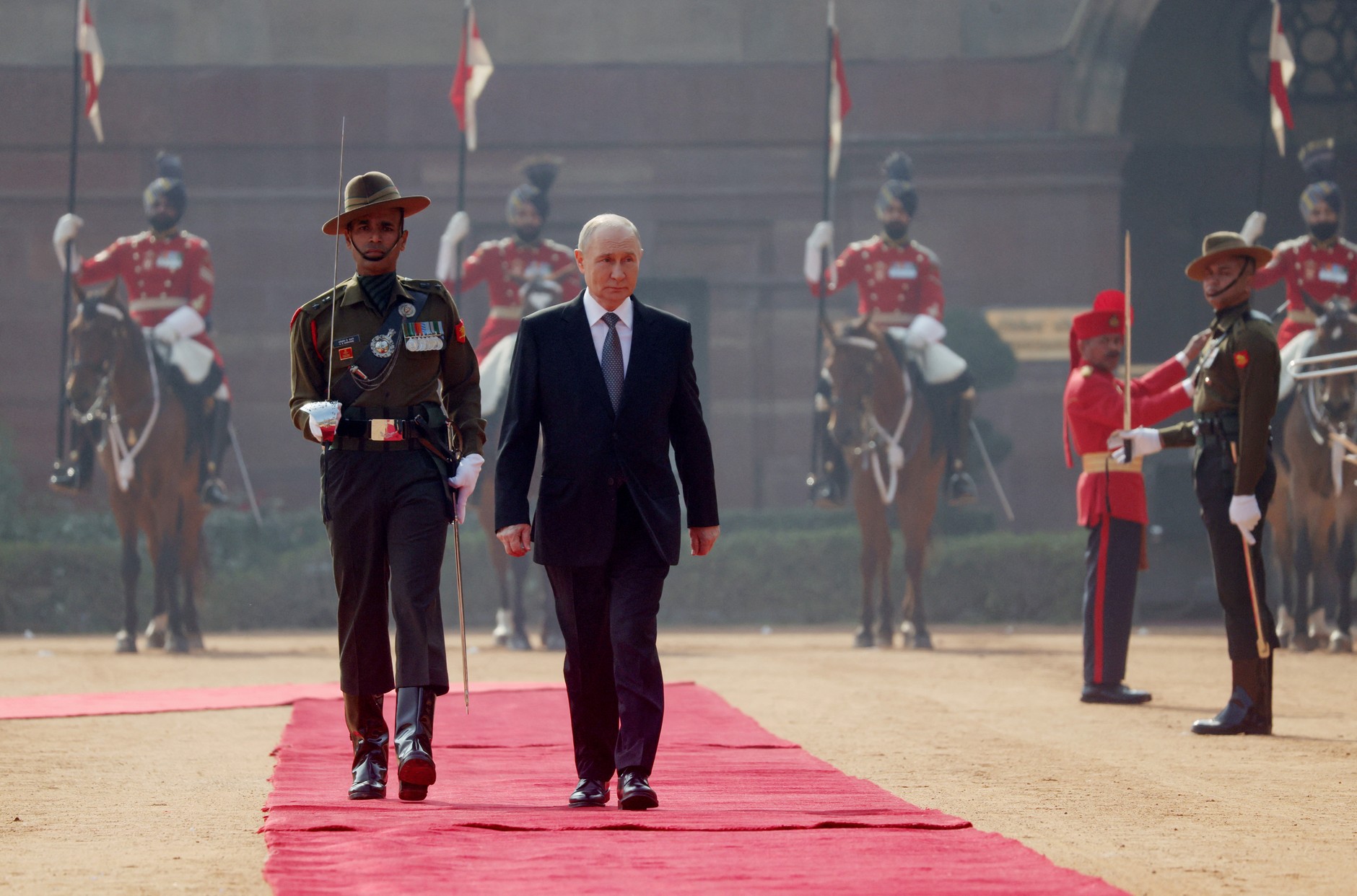
Vladimir Putin upon arrival in India, December 5, 2025.Konstantin Zavrazhin / AFP
A broader issue may also be raised during the summit joint production and integration of the defense industrywhich would support India's “Make in India” initiative while ensuring supply chain reliability for platforms of Russian origin.
As reported by Bloomberg, India has already allocated approximately USD 2 billion. (PLN 7 billion) for the leasing of a nuclear submarine from Russia – this is a continuation of the agreement from 2019, which was delayed due to ongoing price negotiations. The final agreement calls for the ship to be delivered by 2028. Another key aspect of the discussed military and defense cooperation is potential access to Russian rare earth elements, a sector currently dominated by China.
A bilateral mobility agreement is expected to be signed during the upcoming summit, which will facilitate the movement of Indian skilled and semi-skilled workers to Russia.
Russia's broader strategy
According to reports, the Kremlin plans to hire even more by the end of this year 1 million Indian specialiststo address acute labor shortages in the industrial and heavy sectors. Demand is particularly high in centers such as the Urals belt, where large production plants and arms industry facilities are located.
This large-scale recruitment drive is part of Russia's broader strategy to fill critical staffing gaps and represents a significant opportunity for Indian professionals, especially those facing visa barriers in Western countries. Apart from employment, the initiative demonstrates deepening economic and people-to-people ties between India and Russia.
However, questions remain about how these programs will be implemented and whether the labor employed can be used for support for Russia's military operationswhich is an additional geopolitical factor in this agreement.
Friday's talks are expected to focus mainly on trade, energy, defense and labor mobility, with each side seeking to achieve practical gains. India wants to reduce its trade deficit and gain access to newer defense technologies, while Russia seeks to secure stable revenues due to the ongoing war in Ukraine.
The visit also carries a broader message: despite international pressure over Moscow's war in Ukraine, relations between India and Russia remain intact. Delhi seems eager to show this and continues to balance between East and West, asserting its strategic autonomy while dealing with pressure from the United States and other Western partners.