Neanderthals, hunters of women and children? The shocking discoveries that reveal a cruel reality of prehistoric Europe


New research based on excavations and archaeological finds in a cave in Belgium reveals a disturbing secret of prehistoric communities. It has been concluded that Neanderthal Man, whose genes many present-day humans carry, hunted women and children to eat.
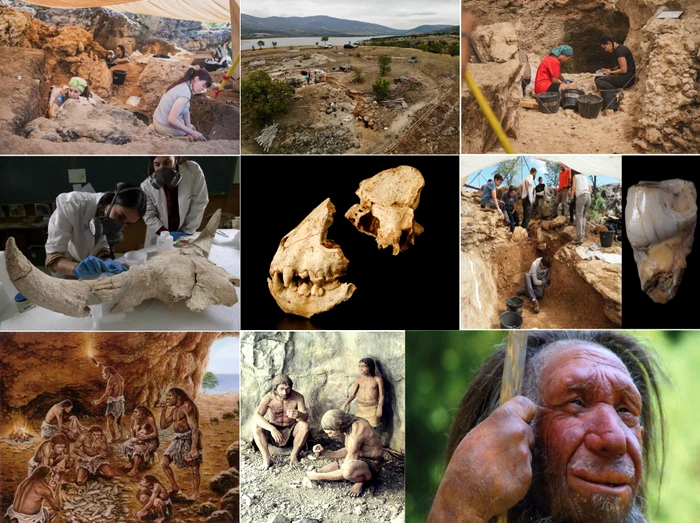
Neanderthal man PHOTO Collage El Español Community of Madrid and others
Cannibalism is an ancient practice of the human species. It is documented both in Neanderthal communities but also in those of Homo Antecessor and Homo Sapiens. In other words, our ancestors, the ones whose genes we still carry today, ate each other. In some cases it was funerary cannibalism, the dead individuals being consumed within the community, in others ritual cannibalism, in which the sacrificed victims were actually eaten by the members of the community.
Evidently, evidence of cannibalism born of need has also been found, especially in times of scarcity, climate change, and dwindling food resources. A new study, however, indicates an even more shocking reality that changes the perception of the way of life of prehistoric European human species communities on the territory of Europe. Neanderthals hunted other humans for food. They are unique discoveries that indicate that man had become a prey for other people, a source of food that was easy to procure and easy to kill. The preferred prey of these Neanderthal communities were children and women of a more fragile constitution.
Cannibal villages in western Europe
The study was carried out by an international team of researchers and published in the journal Nature. It's all based on a series of disturbing archaeological discoveries made in the Troisieme cave in Goyet, Belgium. In those caves for almost 60,000 years (120,000-40,000 BC) lived different communities of Neanderthal man, an ancestor whose genes we still carry today. Previous studies in the Goyet Caves revealed that those communities practiced cannibalism on a large scale. More specifically, about a third of the 101 human bone remains found in the caverns show clear signs of cutting, skinning, and disarticulation, fresh bone fractures, and percussion notches that indicate marrow extraction.
The processing of these human remains resembles the butchering techniques also used on Neanderthal hunted animals such as horses or reindeer found at the site. All this suggests, as scientists say, nutritional cannibalism. In short, people were killed and eaten so that the whole community could survive. Not for ritual purposes, but to satisfy hunger. The bones discovered at Goyet represent the largest assemblage of cannibalized Neanderthal remains in northern Europe. Members of that community ate humans, just as they did hunted wild animals.
Women and children hunted like wild animals
If the fact that the Goyet caves were inhabited by real communities of cannibals, who constantly fed on human flesh, is something I have known for at least two decades, the study “Highly selective cannibalism in the Late Pleistocene of Northern Europe reveals Neandertals were targeted prey”, brings disturbing new details about how this was done. In short, the scientific team concluded that Goyet Neanderthals hunted other Neanderthals, as they did wild animals. They identified other communities, stalked prey, attacked and killed it. The corpses were brought to the caves of Goyet, butchered and then eaten.
The soft parts, i.e. muscle, fat and organs, were preferred. The researchers came to this conclusion after studying the skeletal remains of at least six individuals discovered in the Troisième cave in Goyet. All the individuals were children and very frail women. In other words, they hunted women and children, the most vulnerable categories. Easy to catch and kill. Four of the individuals were identified as adult or adolescent women of particularly small stature and slender build, while the other two were very young, a child and a newborn. Researchers at IFL Science performed genetic analysis and confirmed this shocking pattern of manhunting.
“We have identified a minimum of six individuals, including four adult or adolescent females. Compared to Homo sapiens and Neanderthals – including regional specimens – Goyet females exhibit short stature and reduced diaphyseal robustness of long bones. They lack skeletal markers associated with high mobility, despite isotopic evidence for non-local origins. The overrepresentation of short, morphologically slender, non-local females, along with two individuals immatures, suggests a strong selection tendency in the individuals present at the site”, state the researchers in “Highly selective cannibalism in the Late Pleistocene of Northern Europe reveals Neandertals were targeted prey”.
Intertribal wars for booty
These discoveries completely change the view on the behaviors of the Neanderthal man. The findings suggest that there were indeed conflicts between their communities, real prehistoric “wars” with survival at stake. That is, the procurement of food.
“Dated to between 41,000 and 45,000 years ago, a period marked by Neanderthal cultural diversity, biological decline, and the arrival of Homo sapiens in Northern Europe, cannibalized Neanderthal females and juveniles from Goyet indicate exocannibalism, possibly related to intergroup conflict, territoriality, and/or specific treatment of outsiders.”show the specialists in the mentioned study.
It is suspected that all these cannibalistic raids and extreme hunting of people on the territory of Belgium, several tens of thousands of years ago, were the effect of climatic and demographic changes that the Neanderthals could barely cope with. This highly robust and Ice Age-adapted humanoid species, specialized in hunting mega-fauna, especially mammoths, faced new challenges. Climate warming, the change in the migration routes of large animals, the disappearance of some species have made life harder and food less and less.
Added to all this is the competition from a new, much more versatile and adaptable species. It was about Homo Sapiens. Less robust but with an apparently more evolved language and a clearly superior ability to adapt, the direct ancestor of modern man was able to quickly dominate the hunting grounds and achieve supremacy. They managed to adapt to the new hunting times, the changing climate and at the same time increase their numbers. All this time the Neanderthals were living hard times. It is assumed that they came to hunt people and due to the dwindling of the prey, the pressure of the newcomers.
Did Neanderthals also attack Homo Sapiens communities, did they also take “prey” from the villages or caves of the newcomers? Without archaeological findings to confirm or deny this, only unanswered questions remain.