Slovak Prime Minister Robert Fico recently stated that he “looks forward” to a conflict with the European Union over the amendment to the constitution. — We are looking forward to this conflict. I can't imagine any international organization dictating how many genders there should be, he said.
However, the commission does not accuse Slovakia of having written down two genders in its constitution, as Fico wrongly claimed, but of something completely different. In an interview with Aktuality, Geist explains what accusations the European Commission brings against Slovakia, what sanctions it may face and whether Poland's southern neighbor is actually at risk of leaving the EU.
“The Slovak government left the Commission no choice”
These are proceedings against a Member State which, according to the Commission, has breached its obligations as a Member State. In other words, it somehow violated European regulations, European law.
Whenever it detects such a violation, the Commission must take action because it is part of its tasks enshrined in the founding Treaties and must protect European law. It is now proceeding in the same way as in the case of Poland some time ago.
Let's move on to the reason, which is the recent amendment to the Slovak constitution. What exactly is the Commission accusing Slovakia of?
Slovakia is accused of wanting to give priority to national law over European law, even though the European treaties clearly state that European law has priority. The Commission therefore had no choice but to initiate proceedings against Slovakia.
How unprecedented is this case?
The fact that it concerns the constitution is relatively unprecedented, although in Poland, for example, it was about the Constitutional Tribunal. In the past, the Commission also checked whether the Constitutional Court's judgments had similar legal force in Germany, where the Supreme Court, which is the de facto Constitutional Court, was also involved in the case.
In a completely different matter, he wanted to deprive the European Central Bank of the ability to take specific actions to save the euro. The German Supreme Court issued a ruling and the European Commission threatened to open infringement proceedings because it threatened the supremacy of European law, which is one of the principles of the European Union.
Thus, the Slovak infringement proceedings are relatively unprecedented because they directly concern the text of our constitution.
What will happen now and what threatens Slovakia?
The Commission will investigate the matter, ask Slovakia for clarification or a statement, which will send it a reply. Based on this response, the Commission will assess what conclusion it will reach. This conclusion may be that Slovakia is violating European regulations, i.e. treaties. In such a case, the European Commission will propose a financial sanction. In most such cases, it is a financial penalty for each day that the country violates European rules.
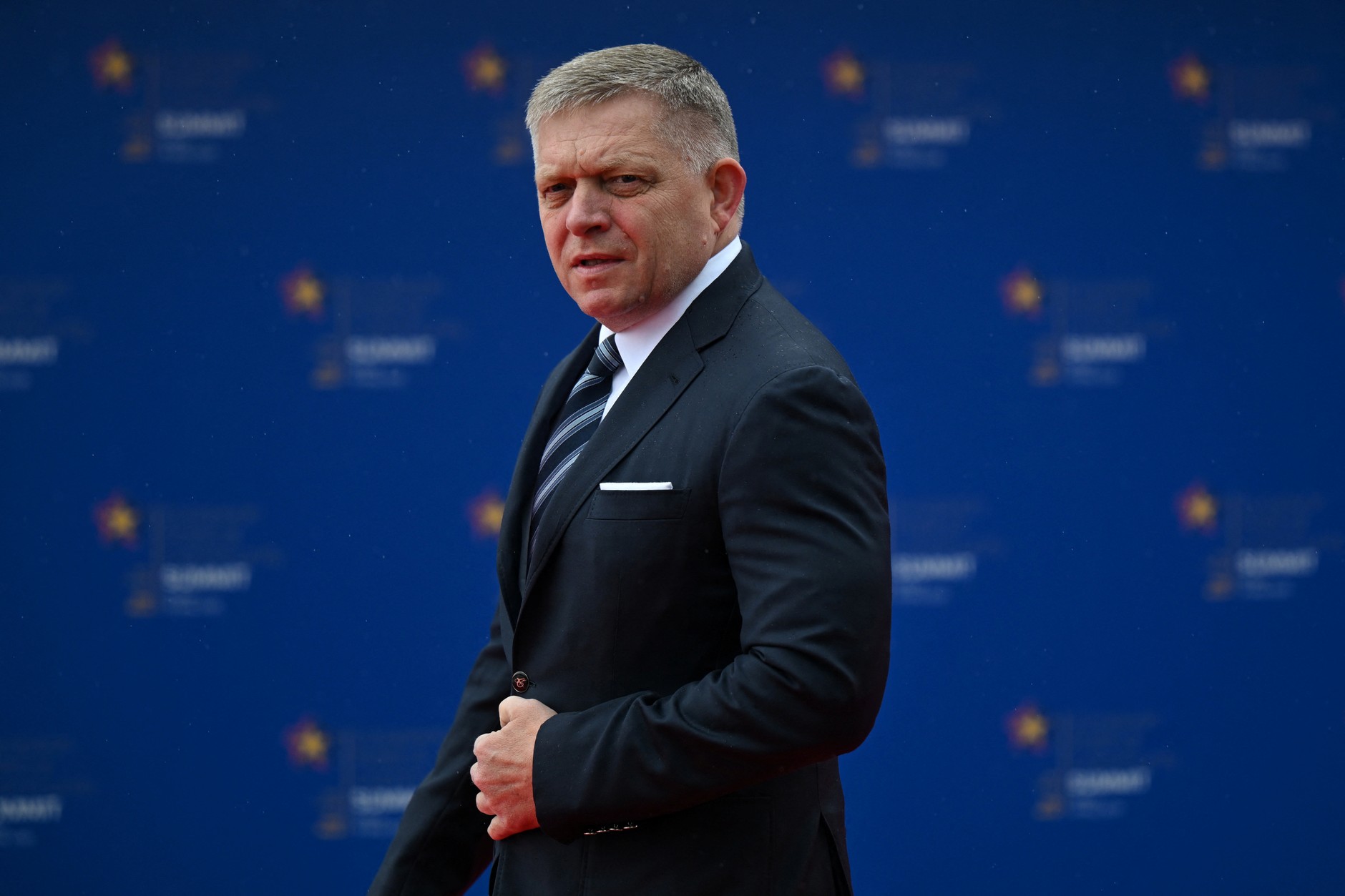
Slovak Prime Minister Robert Fico arrives at the European Political Community summit in Tirana, May 16, 2025.ARMEND NIMANI / AFP
What sanctions are we talking about? In the case of Poland and its justice reform, these amounts amounted to around one million euros per day.
Yes, it can be up to a million euros a day. The penalty should be proportionate. The threat to the basic principle of the functioning of the European Union is a problem because it is not about 13, 14 or 72 genders, it is about the fact that if the EU is to be a single market, uniform rules must apply throughout the EU. And these uniform rules must be guaranteed by the European Commission in case countries start to break them or contradict European law. This is therefore a serious problem and therefore the sanctions may be proportionately serious.
“We are closer to leaving the EU than five years ago”
If I understand correctly, the proceedings towards Slovakia do not concern the entire constitution, but primarily the part that mentions that Slovakia will retain sovereignty in cultural and ethical issues. Although it's a bit more complicated because the constitutional amendment also uses the word “first of all” in this case. According to some lawyers, this actually means that European law as a whole should no longer take precedence over Slovak law, and this does not only apply to cultural and ethical issues.
Yes, many constitutional law experts have said the phrase suggests it's not just about cultural issues. From my point of view, however, it does not matter. This principle is of a general nature. Of course, the European Union does not have competences in all areas, we still have veto power in areas such as the European budget and defense. That's okay.
What defense options does Slovakia have in this case?
Slovakia may challenge the Commission's decision to the Court of Justice. If the tribunal finds the Commission right, the case will be closed and until we propose a remedy, we will have to pay fines.
There are voices from the opposition that this constitutional change may be Slovakia's first step towards leaving the EU, or rather moving away from the EU. What is your opinion on this?
I believe that we have moved significantly away from European integration over the last two years, and this amendment is just further confirmation of this trend. We're not talking about cultural issues here. The point is, however, that as a country, by changing the constitution, we probably consciously violated one of the basic principles of European integration, which concerns questioning the validity of European law.
In this way, we also undermine the existence of the European Union as a single legal area. Thanks to uniform rules, the single market can also function, which is a serious problem. We do not know today whether this will lead to Slovakia leaving the EU or not. However, we are definitely closer to leaving the EU than we were three or five years ago.