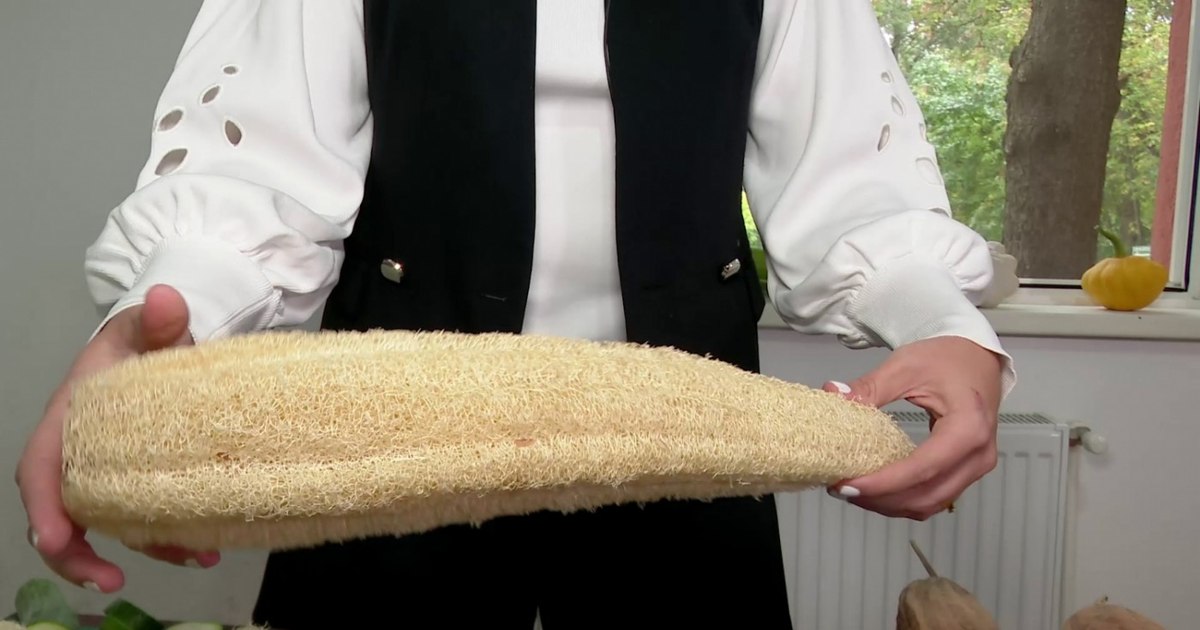
The Plant Genetic Resources Bank (BRGV) in Buzău will approve a variety of loofah, also known as vegetable sponge, whose fruits can reach up to one meter. This plant can be used both for personal care and for the production of ecological solutions for insulation and soundproofing of homes.
The loofah, the vegetable sponge that can replace polystyrene and industrial soap PHOTO: Archive
Originally from Asia, loofah is also cultivated sporadically in a few areas in Romania, especially in the Western Plain, the Oltenia Plain and the Buzăului Plain. The fruits used as bath sponges are soft, porous, biodegradable and non-toxic.
“I managed to obtain the first variety of luffa cylindrica in Romania, genetically stabilized. All previous attempts had failed, as fruit with black and white seeds were obtained, and many did not reach maturity. This year we will again send a variety to be approved, the difference being that the fabric of the vegetable sponge is a little thicker“, Costel Vînătoru, director of the BRGV, told Agerpres on Wednesday.
He explained that fruits can be grown successfully in sheltered areas, following the appropriate technologies. The plant needs light and high temperatures, does not tolerate frosts and prefers loose, moist and permeable soils.
A plant with multiple uses
“We can talk about a plant that can be grown both in greenhouses and solariums, and in the field, with the specification that it must be palisade, that is, supported on a rack or string. In addition to luffa cylindrica, we also have luffa acutangula, which it can also be appreciated as a vegetable. The small fruit can be eaten in dishes, and when mature it becomes a bath sponge”the BRGV director also said.
“It is special because in its fiber we find saponins that release slowly and act as a natural shampoo or soap. It cleans the skin very well, leaving it velvety, and it has very strong antiviral properties”stated Costel Vînătoru.
Besides being used as a decorative plant or vegetable, loofah can be used to make hats, shoe soles, tablecloths, rugs or soap. The fibers of the mature fruits are also used to insulate homes, especially in ecological constructions.
“These fibers absorb and retain heat well and can replace polystyrene, providing greater resistance to homes. They can be used for soundproofing rooms or doors. We could develop an entire industry in Romania if we expand the use of this product. We have varieties of various sizes, between 30 and 50 centimeters, and the luffa acutangula can exceed a meter and is valuable for construction”Costel Vînătoru concluded.
The approved variety is also recommended for cultivation in an ecological system.