Lubenita from Greece endangers the profit of Romanian farmers. “The first Dăbuleni watermelons will be after June 20”

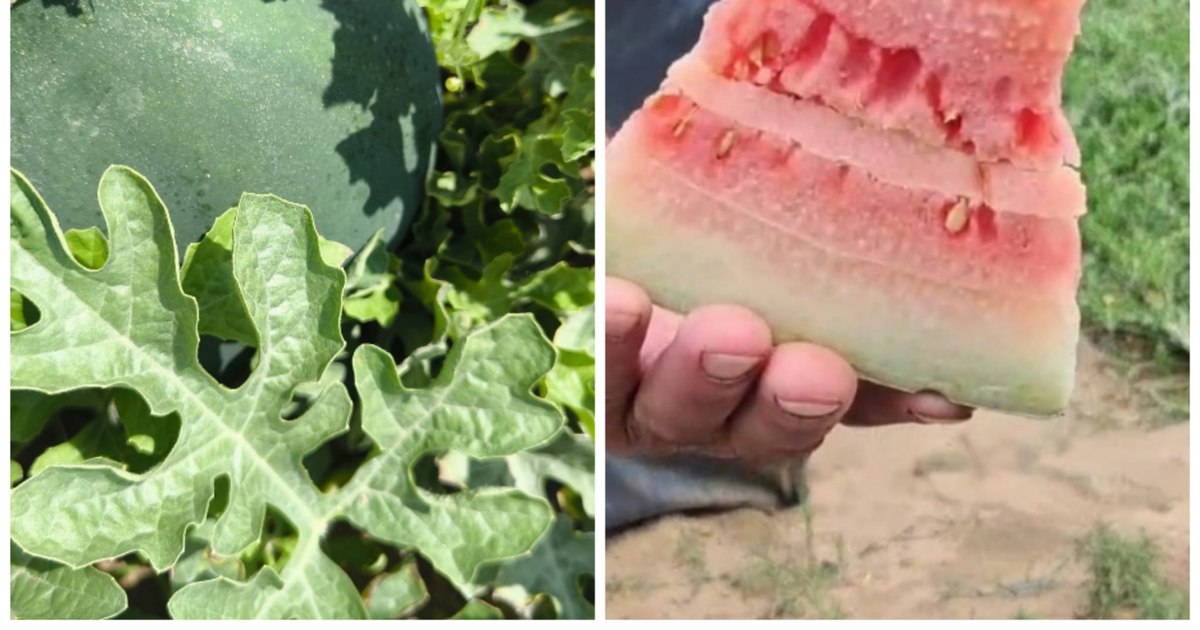
A delay of at least two to three weeks is recorded by farmers in the south of the country who produce the most sought-after watermelons on the market. Meanwhile, supermarkets and markets were filled with melons from Greece.
Lubenita from the Călărași-Dăbuleni area, Dolj county, has not yet ripened PHOTO: Ionelia Nucă
Dăbuleni melons, in which the farmers of “Sahara Oltenia” place their hopes of making a profit year after year, will be on the market only from the second half of June or even the beginning of July. The cold spring greatly delayed production, and the farmers, although they did their best, had no way to compensate for the cold nights.
“He needs another two weeks, maybe three. Towards the end of the month it ripens. Okay, it might be a little closer to others. They put them in March, I put them in April”, says a farmer from Călărași, Dolj County, the locality with the largest area cultivated with melons, while cutting a melon to show that it is not yet ripe. Last year, at the beginning of June, the first producers were already with melons on the market.
“Everyone put protective cloth on them, managed as best they could. He also gave us the winds and rubbed all the ties against the sand and they fell off. They tied some more and now we are waiting for them to grow. The temperatures were low. We had big expenses, tens of millions (n. ed. – old lei). And when you take them to the market, they think it's expensive. You go to the market – there is a price, you estimate another price from home. Last year I caught 2 lei, 2 half lei, in Pucheni, where I could. We hope it will be fine, but this delay affects us a lot”, added the farmer.
Farmers expect a good production, but the price could be the problem PHOTO: Ionelia Nucă
A delay of almost a month also means that they will sell at much lower prices than they hoped, because already the markets and supermarkets are selling melons brought from Greece. The price has already dropped to 5 – 5.5 lei/kg and even below 5 lei, and the producers are afraid to make any more calculations, because if they go down they will go down, but if they go up it's almost impossible.
On the other hand, for them the expenses were considerably higher, from the cost of diesel to phytosanitary treatments, everything being more expensive in the agricultural year 2026. Only the rains helped them and they didn't need to water so often.
“Climatically, the spring was special, the temperatures were somewhat lower, especially at night, and the precipitation regime was richer,” explained Dr. Eng. Ștefan Nanu, director of the Research-Development Station for Plant Culture on Dăbuleni Sands. There is more pressure from disease and pests, and growers will have to be more careful, invest more in ensuring the health of the plant, added Nanu.
“Vthere is some delay in the ripening of melons. The first Dăbuleni melons that will appear on the markets will be after June 20, with the big mass coming somewhere around July 1, with differences from grower to grower, depending on the technology applied”the head of the research station also specified.
“You'd better go to Spain, stay for three or four months and come back with more money”
“From July 1, we hope to be on the market as well. This year it was very cold and they got hard. We spend, we put money into them, water treatments, we also try to do them, but the weather… It was cold, there were winds. Now, when they also tied them, they were the size of a finger, the winds came, it turned them upside down, all the ties fell, very few remained that are bigger, at 4-5 kilograms. And they tied again, now we wait for it to grow. It was a very, very difficult spring. I protected them, I had thermal foil, I had felt on them, but when I took them outside the winds came. We caught wind just as we pulled them out of the tunnel. They need water and heat to develop, to grow, to be sweet and red”, explained a lady farmer from the same area.
The summer product, bought from the ice, brings profit later than the producers expected. “I found a solution for shading”
They did not expect such a difficult spring. The rains, the woman says, were clean: “Usually they made mana after it rained. Now there is no mana in them, they are beautiful, but our ties fell then, due to the winds. He turned them upside down for us, he made them for us… It took three days for us to finish. We were conducting them, the next day the wind blew and it blew them into place. Compared to last year, I think the production is grand, but later, last year I went to the market with them on June 1”.
Imported melons are sold in markets and supermarkets PHOTO: Alina Mitran
The biggest fear of farmers is that the receipts may not be enough to cover their expenses. “The good prices are gone. These samsars take from the Greeks, bring goods, and when we go out the prices are low and our profit is… In fact, we hope it will be. And that's because we only think about the expenses we put in, we never count our work, our work is always unpaid.” said the woman.
Among the growers there are also people who give up, since the costs keep increasing and the profit either stays the same or decreases. “It's better to go to Spain, I stay there for three or four months, I come with more money. In Spain you don't spend any more. The day goes by, you've got the money. But here, until you collect yours you put them in, and only then do you look to see if there's anything over…”says a farmer from Dolje.
Dăbuleni watermelons, the treasure of the sands of Oltenia that others capitalize on. The researchers want the watermelon here to become a national brand
In Dolj county, according to data centralized at the level of the Dolj County Directorate of Agriculture, the area cultivated with melons approaches, as last year, 2,500 hectares.
The largest area is found in the town of Călărași – 900 hectares, followed by Dăbuleni – 700 hectares. Large areas can also be found in Daneti – 300 hectares, Sadova – 300 hectares, Cîrna – 300 hectares, Moțăței – 110 hectares, etc.. To the almost 2,500 hectares cultivated in 2025 with watermelons, another almost 500 cultivated with melons have been added. In the south of Oltenia, the earliest melons are obtained, a week or two later, harvesting also begins in other plain areas.
Lubenita de Dăbuleni still needs at least 14 sunny days to ripen PHOTO: Ionelia Nucă
The farmers' problem still remains the exploitation of the production at a satisfactory price, because they are not yet working on firm orders, but year after year they wait to see “how's the market going”without knowing whether there will be profit or loss.