The mystery of Europeans that no one was allowed to touch. The most enigmatic population on the continent, discriminated against for over a millennium for an unknown fault


The most mysterious population on the territory of Europe still lives today somewhere in the south of France, on the border with Spain, in the area of the Pyrenees Mountains. They are called many things but have remained known in history as cagots. They have been marginalized for an entire millennium without knowing why.
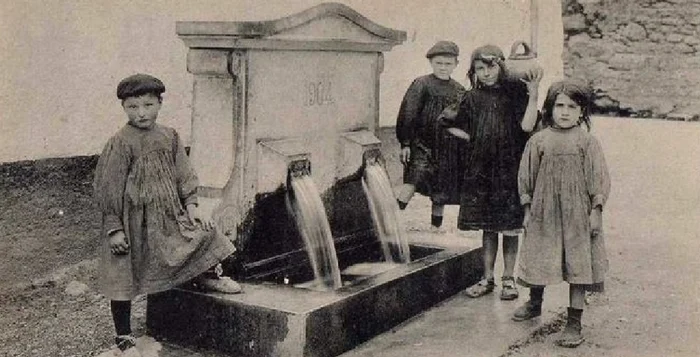
Les Cagots in the south of France PHOTO loucrup65.fr
The peoples of Europe are perhaps the best known in terms of origins and process of ethnogenesis among all the populations of the globe. Less a truly mysterious population that still lives today in extremely small communities in the villages and small towns of southern France. They were called many things, but remained known as Cagots. No one knows their origins, where they came from and why they ended up being marginalized. And indeed these cagots are a minority who have lived for over 1000 years on the fringes of society, in continuous discrimination.
They were the “untouchable” people of Europe, from whom the rest of the population fled. They suffered a similar fate to African slaves in the United States during the slavery era. Less the forced labor part. Otherwise, they were forced to live on the outskirts of the towns, only in neighborhoods intended for them. Even in churches they were not allowed to enter through the main doors, but through side entrances, without being able to sit with the others. The last descendants of these cagots, do not know even today why their ancestors were marginalized and what is their origin.
The people of the Pyrenees condemned to live in ghettos on the fringes of society
Surely few have heard of cagots. It is not surprising either. Today there are only a few rarefied communities. In addition, until the beginning of the 20th century the cagots were real pariahs, people who lived on the fringes of society. No one was allowed to touch them. Even the churches had a separate entrance and were separated from the other parishioners by a rope, which delimited their prayer area within the place of worship. To this day, for some elderly people in the area of the Pyrenees, the word “cagot” has a pejorative meaning.
Calling a person “cagot” is an insult, designating a certain kind of peasant who inspires distrust and contempt. These cagots lived on both sides of the Pyrenees. That is, in the south-west of France, in regions such as Aquitaine or Bearn. Some communities could be found even further north in Brittany. On the other side of the Pyrenees, in northern Spain, they lived in the Basque Country area. In Bearn they were called “cagot”, in the Basque Country they were called “agotak” and in the Finistere area, on the coast of Spain, they were called “caquou”. They were first mentioned in historical sources, in medieval France, in the 11th century, being called cagots. These people, of unknown origin, lived in small towns and villages, but on the fringes of society. They had an extremely bad reputation, although they were not known for crime or other anti-social activities. In contrast, there were quiet, withdrawn societies that never opposed marginalization, accepting with dignity the repulsion of the majority of the population. Basically, they lived in real ghettos.
That is, neighborhoods intended only for them. They were called “Cagotiers” in French. Because of their “uncleanness” they were forbidden to touch non-Cagots. No one knows what the cagots did to be marginalized, to become the pariah of society. By the time they were mentioned, around 1000, they were already an “untouchable” caste. Marie-Pierre Manet-Beauzac is a descendant of these cagots and lives in Tarbes in the French Pyrenees. He realized that even in the 20th century there was an incomprehensible and unknown revulsion regarding this population. “To speak of Cagots is still a bad thing in the mountains. The French are ashamed of what they have done to us, the Cagots are ashamed of what they were. That is why no one nowadays will confess to being of Cagot origin”Marie-Pierre Manet-Beauzac testified for “Independent”.
People persecuted for an unknown fault
The case of the cagots is unique in the history of Europe. Although they spoke the language, shared the culture, religion and looked almost the same as the majority population, the Cagots suffered a terrible fate. For a reason still unknown to this day, they were considered “unclean”, inferior, a type of animal to be eaten. Repulsion towards them had reached such a high degree that they were untouchable. That is, no one approached their neighborhoods and the interaction was strictly economic. The cagots were not allowed to touch the majority population.
If they did they were killed or maimed. They were forbidden to touch food in markets, prepare or serve food for public consumption, eat with non-cagots, bathe in public baths, and use public toilets. The markets were reserved on certain days so that the cagots could shop without coming into contact with other people.
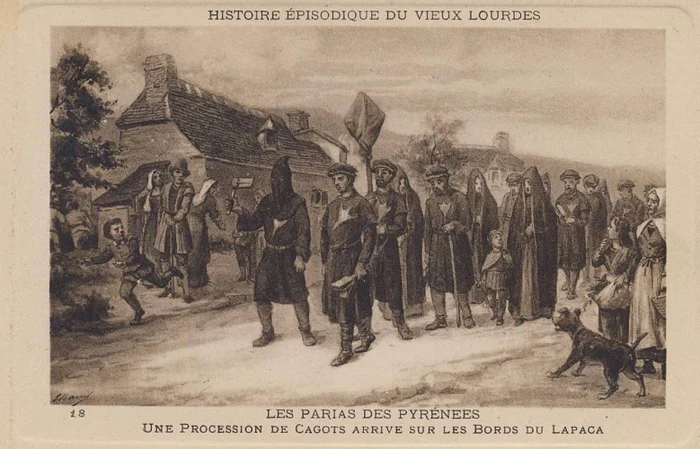
Procession of cagots PHOTO wikipedia
“I turned, between the church and the crenellated wall. There is the cemetery, walled with large slates, where the crosses and names dug with a nail are erased in rain, snow, and the feet of passers-by. One door, now built up, was the door of the cagots. The cagots, or goitreux, were pariahs. Their door was low, as we can judge by the vague line drawn by the stones surrounding it.”wrote Victor Hugo in his book “Journey to the Pyrenees”, in the middle of the 19th century. Even the Communion wine was served separately to the cagots using large, long wooden spoons. They were even forbidden to bury their dead in public cemeteries and necropolises.
Cadots were often forced to announce their arrival at the entrance to the city by either shaking a loud bell or rattling. They were also forced to wear certain ostentatious clothes and often wear a goose leg around their neck; based on the myth that they had webbed feet.
Cagots were only required to work in a few specific fields, such as rope making, wine barrel making and coffin making. Economically and socially it was impossible for a cagot to rise above his status. They could not work in other fields nor could they marry people other than girls from their community. Between the 11th and 19th centuries, the cagots lived a life of discrimination, ostracism, insults and poverty. And the law against them was harshly enforced. In the early 18th century, a cagot in the Landes was seen collecting water from a public well. He was punished by cutting off his hand and nailing it to the door of the local church.
In 1741 a cagot from Moumour was discovered cultivating a field and as a result had his legs pierced with hot iron spikes. The Cagots were so hated that when Pope Leo X issued a papal bull ordering them to be treated as normal human beings, the bull was completely ignored, even by local church officials. In order to avoid being punished, maimed or killed, many cabot communities did not even leave the ghettos on the outskirts of the cities. In some communities they were forced to wear a goose leg around their neck. But no one knows why this inhumane treatment.
The origin of cagots from science fiction and the Bible to historical research
In order to understand why this community was so marginalized, although there were no obvious reasons, the question of the origin of the cagots was raised. Knowing their origin would have provided more answers to some questions. The first information about the origin of cagots is science fiction and related to biblical events. For example, various medieval legends say that these Cagots were the descendants of the carpenters who made the cross on which Jesus Christ was crucified. Others, also in the Middle Ages, said that the Cagots were the descendants of the masons who built Solomon's Temple but were cursed and expelled because they worked for salvation.
Another medieval Spanish legend says that these cagots were descendants of a master sculptor from the Pyrenees named Jacques, who traveled to ancient Israel via Tartessos to make statues of two prophets for Solomon's Temple. While in Israel, he was distracted by a woman. He got the sculpture wrong and because of this his descendants were cursed to suffer from leprosy. Beyond these mythological explanations, historians have looked for scientific evidence regarding the origin of cagots. One theory says that the cagots and their discrimination was related to leprosy. The Cagots would have been the descendants of those who survived the miraculous leprosy. Or they might have had a genetic skin condition that made others think they were lepers. In Navarre these cagots were believed to be descendants of French lepers who immigrated to the region.

Cagotol district PHOTO wikipedia
The English argued that these cagotes were originally part of the bosom of a leper community because of the similarities in the treatment of cagotes in churches and the measures taken to allow lepers from England and Scotland to attend places of worship. For his part, the medievalist Francisque Michel, the author of the book “Cursed Races of France and Spain” from 1847, said that the name “cagot” and its synonyms come from the Indo-European root “cac”, which means bad, coarse or even excrement. “It kept its original meaning, because 'cagot' meant a leper or, more precisely, a sick, hateful and dangerous man”he specified. Guy de Chauliac wrote in the 14th century, as did the renowned French physician Ambroise Paré, of the Cagots as lepers with “pretty faces” and skin without signs of leprosy, describing them as righteous “white lepersLater dermatologists believe that Paré was describing leucoderma, being confused with leprosy in cagots and hence their marginalization.
Another theory indicates that these Cagots were marginalized because they were descendants of heretics in France called Cathars. They were persecuted for heresy during the crusade against the Albigensians. However, as other specialists or authors testified, the Cagots did not differ from the rest of the population, especially since they spoke the same language, even adapted to dialects, had the same religion and looked almost the same physically. In conclusion, their discrimination remains a mystery.
The French Revolution saved the cabotage from discrimination
Although since the 17th century, the French king Louis XIV lifted the restrictions placed on cagots and campaigned for their total integration into society, it was only in the 19th century that the measure was put into practice, at the level of the population. A substantial change in mentality came as a result of the French Revolution.
Many Cagots were ardent supporters of the Revolution because they were the most oppressed by French society and government and, of course, had nothing left to lose. During the Revolution, Cagots often stormed government buildings and archive offices to destroy family documents and birth certificates that identified them as Cagots. Finally, the French Emperor Napoleon Bonaparte officially abolished all legal and social discrimination against cagots.