INTERVIEW. “And Ion Creangă should be considered a troll.” How Radu Jude responds to the criticism that he “ironized” his viewers in the movie “Dracula”


Director Radu Jude recently came to the public's attention with “Dracula”, in which he explores the myth of the famous vampire, in all its forms. The film is also a chaotic, uncensored visual adventure, which earned Jude a lot of criticism, including that he was screwing up his audience. In fact, some have also left the cinema hall. In an interview for the HotNews audience, the artist explains that this is not the case, because “Dracula” is made “with a lot of affection for the audience”.
- “And I don't really see how the online phenomenon of trolling could have anything to do with the film, which offers a series of stories and nothing more. Or then Ion Creangă should also be considered a troll,” says Radu Jude.
After winning, in Berlin, the Silver Bear for the best screenplay, for “Kontinental '25”, Radu Jude came to the public's attention with his own interpretation of Dracula, but also of the Romanian myth with tourist potential that surrounds him. “I'm Vlad Țepeș Dracula and I love you all” – that's what we hear at the beginning of the film, while all kinds of demented portrayals of the central character appear on the screen, made with the help of artificial intelligence.
From the first minutes (of the almost three hours that the action lasts), we realize that we will be part of a chaotic and uncensored visual adventure, which can certainly take us out of our comfort zone (or even out of the cinema, as happened to some viewers) and can make us laugh profusely, but also test our patience, as the case may be.
As noted in the official synopsis, “Dracula” features a frustrated and creatively blocked director (played by Adonis Tanța) who turns to artificial (fake) intelligence to make his next film a hit. The result is a series of increasingly absurd and surprising vignettes that explore the myth of Dracula in all its forms. From a chase through the streets of Sighisoara to strange apparitions in the villages of Romania, Dracula is a collection of stories about vampires, lost loves, blood, grotesque and AI-generated images – a reflection on cinema, myth and kitsch.
“The intention was to deliver the best film I can make”
Radu Jude doesn't talk in interviews about how he sees Romania or about some of the problems in our society, but that's because he does it through his films. Even if it seems like a collage of stories, with a multitude of cinematic references, “Dracula” touches on social and political aspects of our country, made with a lot of irony and a flair for the absurd.
Filmed with an iPhone over the course of 27 days, in over 40 locations (Medieval Citadel in Sighișoara, Bethlen Castle in Biertan, Albești cemetery and Grivița Roșie area in Bucharest), “Dracula” brings to light (and adapts for the big screen) the “first Romanian novel with vampires”, “Vampirul”, written by GM Amza et al. Bilciurescu, in 1938, the short story “In passing”, written by Nicolae Velea, but also “Povestea povestilor” by Ion Creangă.
“The intention was to deliver the best film I can, as I've tried every time,” Jude tells HotNews.
International critics have mixed opinions, from “the first truly intelligent use of AI in cinema,” as IndieWire noted, to “a film that defies convention and reinterprets the Dracula myth in its home country,” as Screen International notes. “At 169 minutes, 'Dracula' may be challenging for the viewer, but it's never boring,” adds Variety, “[…] deliberately dirty and childish, it feels like the work of someone who was free to make any vampire movie and chose instead to make a dozen crazy vampire movies at the same time,” says the Hollywood Reporter, and “Jude is an interesting, admirably unorthodox director who likes to challenge his audience. Here, however, he simply punishes us,” as The New York Times concludes.
“Dracula” had its world premiere in Locarno and selections in New York, Chicago, Viennale, Sitges and Warsaw, and its cast includes talented actors such as Adonis Tanța, Gabriel Spahiu, Oana Maria Zaharia, Alexandru Dabija, Lukas Miko, Andrada Balea, Ilinca Manolache, Șerban Pavlu, Nicodim Ungureanu, Doru Taloș, Alexandra Harapu, Oana Mardare, Eszter Tompa and Alina Șerban.
Because the film also considers the contribution of AI to creativity (and more), Jude created his own synopsis of the action, in his characteristic style.
“I asked chatGPT what my film is about and he replied: “Dracula by Radu Jude is not a classic adaptation of Bram Stoker's novel, but a radical reinterpretation, set in a contemporary setting. The film follows the story of a director who tries to stage a show about Dracula, but his project turns into a reflection on history, propaganda and national identity. As the myth of the vampire intertwines with social and political realities of today's Romania, the film becomes a visual essay full of irony and critical commentary. Jude combines scenes of theatrical rehearsals, archive footage and meta-cinematic reflections, resulting in a hybrid, provocative and deeply self-reflexive film.” I don't have much to add, except that the audience will get 14-15 stories, some with vampires, some without, some comedic, some serious, and everything the “general public” wants is in the film: nudity and sex, bad humor, beatings, blood, knocks, knocks, knocks – just like at the gates of the East.”
Created in antithesis to the glorious blockbusters of today, the film does not present a cursive flow of chance, but a deliberate chaos, as is practically the world in which we live. It is certain that Jude confesses: “Dracula” is made with a lot of affection for the audience, I did not mock them.”
“I don't make films that I'm not interested in”
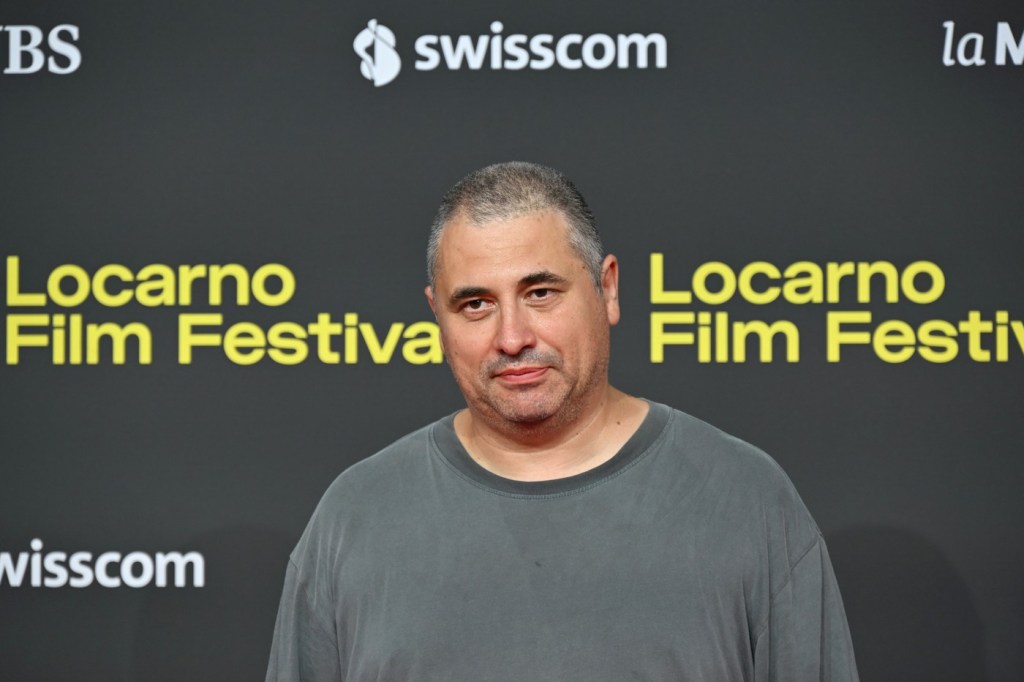
– You said that “Dracula” was born from an impossibility to find financing, to make another film. In the end, did you end it as a form of resignation or a form of revolt against our film industry?
– We talked a little about the origin of the project, which really was born at a project market (Cinemart in Rotterdam), following some discussions, but it's not about resignation or rebellion, but about the desire to make this film in this form. I don't make films that don't interest me. “Dracula” is a film that offers, I hope, at least a different type of cinema than what was made in our country.
– Dracula has been explored over the years in different forms in cinematography, always side by side with Romania and Transylvania. What did you want from your own Dracula (or his various variants)? How did you want to reposition it in the heart of the country where it comes from and which films served as inspiration for you along the way?
– Inspiration came less from cinema (although Andy Warhol, Ed Wood or George and Mike Kuchar, Pasolini, Godard, etc. are filmmakers who inspired me and inspire me) and more from other arts, especially from literature and painting. It is about the first literary novels, where digressions were part of the structure (v. Tristram Shandy by Laurence Sterne); moreover, one of these novels is also quoted in the film, it is about “Jacques and his master” by Diderot.
There would also be a certain type of humor coming from ancient literature, such as Boccaccio, Rabelais or Creangă, to which I freely adapted a story in the film. What I wanted from Dracula? I think that first of all I should offer several possible versions of this myth, in as diverse directions as possible, in forms that are sometimes more direct, sometimes more oblique. Cinema, like literature, represents a field on which various hypotheses can be tested, in “Dracula” I wanted to test this hypothesis, of the monster, of the vampire, of Dracula, of Vlad the Impaler, partly of the AI. I only offer a perspective, someone else can come up with other variants, other interpretations, etc.
“Once the film is made, it no longer belongs to me”
– You made, practically, in an assumed way, a film that does not shy away from kitsch, vulgarity, chaos. Did you care about the idea of spoiling a “good movie” or what was actually the intention?
– The intention was to give the best film I can, as I have tried every time.
– Many Western critics said that the film is too loud, too sexualized, too disorganized. Have you read the chronicles, how did you like them? Did you feel validated in any way for your rebellious filmmaking venture?
– Once the film is made, it no longer belongs to me, it's normal to have some kind of reactions. I have only read a few chronicles, because until now I have been in preparation and filming with another film. I generally read them only to further apply the advice of Jean Cocteau, one of my role models: “Listen carefully to the first criticisms of your work. Note exactly what the critics do not like – then cultivate that aspect: it is the only part of your work that is individual and worth preserving.”
– You are criticized for making fun of the viewer as well. With this movie, did you want to challenge him or just troll him?
– “Dracula” is made with a lot of affection for the audience, I didn't mock them. If there are moments of humor, they have to do not with the audience, but with the world in the film. And I don't really see how the online phenomenon of trolling could have anything to do with the movie, which offers a series of stories and nothing more. Or then Ion Creangă should also be considered a troll.
– The film is full of “anti-cinema” gestures – bad frames, long, disturbing scenes, repeated speeches. Why so much nudity, porn and sex though?
– First of all, I would note that even if this film were an anti-cinema, then it would still be cinema (just as Ionesco's first plays were considered by him as anti-theatre, being finally accepted as theater).
The frames in the film are not bad, by the way the cinematographer, Marius Panduru, is a great artist, among his last films is a film with a huge budget starring Juliette Binoche and Ralph Fiennes and recently Marius filmed with one of the biggest European filmmakers, Angela Schanelec.
It is true that some images are not standard, but from my point of view, this is something else entirely; I imagine they can seem “stupid” as long as they sometimes don't meet the standards we've come to expect from television, but they're very expressive. Then, with two or three exceptions, the frames are not long, it's one of my fastest films, so I don't know what to say. And I do not identify repeated speeches in the film. Regarding the representation of nudity and sexuality, it exists, I agree, but in a playful register, a la Boccaccio or Ion Creangă; altogether these images in the film, put together, represent less than 15 minutes, so less than 10% of the film. But, I repeat, the most important thing seems to me is the tone of these scenes, and it is a jocular one, as Mircea Ivănescu used to say.
“Romanian cinema has a lot of potential”
– What is more honest today: a bad but honest movie, or a “good” movie made just to please the audience?
– For me, honesty is not a value in art. In Tristan Tzara's words, “I'm interested in the intensity of a personality.”
– And as your films also bring into view Romania with all its social, political, religious problems, how do you see our country today, but, above all, how do you see Romanians?
– Unfortunately, I can't express any idea about something so vast, I don't have the necessary skills. And I don't even think that “Romanians” are something like that, homogenous, that can be described, every person is different. However, I can say something about Romanian cinema, namely that it has a lot of potential and it depends on both the filmmakers and the political and cultural establishment as a whole, if this potential will be actualized.
 INTERVIEW “Most people consume vulgar shows and pornography, but they don't like it when a director like Radu Jude puts the mirror in their face”