The stock exchange in Russia is gaining in the game for peace. Will the “aggressive” plan to end the war also leverage the trading floor in Warsaw?


While most of the world's major stock exchanges are on track to have their worst week in seven months, indexes in Russia may have their best week in several months. The reason for the speculative increases is the “aggressive” desire of the US administration to conclude peace between Russia and Ukraine. For now, the dance floor in Warsaw is not participating in the game for peace.
While the S&P500 has a discount of up to 3% this week. (before Friday's session), which means the worst week on the US stock market since April and the wave of sales caused by the introduction of US tariffs, Russian indices are recording the best week since August this year.
MOEX is gaining 1.6% on Friday, while RTSI calculated in dollars is 1.4%. In the rest of Europe, the main indexes fell significantly. DAX fell by over 1% since the morning. The discount on WIG20 even exceeded 2%. This week, MOEX can boast an increase of 5.7% (at times even 6.5%), which, if it reaches the end, will be the best result since the first half of August.
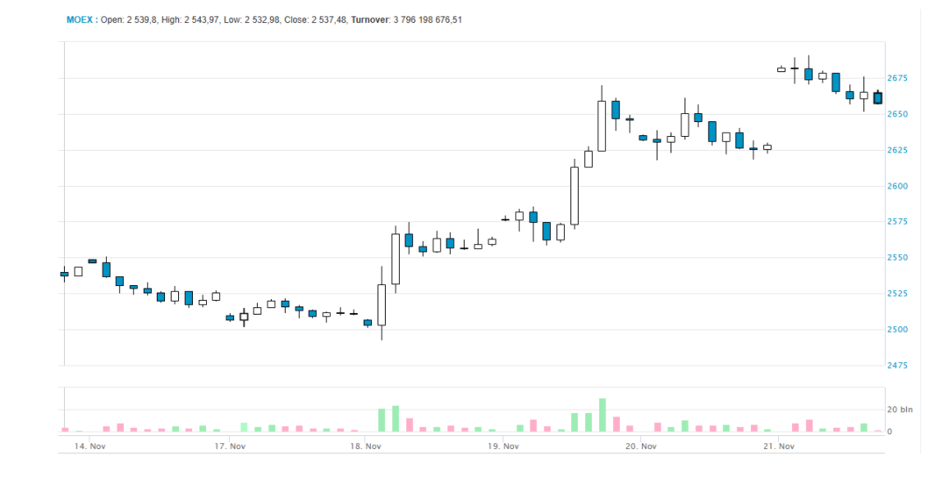
The leitmotif pushing Russian indices up are speculations about a possible peace between the Kremlin and Kiev. The first attempts to reach a ceasefire and sign an armistice immediately after Donald Trump was sworn in as US president failed, but investors are already playing a new hand, with more speculation and media reports than official statements from the interested parties.
By the way, let us add that the Moscow Stock Exchange has significant restrictions on foreign investors, especially those from countries considered “unfriendly” by Russia. The Kremlin introduced, among others: regulations that allow the sale of shares only for no more than 50% of their value investors from “unfriendly countries”.
Many international banks and brokerage firms have stopped providing services in Russia. Even though formally foreign investors can invest in Moscow, due to sanctions, regulatory restrictions and capital controls, their activity is very difficult.
New hopes for peace
The upward wave has been ongoing since mid-week following Axios' reports about the Trump administration's new plan to end the war in Ukraine. This has revived hopes that Russia and Ukraine will soon sign a peace agreement after almost four years of fighting. On Thursday evening, Ukrainian President Volodymyr Zelensky said he was ready for “honest” cooperation with the United States and Europe regarding the alleged US-Russian peace proposal.
It is a 28-point plan partly modeled on the recent 20-point ceasefire plan in Gaza. However, it assumes significant territorial and military concessions from Ukraine and the lifting of sanctions against Russia. One of the provisions concerns Poland directly, which was commented by Prime Minister Tusk by saying that decisions regarding Poland will be made by Poles.
Aggressive pursuit of peace
According to Bloomberg, the White House made it clear to President Zelensky that he should accept the agreement. The Financial Times reported that Americans expect him to accept a plan leading to a peace treaty “before Thanksgiving,” which is next Thursday. The Journal indicated that the White House is working on an “aggressive” timetable for ending the war by the New Year.
Observers, however, indicate that some of the provisions contained in the alleged US-Russian peace proposal will most likely be criticized by Kiev. This applies primarily to points that would force Ukraine to give up territory to Russia and drastically reduce the number of its armed forces.
Investors on the WSE are playing cautiously
The increases on the stock exchange in Russia should be considered as speculative trading following the media heating up the atmosphere regarding the peace plan. On Friday, however, there is no significant interest in the Warsaw Stock Exchange, i.e. the trading floor of a frontline country for which a potential end to the conflict would mean removing a significant risk and should provide a significant premium over current valuations.
It is true that on Wednesday, when the first reports about the new peace plan appeared, WIG20 gained over 1.8%. and was the strongest index in Europe next to MOEX. On Friday, it was possible to limit the scale of the depreciation, which in the first part of the session even reached -2%. to approximately -1.2 percent a few hours before fixing. A factor indicating that the truce issue is being played on is the growth of companies from the WIG-Ukraine index and companies from Ukraine listed on the WSE.
Less than three hours before the end of the session, KSG Agro shares were gaining 6.7 percent, CoalEnergy's price was rising by 4.6 percent, MIlkiland was growing by 3.4 percent, Astarta was gaining 2.5 percent, and Kernel was gaining over 4 percent. Let us add that the increases took place while approximately 70 percent companies on the broad market experienced a decline.