Parâng, the “Cinderella” of resorts in Romania, isolated in winter. How the most spectacular ski slope was built here


Parâng mountain resort was established in one of the most spectacular mountain regions in Romania, being surrounded by ridges that reach over 2,500 meters. However, it remained a “Cinderella” of the recreation areas in the Carpathians, and every winter many tourists look at it with doubt.
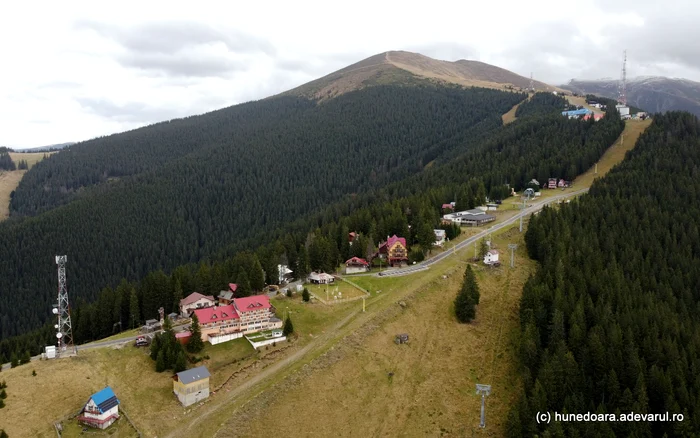
Parâng mountain resort. Photo: Daniel Guță. TRUTH
Located above the towns of Petroșani and Petrila in the Jiului Valley, to which it is connected by a 12-kilometer road, the Parâng resort was, in the 20th century, one of the most popular recreational areas in Romania.
After 1990, the number of cabins and guesthouses increased to over 100, and the investments planned in the 2000s by the Romanian state, through the “Ski in Romania” program, aimed to transform the resort into a ski area comparable to those in the Alps.
In 2012, the Romanian Government stopped funding for the Parâng Massif development project, estimated at 70 million euros at the time.
The plans were to expand the ski area on an area of 150 hectares and to develop 17 slopes (including 12 new ones), as well as to build a gondola between Petroșani and Straja, the neighboring mountain resort. The project also provided for the arrangement of 750 parking spaces in Parâng.
The road to the resort, closed during the winter
In 2014, the Petroșani City Hall inaugurated the second chairlift in the resort, with a length of over two kilometers, which starts from the Rusu complex towards the chalets in the alpine area.
The resort's old chairlift, which is still in operation today, was completed in December 1973 and climbs to an elevation of 1,684 meters, near the IEFS accommodation complex, intended for athletes who used to train at the resort.
In the following years, the Hunedoara County Council built a 5.5-kilometer mountain road between the Rusu area (1,168 meters), at the foot of the resort, and the cabins in Parâng.
The first segment of the road, which included two tunnels under the ski slopes, with a length of 4.5 kilometers, was opened to traffic in 2021. The second segment, about 800 meters, which climbs to more than 1,700 meters, was completed in 2023. Due to the risks involved, the alpine road is closed every year during the winter.
“The Hunedoara County Council announces that, for the safety of road users, starting from November 15, 2025 and until March 31, 2026, several sections of county roads will be closed to public traffic during the cold season. For county road DJ 709F, Cabana Rusu – Parâng Massif sector, between km 7+100 and km 12+600, the access to the Massiv The rope will be done with the chairlift. The measure is a preventive one and aims to protect the life and safety of citizens, given that these sections present high risks of landslides, frost or strong blizzards.” the Hunedoara County Council recently informed.
The closure of the mountain road has created, in recent years, dissatisfaction among tourists, and some of them complained that they had to walk several kilometers to the places of accommodation, because in some periods even the two chairlifts did not work.
The old chairlift, the “emblem” of the resort
The more than five-decade-old chairlift has encountered problems in recent years, due to frost, but also its technical condition affected by the passage of time. In July 2024, the cable installation broke during an overhaul, and two workers on the chairlift were seriously injured after falling from a height.
It was later repaired, and since December it is again waiting for tourists to use it. Until now, however, the snow covered only the highest ridges of the Parâng Mountains, while the meadows used in winter as slopes remained covered with grass.
From the resort, travelers can climb to the Parângul ridges on the route that crosses Vârful Parângul Mic (2,074 meters), Refugiul Cârja – Vârful Cârja (2,405 meters), Vârful Gemănarea (2,426 meters) and Vârful Parângul Mare (2,519 meters).
“A particularly pleasant and relatively easy route starts from the Parâng resort to the peak of Parângul Mic. The panorama is spectacular, wherever you look. The route takes no more than 1-2 hours (one way), but you can enjoy the area more if you continue a little further on the ridge, towards the peak of Parângul Mare, and then return to the resort on another path, at the base of the ridge”recommends a resort guest.
Other Romanians point out that in winter, the conditions on the mountain are difficult, and the ascent to Parângul Mic, although short, can be dangerous.
“The mountain, no matter how beautiful we see it, is just as dangerous in bad weather. In winter, it is not recommended to venture even to the top of Parângul Mic if you do not have proper equipment and a solid knowledge of winter mountain hiking. To enjoy a successful outing and charming landscapes, keep a close eye on the weather and snow conditions. The mountain stays there, it does not go anywhere.” is the advice of another traveller.
Excursions in Parâng in the 19th century
The recreational area of the Parâng Mountains started to become attractive for tourists at the end of the 19th century, in the years following the establishment of the first mining colonies in Petrila and Petroșani.
Until the 19th century, the carboniferous region was an almost wild land, occupied by a few small villages of shepherds and forest workers, isolated in the valleys of the two Jiuri that join at the foot of Parâng, the former border between Transylvania and Romania.
At the end of the 19th century, travelers arrived in Petroșani by train, using the Simeria-Petroșani coal railway, or on the road built in those years through the Jiului Gorge, which connected the small mining towns to Târgu Jiu. Once they arrived in the mining town, they found locals willing to accompany them to Creasta Rusu, the place from where they could start on the path that went up to the heights of Parâng.
“Those who love mountain hiking will find nearby Parâng a rewarding trip; the climb is much easier than towards Retezat. Guides and horses can be found both in Petroșani and Livezeni, and the trail can be started immediately at Jieț, climbing the stream valley to the south, right at the foot of Parâng. We pass first through beech forests, then conifers, reach the area of alpine meadows and, after three hours' walking, reach the stable and the Parâng peak of 2,076 meters, which also gives the massif its name. The peaks of Sliva and Cârja are higher, and after 5-6 hours of ascent, we reach the highest point, Vârful Mândru (No. Parângul Mare), of 2,520 m. The Parâng is interesting not only for its panoramas, but also for the wealth of flora and fauna, being particularly rich in black goats — indeed, it is believed, richer than Retezatut”the Hunyad newspaper reported in 1892.
The first slope in Parâng, equipped with dynamite
The first tourist cabins were established in the Parâng Mountains at the beginning of the 20th century. In their place, the recreational area began to develop from the 50s, with the development of the ski slope and the installation of a ski lift. Winter camps and ski competitions were held here.
“The slope from Parâng starts from Vârful Parâng, goes down the face of Slivea to Valea Sliveiului. It starts from 2,075 meters and reaches 1,350 meters, thus having a difference in level of over 700 meters and a length of approximately 3,000 meters”, informed Sportul Popular in 1957.
The development of the slope required the clearing of some very difficult portions, the dynamiting of some rocks, the works being carried out by voluntary work with the help of miners and locals from the villages of the Momârlans.
“The slope has all the characteristics of modern downhill, special slalom and giant slalom courses: steep drops, difficult turns, counterslopes, many and sharp jumps, which will cause many problems for the competitors. It will take some time before our skiers can cover the course at full speed.” said the ski teachers from Parâng.
It was also then that the first ski lift in the resort was built, which started from an elevation of 1,430 meters and reached 1,780 meters, with a length of over 900 meters.
At the beginning of the 70s, an accommodation complex was built for athletes and students from the Institute of Physical Education and Sport (IEFS) and also then the first chairlift in the resort was put into use. Around the complex located at 1,700 meters, the resort expanded chaotically after 1990.