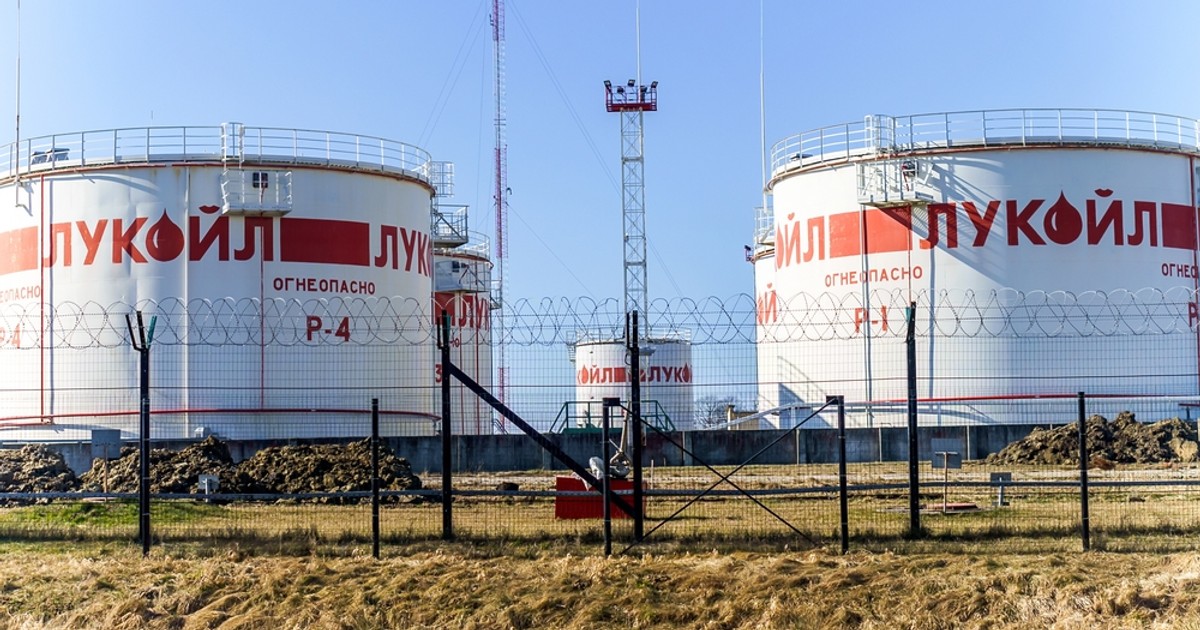
“American oil giant Chevron is considering options to buy the global assets of sanctioned Russian oil company Lukoil” Five sources familiar with the matter told Reuters on Monday.
The U.S. Treasury last week allowed potential buyers to talk to Lukoil about its foreign assets. Chevron would join Carlyle and other companies in the race for Lukoil's portfolio worth at least USD 20 billion.
Why are Lukoil's assets in Chevron?
Reuters notes that Chevron is considering options to purchase Lukoil's assets that overlap with the activities of these companies, and not the entire portfolio. The interested party himself stated that he complies with the laws and regulations applicable to his business and does not comment on commercial matters.
See also: Russian oil prices are at their lowest level in 2.5 years. Donald Trump's sanctions are already working
Łukoil extracts approximately 2%. world oil production at home and abroad. The company reported thatis looking for buyers for its international assets, which generate 0.5 percent. world oil production and whose value is estimated at approximately USD 22 billion, according to data from 2024.
Lukoil has three refineries in Europe, interests in oil fields in Kazakhstan, Uzbekistan, Iraq, Mexico, Ghana, Egypt and Nigeria, and hundreds of gas stations around the world, including in the United States. It has 13.5 percent. shares in the Karachaganak deposit and 5 percent shares in the Tengiz field in Kazakhstan, which also belong to Chevron and Exxon Mobil.
The rest of the article is below the video
Lukoil also has an interest in the Nigerian maritime license OML-140, which is managed by Chevron. It is also the operator of the West Qurna 2 project in Iraq, where Exxon had long been the operator of the neighboring West Qurna 1 project before withdrawing last year.
Chevron – what kind of company is this?
Chevron is one of the world's largest energy companies, primarily engaged in the exploration, extraction and processing of crude oil and natural gas. The company operates in many countries, conducting mining projects both on land and at sea, as well as investing in refineries and fuel distribution networks.
See also: The sanctions have shaken Lukoil's foreign businesses. Problems from Iraq to Switzerland
Chevron is also committed to the development of renewable energy and low-emission technologies, although its main area of activity remains the traditional fossil fuel sector. The company is important to the U.S. economy and the global energy market, influencing energy security and global commodity prices.
The oil industry's fight for assets
The global oil market is highly competitive, but at the same time it is dominated by several large global players who have a key influence on production, prices and development strategies in the industry. The most important oil companies include: American ExxonMobil and Chevron, British-Dutch Shell, French TotalEnergies, Russian Rosneft, Chinese Sinopec and CNPC, and Saudi Arabia's Saudi Aramco, each of which has huge mining resources and a global distribution network.
Most of these companies come from countries with a developed energy sector or from countries with significant oil reserves, and their activities include exploration and extraction, as well as processing and sale of fuels. Acquisitions of competitors are very important in this industry because they allow for increasing control over resources, expanding the sales market, optimizing production costs and strengthening the position against price and geopolitical risk, which makes mergers and acquisitions one of the main strategic tools of oil companies.