The National Bank analyzed over 66,000 products and tells us how the shops transferred the increase in VAT to Romanians' basket / What became more expensive, what less


Supermarket from Romania. Illustrative photo by Marian Mocanu | Dreamstime.com
The increase in Value Added Tax was transmitted almost entirely in prices, but with large differences between food and non-food products, says the National Bank, in the most detailed X-ray of prices ever made in Romania to see the impact of a fiscal shock.
- The NBR analyzed in detail how traders changed the prices of more than 66,000 products.
- In food, the price increase was fast, complete and almost mathematical. Most products went up in price exactly as much as the VAT obliged them, and some even more.
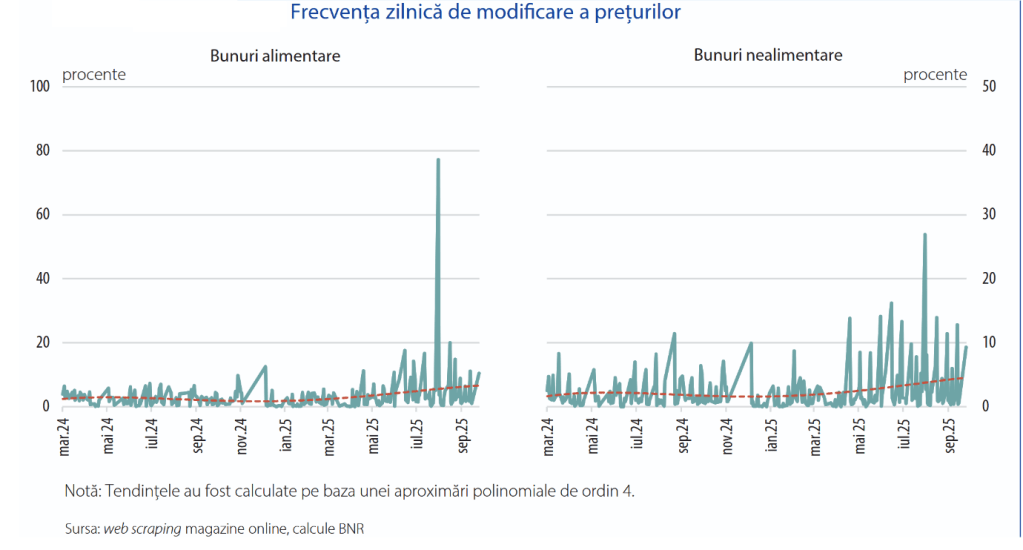
To carry out the study, the NBR collected prices (almost) daily from March 2024 to September 2025, and the NBR's analysis focuses on the symmetrical two-month interval around August 1, when the VAT increase came into force.
The database includes daily prices for approximately 33,000 food items (including volatile food and alcoholic beverages) and a similar number of non-food items from three major supermarket chains.
How often do traders change prices normally
On a typical day:
Of the total of almost nine million observations, just over 250,000 represent actual (non-zero) price changes; in other words, about 3% of prices change on a typical day. The frequency of change is higher in the case of food (about 3.3%) than in the case of non-food goods (2.4%).
After the announcement of the tax increase, the pace doubled. In June–September 2025, the frequency rose to over 5%. Traders started repositioning their prices long before August 1, anticipating energy price hikes and new taxes.
What exactly happened on August 1st
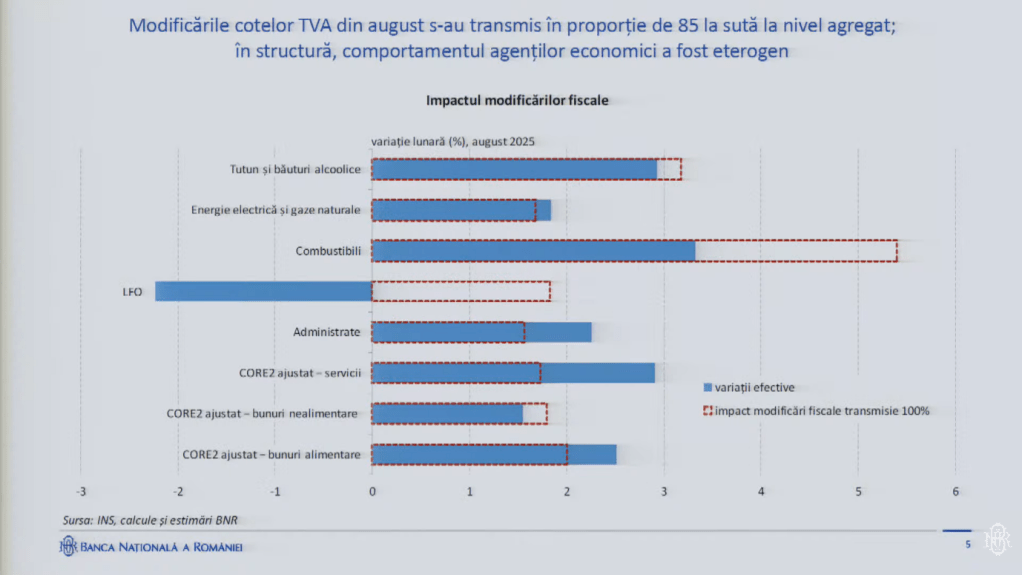
Food: almost mathematical transmission of VAT
- 80% of products changed their fixed price at the beginning of the month.
- 55-60% of the adjustments were exactly as much as VAT.
- Only 8% were smaller.
- 13% of products were priced higher than the VAT increase would have justified – a slight “overreaction”.
Non-food products: slower and more chaotic reaction
- Only a quarter of products changed their price on August 1.
- Only half of the price increases were within the mathematically justified range of the VAT increase.
- Almost 30% of the changes were greater than 2%.
Why in the case of non-food products the prices did not rise immediately
The BNR offers two explanations:
Fall season – September and October are months when retailers tend to adjust prices on non-food items (clothing, electronics, miscellaneous goods) anyway. Many traders preferred to wait for that moment.
Non-grocery menu costs – markups tend to be higher and retailers don't change prices for just a 2% increase. Menu cost is a term in economics that describes the cost a firm incurs when it changes a price.
In this context, a VAT increase of 2 percentage points is not enough, on its own, to trigger an immediate change.
What was seen in official inflation
The National Bank confirms the following:
The foods: August monthly inflation was 2.5%, which is even slightly above what would have resulted from just normal inflation + the new VAT rate. Here, transmission was complete, with small episodes of overbidding.
Non-food products: They rose by 1.6% in August – less than would have resulted strictly from VAT. So the transmission was gradual, not instantaneous.
Conclusion: The increase in VAT was passed on to prices, but not in the same way for all goods.
Food became more expensive instantly, the route was different for non-food products
On food: Transmission was fast, complete and almost mathematical. Most products went up in price exactly as much as the VAT obliged them, and some even more.
On no power: Transmission was slow, fragmented and delayed. Traders preferred to adjust prices in waves, not all at the same time.
In the economy, the VAT effect came on top of two other shocks: the increase in the price of electricity from July 1 and the fiscal uncertainty before the measures were adopted. These caused the price reset process to start two months earlier, from June itself.
 The VAT increase was not transmitted to prices for vegetables and fruits. Where the increase in prices was greater than that of VAT / How much inflation increased. Mugur Isărescu's announcement