Tax scale, linear or lump sum? Check which option is the most profitable [WYLICZENIA]


— In the face of rising costs of running a business and changes in tax regulations, entrepreneurs are increasingly asking themselves the question: what form of taxation will be the most advantageous for me? Should I choose a tax scale, a flat tax or a lump sum tax? – says Joanna Narkiewicz-Tarłowska, managing director and tax advisor at Vialto Partners.
At the request of Business Insider, Joanna Narkiewicz-Tarłowska and Grzegorz Ogórek, director at Vialto Partners, prepared estimated calculations of the effective tax and contribution burden in each of the three forms of taxation, for three levels of income: PLN 12,000. PLN 30 thousand PLN and 150 thousand PLN per month.
We also explain what, apart from income, to take into account when choosing the form of taxation.
Read also in BUSINESS INSIDER
Different forms of JDG taxation – what do they depend on?
— The calculations show clearly: the choice of the form of taxation is not a one-off, but a strategic decision. It should take into account that what type of business the taxpayer conducts, what is the level of revenue, cost structure and changes in regulations – says Grzegorz Ogórek. Choosing the “default” form of taxation (i.e. tax scale) may lead to the loss of significant benefits or an unexpected increase in tax burdens. — For many entrepreneurs, a thorough analysis of the form of taxation and professional consultation may turn out to be the most profitable investment, argues Joanna Narkiewicz-Tarłowska.
What should you take into account when choosing the form of taxation?
Running a business must take into account several elements, specifically:
- the amount of income (lump sum) or income (on the PIT scale or linear PIT),
- tax rates,
- costs of obtaining revenues (they cannot be included in the lump sum),
- preferences and discounts (many are unavailable in lump sums),
- health insurance premium.
The basic (default) form of taxation is the PIT scale with the following rates: 12%. and 32 percent over 120 thousand zloty. Entrepreneurs pay tax on the straight-line PIT at a rate of 19%. Lump-sum rates apply from 2%. up to 17 percent, depending on the type of activity.
Vialto Partners experts point out four elements that must be taken into account when considering the choice of the form of taxation.
Firstly The form of taxation is crucial when income is high. With lower income (revenues less costs of obtaining), the differences between the tax scale and the flat tax may be moderate, and even the tax scale may be more favorable (due to the possibility of including PLN 30,000 tax-free allowance, a low rate of 12% and the possibility of taking advantage of tax relief). However, in the case of higher income (e.g. PLN 30,000 per month and more), the flat tax (19%) begins to look much more attractive – because it eliminates tax progression and becomes more predictable.
Secondly lump sum is an option for those who have low business costs. A lump sum on recorded revenues may be beneficial when the entrepreneur incurs relatively low costs (or practically no costs). This is due to the fact that the tax base is revenue, not income. In the case of a business with high costs or revenues significantly exceeding costs – a lump sum may be less profitable than it seems.
Thirdly, the tax scale – still reasonable for businesses with high costs or people benefiting from tax reliefs. Taxation under general principles (tax scale) allows you to take into account the costs of obtaining income, many tax reliefs and favorable settlements (e.g. jointly with your spouse). Therefore, for entrepreneurs with high costs or those running a service business, where expenses constitute a significant part of revenue – the scale may be a better choice than other forms of taxation.
Fourth, health insurance premiums and the context of legislative changes are also key factors. Calculations made at various levels of income have shown that the health insurance contribution and changes in its calculation (e.g. exclusion of the possibility of deducting the contribution) have a significant impact on the profitability of the form of taxation. It is also important for the entrepreneur to take into account not only current revenues, but also long-term implications – in this case: whether the form of taxation will still be favorable in the event of future revenues or changes in cost conditions. The entrepreneur may also consider changing the form of taxation if the calculation shows that it will be more favorable (of course, maintaining the rules for changing forms, which means the need to report the change to the tax office by February 20, 2026).
What results from the calculations regarding the forms of taxation for revenues of PLN 12,000? PLN 30 thousand PLN and 150 thousand zloty?
The calculations were prepared by Joanna Narkiewicz-Tarłowska and Grzegorz Ogórek from Vialto Partners. The tables below present estimated calculations for three levels of revenues and costs per month:
- 12 thousand PLN revenues and PLN 2 thousand PLN costs,
- 30 thousand PLN revenues and PLN 5 thousand PLN costs and
- 150 thousand PLN revenues and PLN 50 thousand PLN costs.
We have marked the most favorable form of taxation in green and the most unfavorable form of taxation in red. Let us add that in the case of a lump sum, there is of course no question of tax-deductible costs, because we pay the lump sum based on revenues.
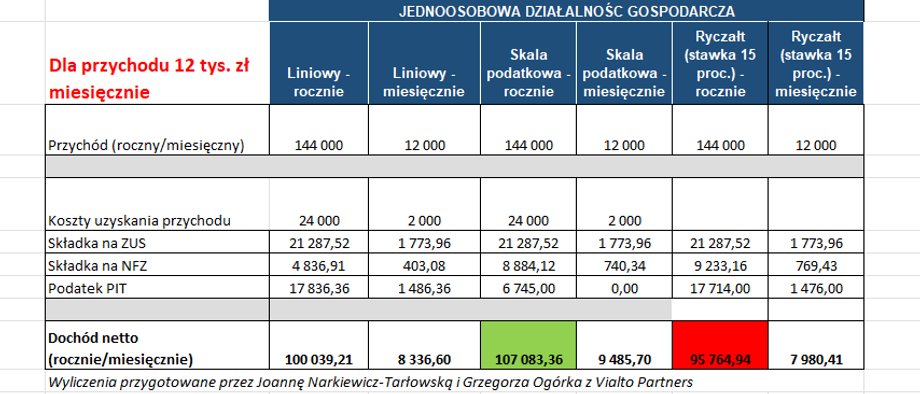
Calculations for revenues of PLN 12,000. PLN per month
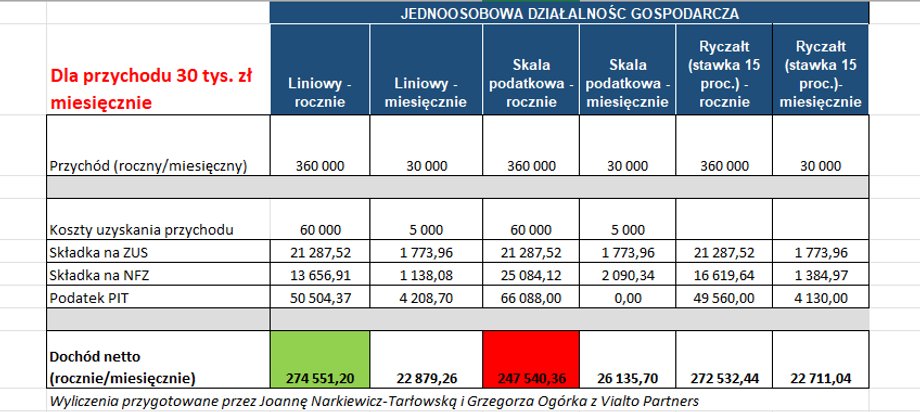
Calculations for revenues of PLN 30,000. PLN per month
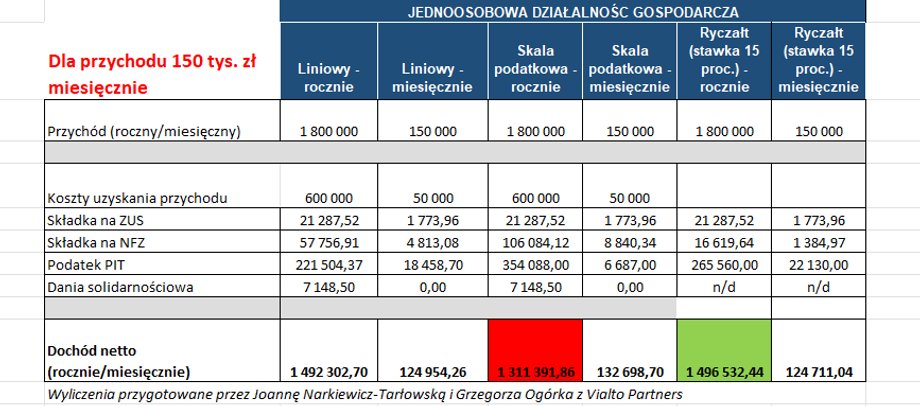
Calculations for revenues of PLN 150,000. PLN per month
So what should entrepreneurs choose?
— Entrepreneurs doing business with relatively low expenses and at annual revenues significantly exceeding the high income threshold should consider a flat tax — it ensures rate stability and predictability, says Joanna Narkiewicz-Tarłowska.
In turn, entrepreneurs with businesses cost-intensivebenefiting from tax reliefs or having lower income (not exceeding or slightly exceeding the tax threshold, i.e. PLN 120,000) – may be in a better position in terms of the tax scale.
As Grzegorz Ogórek adds, if services are provided at minimal costs, a lump sum payment may be an attractive optionbut the decision requires a detailed calculation – to assess whether the lump sum does not “take over” the potential savings resulting from costs and reliefs.
— They are important when choosing the form health insurance premiumsthat affect the entrepreneur's net amounts. In this case for higher incomes, a lump sum is the most advantageous option – points out Grzegorz Ogórek.
Author: Łukasz Zalewski, journalist of the Law section of Business Insider Polska