Massacre under the eyes of the world. The story of one of the most terrible crimes in recent European history


One of the most terrible crimes against humanity took place on June 10, 1942 in the Czech Republic. More than 300 people were brutally killed and their village, Lidice, razed to the ground. Among those killed were women and children, including babies.
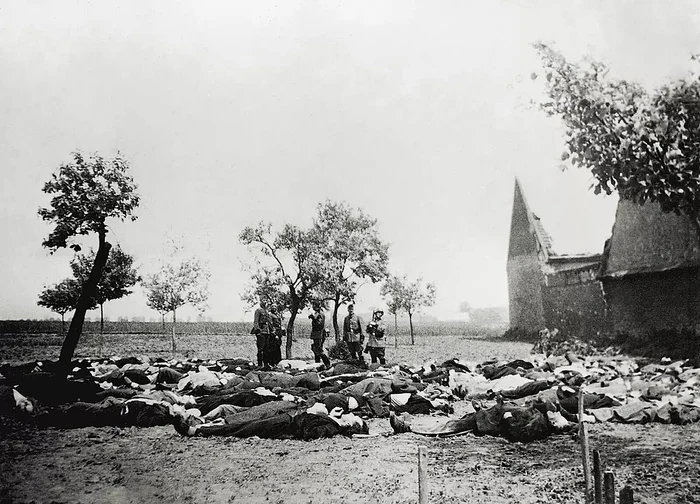
The Nazi massacre in Lidice PHOTO englis.radio.cz
On June 10, 1942, Lidice, a village with only 360 inhabitants in Czechoslovakia, was surrounded, since the early hours of the morning, by a lot of troops belonging to the Wehrmacht and the Sicherheitsdienst (the intelligence service of the Nazi Party, part of the SS, as an elite paramilitary organization, abbreviated SD). Until the afternoon of that day, the population of the village was partly exterminated, partly deported.
In 48 hours the entire village disappeared from the face of the earth, all the buildings being destroyed and leveled. Of those deported, women and children, more than 90% died in the extermination camps. It was one of the worst crimes against humanity of the modern era and one of the worst atrocities committed by the Nazis in Europe.
Many would ask, what was the fault of the people of Lidice anyway? Why this massacre directed including against children and women? The answer is simple, proven by documents and testimonies from that time: the people of Lidice died innocently. There was, however, a pretext and a reason for Nazi revenge, but the inhabitants of that village were effectively collateral victims.
Operation “Anthropoid” and the assassination of a Nazi executioner
The Lidice disaster started with the assassination of a high-ranking Nazi official. This is about Reinhard Heydrich, Heinrich Himmler's chief lieutenant in the SS, that elite paramilitary body of the Nazis. In addition, Heydrich was the commander of the Protectorate of Bohemia and Moravia, as Czechoslovakia was called after its conquest by Nazi Germany in March 1939, pursuant to the Munich Agreement of September 1938. Briefly, Reinhard Heydrich was the governor of Nazi-occupied Czechoslovakia. This character was a true executioner in the service of the Nazi regime and a key man in the sick plans of Hitler and Himmler. First of all it played a key role in organizing the Holocaust in the early years of World War II.
On July 31, 1941, Hermann Göring instructed Heydrich to implement a “final solution to the Jewish question”, authorizing him to take all necessary organizational and administrative measures for the extermination of the Jews. Heydrich presided over the famous Wannsee Conference where all the logistics of the “final solution” were worked out. Heydrich also organized the Einsatzgruppen, mobile teams of criminals tasked with terrorizing the population and causing genocide in occupied areas. These mobile squads killed nearly a million Soviet and Polish Jews in German-occupied territories. Heydrich's name is also linked to the ghettoization of the Jews, the organization of the mass killing of the Jews in Germany and the destruction of their property, but also the provoking of the Second World War by organizing the simulated attack on the German radio station (the Germans said that they were attacked by the Poles). In short, a butcher.
Heydrich's days were, however, numbered. The Allies set up Operation Anthropoid with the precise aim of ridding the world of the “Hangman of Prague”, as it had come to be known after thousands of Czechs were executed or sent to prison. Two Czech soldiers in exile in England were trained by British special forces to carry out the mission to assassinate Reinhard Heydrich. Their names were Jozef Gabčík and Jan Kubiš, and they were parachuted by a British team into the territory of Czechoslovakia in December 1941. They had false documents and managed to obtain the necessary weapons from various individuals in the resistance who were collaborating with the British. They studied Heydrich's route well and decided to act on the morning of May 27, 1942.
Heydrich was driven from his country villa in Panenské Břežany to his office in Prague Castle. He was traveling in a convertible car, given that it was a pleasant, sunny weather, accompanied only by the driver. Obviously, the driver was part of the military personnel and also acted as a kind of bodyguard. Gabčík cut off the car's path and fired. To top it off, the Sten machine gun he was equipped with jammed.
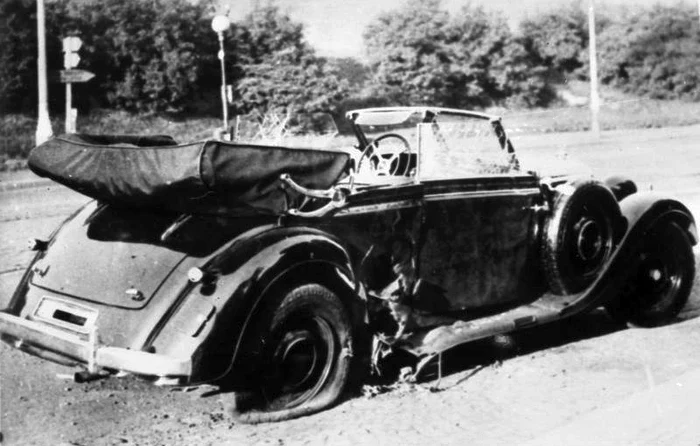
Heydrich's destroyed Mercedes PHOTO wikipedia
At that moment Heydrich pulled out his pistol, most likely a Luger P 08, and tried to shoot Gabčík. But Kubiš in order to save his partner and especially to complete the mission threw a modified anti-tank grenade at Heydrich's car. The resulting explosion injured both Heydrich and Kubiš. Badly wounded, Heydrich sent Klein, who escaped unharmed, to follow Gabčík on foot. The Czech shot the driver in the leg, below the knee, and managed to escape alongside Kubiš. A woman saw Heydrich near the wrecked car and stopped a delivery van going to Prague. Heydrich was taken to the Bulovka Hospital guard room. A splenectomy was performed, and the chest wound, left lung, and diaphragm were debrided (dead or infected tissue was surgically removed to speed healing). Although Heydrich appeared to be recovering reasonably well and despite increased medical attention, the “Hangman of Prague” died of septicemia on June 4, 1942. Operation Anthropoid had been a success.
A wild hunt and a boastful lover
Already on May 27, after learning of the assassination attempt on Heydrich, his deputy, SS officer Karl Hermann Frank, proclaimed a state of emergency and siege. A wild hunt for the culprits began. Assassins were sought everywhere and those suspected of complicity were killed on the spot. Moreover, their entire family was killed. The reprisals were cruel. In just a few days, 36,000 houses were razed. By June 4, 157 people had been executed as a result of the reprisals, but the killers had not been found and no information provided.
Many Czechs remained scapegoats. Arrests, executions, deportations to camps were carried out. On June 9, 1942, the need to avenge Heydrich's death was reiterated. The measures indicated by Hitler in this case were as follows: any village or town that harbored the murderers was to be razed to the ground, all the men executed, the women sent to concentration camps and the children suitable for “Germanization” sent to the families of SS officers. But there was still no scapegoat to be found. Then appears the letter of an unfaithful husband who wanted to somehow get rid of his mistress. Václav Řiha in an attempt to end the relationship with Anna Maruščáková wrote her a note insinuating that he had participated in Heydrich's assassination, stating that he had done “what he wanted to do” and that the two would never see each other again, so as not to endanger her. The letter went to the wrong place. More precisely, the letter was sent on June 3 to the factory in Slany, in the immediate vicinity of the village of Lidice, where Anna worked.
However, the young woman was not at work because she felt sick and was sent home. The owner of the factory, Jaroslav Pála, opened the letter and read it. Frightened by the content, he immediately notified the police. Finally the letter reached the Gestapo. Václav worked in Kladno, another town near Lidice and Slany. Interrogations followed, obviously very brutal. It was quickly concluded that Řiha had nothing to do with the assassination. But when Anna was questioned, she confessed that at one point Řiha had asked her to send greetings to the parents of Josef Horák, a man from Lidice who had left to join the British Royal Air Force. This is how the Gestapo arrived in Lidice. They didn't even need further explanations or reasons. The village was doomed. Obviously, the locals were totally innocent and had nothing to do with the assassination and the assassins.
People butchered like animals in a slaughterhouse
Horst Böhme, the SS commander of Einsatzgruppe C Division, was tasked with solving the problem according to Hitler's instructions: people massacred, village razed to the ground, women in the camp, children Germanized. With the help of the Wehrmacht soldiers but also with the SD paramilitary troops, the encirclement of the village began in the early hours of the morning. The Nazis asked the locals to gather in the square in the center of the village. Later, the Germans went from house to house and checked if anyone was hiding. Afterwards, the SS members separated the men from the women. All teenagers who had reached at least 15 years of age were placed next to the men. All the men and teenagers were taken to a nearby farm. Mattresses were taken from neighboring houses and taped to the wall of the Horák barn to prevent bullet ricochets. The slaughter began at 7.00 am.
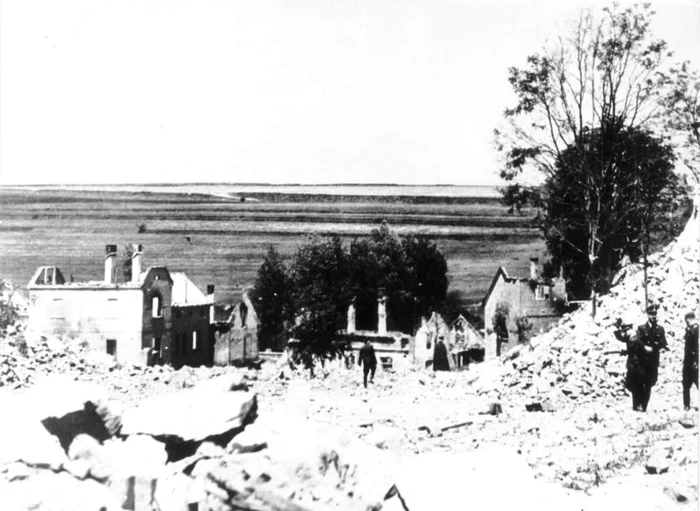
Lidice was razed off the face of the earth PHOTO wikipedia
Men and teenagers were shot in groups of 10. The bodies were effectively left to lie where they fell. By the afternoon hours, 173 men and teenagers had been systematically killed. Several others were shot as they tried to flee. A 14-year-old boy was also put on the wall of death, because he was close in age. At the same time, those who were absent from the village, for various reasons, were searched and taken to a demonstrative firing squad in Prague. The people of Lidice, the small mining village near Kladno, were known to be hardworking, honest and welcoming. The news of their murder, announced as if ostentatiously by the Nazis on the radio, shook the whole world. And the cruelty of the Nazis was not limited to the killing of teenagers and men.
A terrible drama of innocent people
The 184 women who experienced the tragedy of seeing their sons and husbands killed were later taken to the town of Kladno, along with their younger children. They stayed there staying in the elementary school for three days. Later, the Nazis took all their children, including infants. The women were loaded into trucks and taken to the camp.
On June 14, 1942, the 184 women from Lidice entered the Ravensbrück concentration camp. From the camp they were sent to forced labor, in construction or the armaments industry. The children, however, had a much sadder fate. Very few were selected for “Germanization” because they were thought to be racially suitable. There were ten in all. They were given up for adoption into the families of SS officers
The remaining 81 were moved to a children's home, where they suffered from hunger and lack of hygiene. In the end, the Nazis decided their fate. They sent them to the Chelmno extermination camp. There they were effectively gassed in “death vans”.
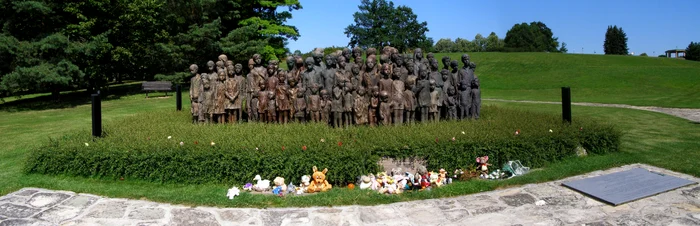
Children's memorial from Lidice PHOTO wikipedia
A few days after the massacre of the men and the sending of the women to the camp, the village of Lidice was destroyed and razed to the ground. The fate of the village of Lidice shook the whole world. Churchill even proposed a similar revenge, by bombing German towns. In many parts of the world, many cities have also added “Lidice” to their names as a symbol of support and memory preservation. Citizen associations were established in Great Britain to collect funds for the reconstruction of the village.
Czech composer Bohuslav Martinů composed “Memorial for Lidice”, an 8-minute orchestral work. The village was rebuilt after the war, but in a nearby area, not on the same site. A memorial was erected in the area of the massacre, including a statue dedicated to the children of Lidice. Only 17 children survived, among those born either in the camp or taken to German families. Of the women, 53 died. The rest managed to return after the war.