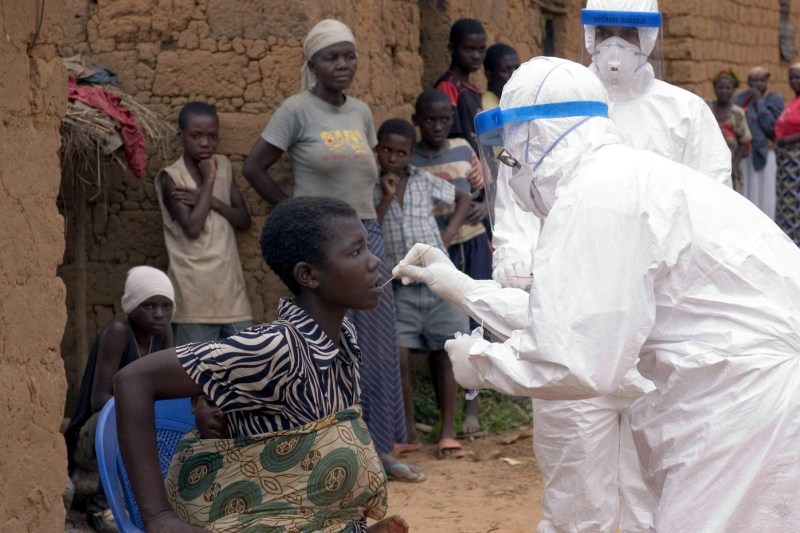
A member of the World Health Organization (WHO) takes an oral sample from a woman suspected of having Marburg hemorrhagic fever, in Kinguangua, near Uige, May 6, 2005. Credit line: CHRISTOPHER BLACK / AFP / Profimedia
The Centers for Disease Control and Prevention (CDC) in Africa says at least nine cases of infection with the Ebola-like Marburg virus, which kills up to 80 percent of those infected, have been detected, according to The Guardian.
Marburg virus is one of the most lethal pathogens known. Like Ebola, it causes severe bleeding, fever, vomiting and dysentery and has an incubation period of 21 days.
Also, like the Ebola virus, it is transmitted through contact with bodily fluids and has a fatality rate of between 25% and 80%.
The head of the World Health Organization, Ethiopian Tedros Adhanom Ghebreyesus, confirmed on Friday that at least nine cases had been detected in southern Ethiopia, two days after the Africa CDC was alerted to a suspected hemorrhagic virus in the region.
“Marburg virus disease (MVD) has been confirmed by the National Reference Laboratory (of Ethiopia),” the Africa CDC said on Saturday.
“Further epidemiological investigations and laboratory analyzes are underway, and the virus strain detected shows similarities to those previously identified in East Africa.”
The authority said Ethiopian health authorities acted quickly to confirm and contain the outbreak in the Jinka area. It said it would work with Ethiopia to ensure an effective response and reduce the risk of the virus spreading to other parts of East Africa.
An outbreak of Marburg virus killed 10 people in Tanzania in January before being eradicated in March.
Rwanda declared in December 2024 that it had succeeded in eradicating the first known outbreak of Marburg, which caused 15 deaths.
There is no approved vaccine or antiviral treatment for Marburg virus, but oral or intravenous rehydration and treatment of specific symptoms increase patients' chances of survival.
Last year, Rwanda tested an experimental vaccine produced by the US-based Sabin Vaccine Institute.