Google is strict about the EU's technological potential towards the US: You are 5 years old

The report prepared by Implement Consulting Group (ICG) in cooperation with Google, presented at the Digital Sovereignty Summit in Munich, is intended to convince Brussels officials and member states to be open to investment and build a friendly business environment for technology companies.
“Digital sovereignty is not a choice between innovation and control, but a combination of these two aspects,” emphasize the authors of the document titled “Digital innovation with control — Clearing the cloud.”
According to its assumptions, the European Union could increase its GDP by EUR 1.2 trillion thanks to artificial intelligence in 10 years — provided that it keeps pace with the latest technologies, enters the most attractive niches and does not close the market. An additional 450 billion. waiting for those who will be innovative. But that's not all. If the European Union does not ensure full access to advanced AI solutions, it will lose EUR 800 billion in potential productivity gains.
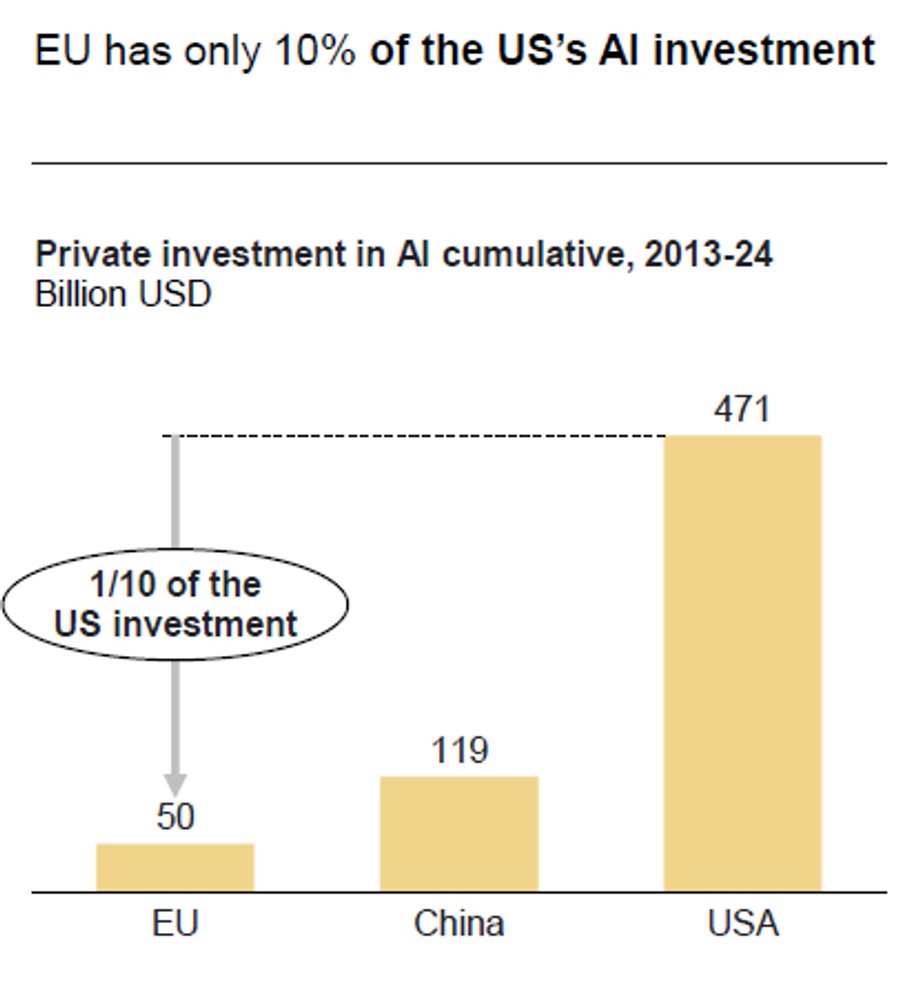
The United States has lagged behind Europe in terms of investment in AI, according to the report
|
Digital innovation with control – Clearing the cloud / Digital innovation with control – Clearing the cloud
ICG and Google are therefore tempting with huge profits if Europe benefits from the development of artificial intelligence. However, they indicate what, in their opinion, the EU must change in its actions to make these ambitions come true.
Europe cannot cope with the digital age
The Google document harshly assesses the condition of the European economy – in this respect it draws on the findings of the community itself, and specifically the famous Mario Draghi report. For over two decades, the European Union has been losing in the race with the United States. The labor productivity gap is already 20 percent. — on average, a US worker generates one-fifth more value per hour than a European. This gap has largely grown in the era of information technology, and now it may turn into an unclosable technological divide.
““Europe is 5-10 years behind in breakthrough innovations in key technologies,” the document's authors say sternly.
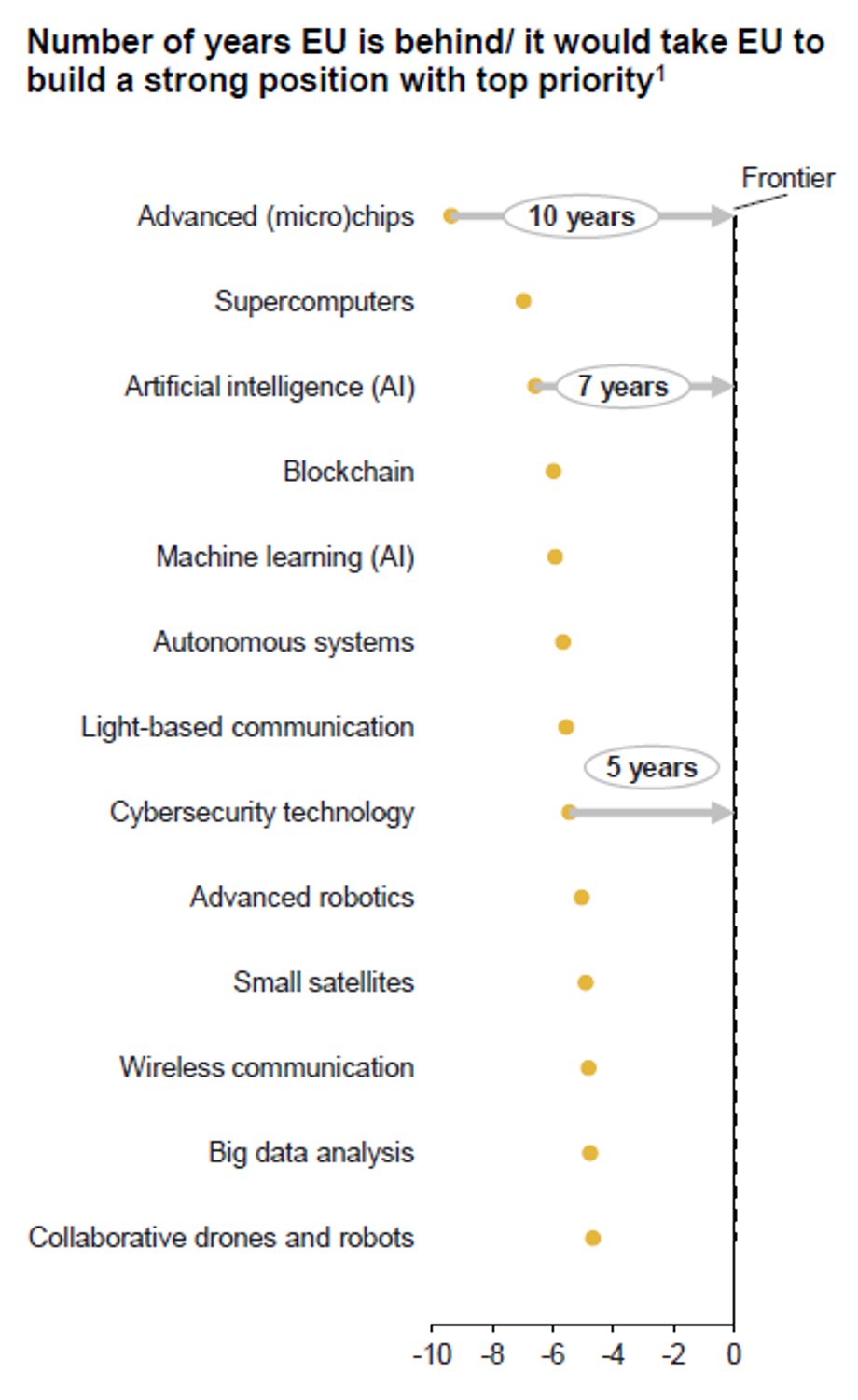
Europe lags behind in key technologies
|
Digital innovation with control – Clearing the cloud / Digital innovation with control – Clearing the cloud
Why? ICG and Google estimate that the EU suffers from underinvestment. The European Union attracted only 10 percent. venture capital investments in artificial intelligence that have come to the United States in recent years. Meanwhile, America's computing capacity is already three times greater than Europe's. If the trend does not change, this gap will only grow.
Solution: market openness
By 2030, Europe must triple its data center capacity. This means allocating EUR 400 billion to infrastructure – half of which is servers, processors and graphics cards. Annually, it will be necessary to invest EUR 75-85 billion. According to the report's authors, this is an achievable task – but only if Europe is attractive to private investment.
Google and Implement Consulting Group argue strongly: Europe must maintain supplier choice, speed, simple market, single market and open market. Digital sovereignty is not a choice between innovation and control – it is a combination of both. Between the lines, the report criticizes the pursuit of European self-sufficiency.
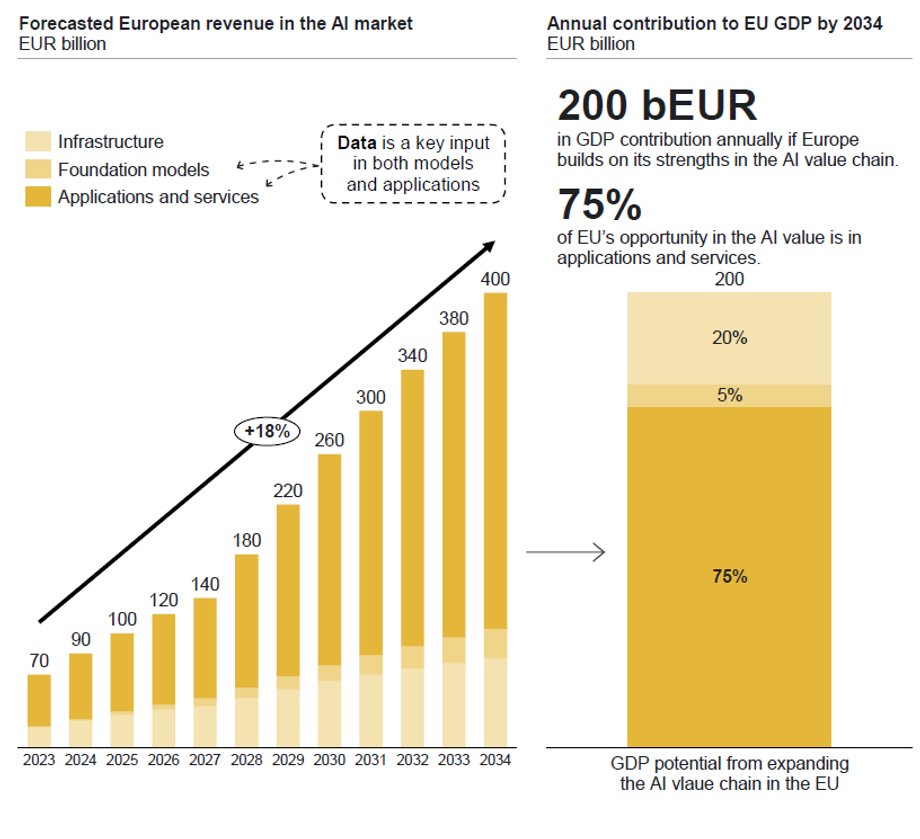
Google's report encourages Europe to focus on infrastructure-based applications instead of building competition for data centers
|
Digital innovation with control – Clearing the cloud / Digital innovation with control – Clearing the cloud
What does Google want from the EU?
Google's report is essentially a data-gathering argument for maintaining an open cloud computing market in Europe. How does the American giant encourage the EU to cooperate more closely with US businesses?
First, it's about safety. What protects us against cyberattacks today are modern cloud solutions, say the authors. Modern cloud solutions offer access to cybersecurity technologies that are five years ahead of the European level. If Europe closes itself to only EU solutions, it will become defenseless.
The rest of the article below the video:
Secondly, it is about energy efficiency. As Google shows, large data centers are 41 percent more energy efficient than average European solutions. The report emphasizes that if operators are able to develop their operations in Europe, energy consumption in European data centers will reduce by 8%. compared to a scenario in which smaller operators will dominate. In the era of energy transition, this issue becomes significant.
Third, it's about clean energy. Google calculates that it manages European data centers with 84%. energy from zero-emission sources, which is higher than the network average. In the years 2010-2024, the company concluded over 170 contracts for the purchase of 22 GW of clean energy around the world, of which over 4.5 GW was in Europe.
Don't look for competition with the biggest ones
The report is also an appeal to the whole of Europe: the greatest opportunity does not lie in building competition for companies such as Amazon, Microsoft or Google in terms of infrastructure and fundamental models. As much as 75 percent European growth opportunities in the AI value chain lie in applications and services – say the authors of the report. And the European AI market is expected to grow by an average of 18%. annually for the next decade – so there is something to fight for.
One of the largest areas for AI development in Europe is to be the public sector. According to the report, the potential of artificial intelligence in this area amounts to up to EUR 300 billion of GDP.
Google expects action from the EU
The report contains a clear appeal to the European Union: it must choose whether it wants rapid growth or isolation.
Google and Implement Consulting Group postulate, above all, harmonization of rules. Instead of each Member State having different requirements – as in the case of France, which has strict requirements on the origin of suppliers – there is a need for a single European standard for non-sensitive data and clear rules for sensitive data. The second rule is to stop polishing gold (so-called gold-plating), i.e. making the regulations more detailed than necessary. The report estimates that Europe owes part of its competitiveness problems to such regulatory gold-plating.
The third issue raised in the report is access to edge technologies. Europe must have access to the latest AI models, training and inference – both European and global. This is a clear suggestion by the US technology giant not to hinder American tycoons' business activity in the EU.
The report warns against an “isolating approach”. If Europe limits itself to “EU-only”, it will expose itself to many dangerous consequences. First, there is the risk of delayed or limited innovation. Secondly, much higher investment needs. Third, increased exposure to cyber attacks due to lack of access to advanced cybersecurity technologies. Fourth, loss of access to the latest AI models.
Instead, the report proposes a “Smart Stack” – a solution that retains the choice between European and global providers, but is fully controlled by Europe in terms of data and security. This approach would take the best of both worlds: protecting European values and being open to global innovation.
According to the authors, the time window for action is 5-8 years. Later it will be too late, because other players will replace EU.