Opening of a monument to participants in local wars and military conflicts
Photo: Government of the Jewish Autonomous Region
November 14, 2013
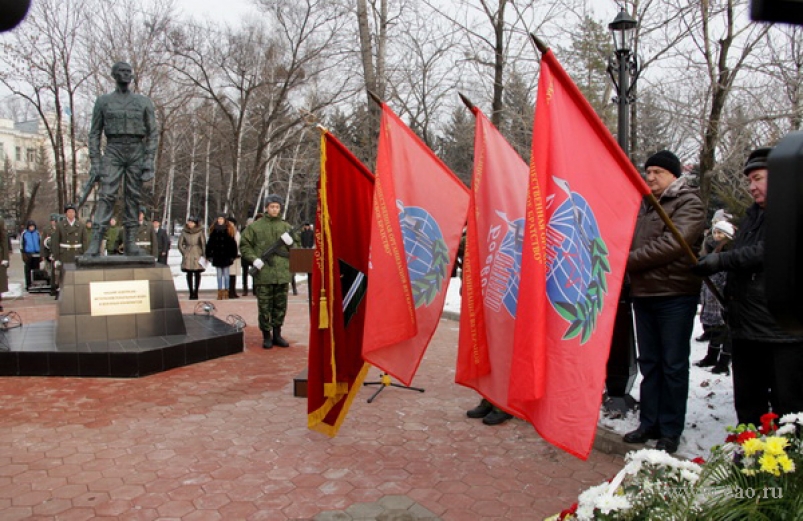
A monument to participants in local wars and military conflicts was erected in Birobidzhan.

On this day, not only relatives of the fallen heroes came to Victory Square. Many Birobidzhan residents gathered here.
The right to remove the fabric from the monument was granted to the mayor of Birobidzhan, Andrei Parkhomenko, and the internationalist warrior Maxim Nevsky.
Among the participants in 35 local wars are 17 of our fellow countrymen. At the opening of the monument, memorial signs were handed over to the relatives of the victims.
The monument appeared thanks to the initiative of the “Combat Brotherhood” organization. The idea was also supported by the leadership of the regional center. The grand opening took place on Old Square.
For 15 years, the organization “Combat Brotherhood” has been seeking the opening of a monument to the heroes of local wars and conflicts. Finally, the city hall supported this idea. The competition committee reviewed several projects. Initially it was supposed to be installed in the area of the regional Philharmonic. The preliminary design of the monument was developed by the Moscow sculptor Kyiv. He represented the figure of a soldier against the background of a wall. But due to the construction of a building on this site, they decided to move the sculpture to Old Square. The sculptor refused to change his sketch.
The monument was created according to a sketch by the famous artist Vladislav Tsap in the Jewish Autonomous Region. The artist V. Tsap based his sculpture of the soldier on the image of Nikolai Kosnikov, the first of our fellow countrymen to die in Afghanistan.
The pedestal for the monument and landscaping of the surrounding area were designed by architect Irina Vladimirovna Pishchits.
The monument was cast in bronze by Chinese craftsmen. The monument cost the city 500 thousand rubles.
November 14, 2018

Day in the history of the Jewish Autonomous Region. Photo: Photo: Newspaper “Amurskaya Niva”
In the newspaper of the Leninsky district “Amurskaya Niva” (12+) 2018 on November 14, Vitaly Ishutin's article “From the Yamskaya Chase to the Telegraph” was published, which talks about the formation of postal services in the Amur and Primorye territories, and how mail was delivered to the village of Mikhailo-Semyonovskaya, now the village of Leninskoye:
“In 1890, mail was delivered to Mikhailo-Semenovskoye by the postal cargo steamer Muravyov and the postal cargo and passenger steamer Grand Duke Alexey. The steamships stopped at all postal and telegraph points only for the time necessary to deliver and receive postal correspondence and replenish firewood supplies. Ships from Blagoveshchensk to Mikhailo-Semyonovsky traveled a distance of 656 and ½ versts along the Amur. As you can see, the transmission of any information from the European part of Russia to Primorye and the Amur region was extremely slow at that time. Therefore, immediately after the annexation of new lands, the idea arose of using an electric telegraph for communication with the Far East. “Telegraphic dispatches,” as telegrams were then called, turned out to be faster and more profitable than horse mail.
November 14, 2018

Day in the history of the Jewish Autonomous Region. Photo: Photo: Regional Library
The newspaper “Birobidzhaner Stern” (12+) 2018 November 14, in the article “Heirs of the Timurites” wrote that the first gathering of volunteer organizations took place in the village of Leninskoye. This rally was held under the motto: “People should help each other. Who will do this if not us?!”
The rally was attended mainly by high school students – representatives of Lenin, Bidzhan, Babstov, Lazarev and Dezhnev secondary schools and the main Kalinin school. The heirs of the Timurites spoke about their affairs, shared their experiences and plans for the future.
The volunteer movement in the Leninsky district is gaining strength, their good deeds are noticeable in every village. Not only older people, but also the younger generation and officials from rural administrations are grateful to these guys.
In the same newspaper, in the article “Everything for the convenience of patients,” it is said that the first on-site cycle of training doctors in lean technologies took place in the Jewish Autonomous Region. At which students of the two-day course “Fundamentals and principles of lean technologies in healthcare” learned how to optimize the work of a medical institution in terms of improving the quality of services provided, creating convenience for patients, reducing queues and increasing operational efficiency.”
A team from the Training Center for Lean Technologies in Healthcare at the Far Eastern State Medical University (FESMU) came to share their experience with EAO doctors. The training program for medical workers in the region is being implemented within the framework of the priority project “Creation of a new model of a medical organization providing primary health care,” which is supervised by the Ministry of Health of the Russian Federation.