

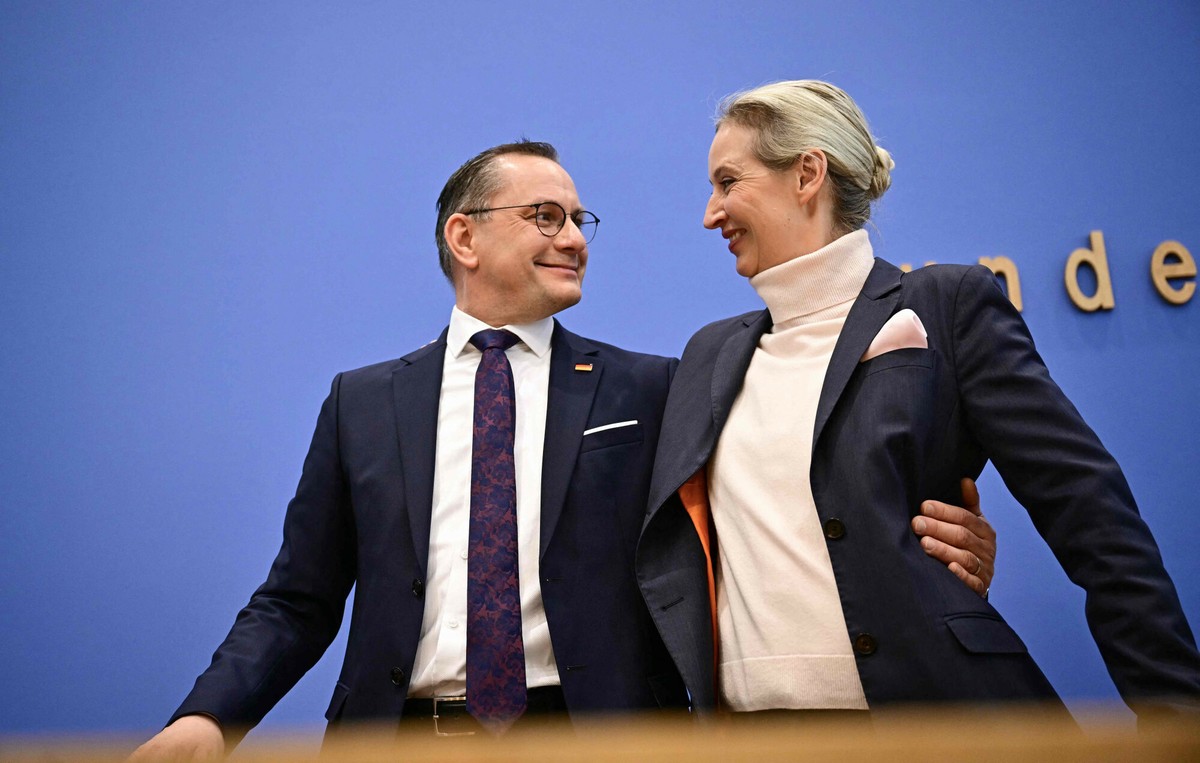
Chrupalla, who leads the party together with Alice Weidel, said in Markus Lanz's program that Germans do not have to be afraid of Russia at the moment. However, he pointed out that any country could become a potential threat, also pointing to Poland in this context. In his opinion, Germany applies double standards in international relations, as can be seen in the example of the Nord Stream gas pipeline and the case of Ukrainian citizen Volodymyr Zhuravlov, whom Poland refused to extradite to Germany. Chrupalla accused the German government of not reacting to this situation.
In response to the question whether Poland could be as dangerous to Germany as Russia, the AfD leader admitted that he saw such a risk. He emphasized that Poland's economic interests differ from Germany's, which may lead to tensions. With regard to Russia, he said that it has been a dictatorship for a hundred years, but as a German politician he is guided primarily by the good of his country. He criticized Russian aggression against Ukraine, although he noted that the West also made mistakes in the period preceding the conflict.
Read also: Germany transfers 40 million euros to Ukraine. “To Survive the Winter”
Disputes within the party
There is a growing dispute among German AfD politicians regarding contacts with Russia. MP Rainer Rothfuss from Bavaria is in the spotlight after he concealed the fact that he was supposed to meet former Russian President Dmitry Medvedev during his visit to Sochi. The party authorities are considering severe sanctions against him, including exclusion from the parliamentary club. Alice Weidel, co-chair of the AfD, clearly stated that Rothfuss would remain in Germany.
Another AfD parliamentarian, Steffen Kotre, will go to a conference in Sochi organized by the pro-Russian foundation BRICS International Forum, but the party has banned him from publishing photos with Russian politicians and commenting on the trip on social media. Markus Frohnmaier, vice-chairman of the AfD club, announced a visit to Moscow in spring 2026, but after criticism from the CDU/CSU and SPD, he withdrew from specific plans.
According to the German ARD television, the limited contacts between the AfD and Russia are due to pressure from the government coalition of CDU/CSU and SPD. Friedrich Merz, the German chancellor, identified the AfD as his main political opponent, criticizing the party for its pro-Russian connections. In October, the head of German foreign intelligence BND, Martin Jaeger, warned of a possible “heated confrontation” with Russia, pointing to its actions aimed at weakening NATO and dividing Europe.
AfD is winning voters
A debate in the Bundestag organized by the CDU/CSU and SPD last week ended with the AfD's contacts with Russia being recognized as a threat to Germany's security. MPs accused the party of being a “Trojan horse of Russia”. Meanwhile, Alice Weidel, trying to distance herself from Moscow, expressed interest in rapprochement with the US under Donald Trump. In the past, Weidel has criticized Russia for violating NATO airspace by Russian drones.
Despite its isolation on the German political scene, AfD is gaining popularity. In the parliamentary elections in February, the party won 20.8 percent. votes, becoming the second political force in the country. Current polls show that AfD is competing for first place with CDU/CSU, achieving support at the level of 25-26 percent.


