New studies indicate that among our ancestors are also species completely unknown to scientists. Their presence was noticed in the DNA of one of the ancestors of modern man who lived in the Asian area.
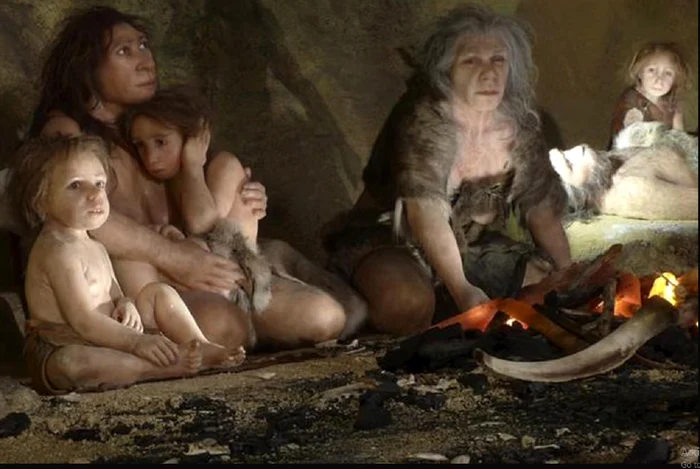
Family of Denisovans PHOTO Reuters
The evolution of hominids was an extremely complex process and far from being fully understood by scientists. Or rather, it has a lot of unknowns and at the same time too few things known for sure.
The emergence of modern man is one of these mysteries of history. It is known to have first appeared in Africa 300,000 years ago, based on fossils discovered in Morocco. Later, through genetic tests of homosapiens fossils, the reality becomes more and more complex regarding its origins. Over time, the modern man who migrated from African territories experienced new genetic contributions with new racial characteristics. Among other things, the tests show that the Neanderthal Man but also the Denisovan Man made his genetic contribution to the formation of the present man. A new study carried out by specialists, based on DNA tests, comes with quite shocking results.
In the genetic composition of modern man there is also the genetic material of a totally unknown species. They do not resemble Neanderthals or Homosapiens. Scientists believe that the Denisovan Man from the Asian area mated with a totally unknown species, and not occasionally, but repeatedly in such a way that the genetic material of that species was successfully passed on to man today.
“We're looking at a 'Lord of the Rings' kind of world
Genetic studies indicate that the modern human genome contains DNA sequences belonging to a completely unknown species. The results of these studies were presented last week at a Royal Society scientific session in London on ancient DNA. The discovery suggests that there was interbreeding between ancient human species in Europe and Asia more than 30,000 years ago. But much more significant was the discovery that they also mated with a mysterious Asian species that is neither homosapiens nor Neanderthal.
At the moment it is not known what species it is. What is certain is that the species interbred repeatedly with Denisova Man, another enigmatic subspecies that lived in Asia several tens of thousands of years ago and eventually became extinct. For their part, the Denisovans, before disappearing as a species, interbred with modern man, and the mysterious genes were transmitted to today's man. Specialists such as Chris Stringer, paleoanthropologist at the Natural History Museum in London, have recognized that “they don't have the faintest idea what the mystery species might be”they stated for Ancient Origins.
The presence of the unknown genome was detected in two teeth and a bone of a Denisovan, discovered in a cave in Siberia. “What emerges as a picture is that it was a 'Lord of the Rings' type world, that there were many populations of hominids”Mark Thomas, an evolutionary geneticist at University College London, told Ancient Origins.
The story of human evolution, a clear proof of unbounded love
The presence of ancient genes from unknown species is, however, a familiar story to anthropologists and geneticists. And this despite the fact that fossil genes have shown that the ancestors of many people living today mated with Neanderthals and Denisovans, both of which disappeared 40,000 years ago.
In short, many people today still have Neanderthal or Denisovan genes, which are nearly 200,000 years old. Some characteristics, such as red hair, for example, or strong musculature, we probably also inherited from Neanderthal or Denisovan ancestors. However, experts say that this is not all. If the mating between homosapiens and Homo Neanderthalensis was somehow understandable, given the similarities in physical order and probably also in articulate language, scientists say that in our genome there are also traces of much older species. Some totally unknown.
A lot of studies suggest that the ancestors of all three groups (sapiens, neanderthalensis, Denisovans) mixed at least twice with “ghost” and older lines of extinct and today unknown hominids. It is suspected that Denisovans or Neanderthals or perhaps even Homosapiens also interbred with Homo Erectus, a super-archaic species that left Africa 1.8 million years ago and spread throughout the world, mainly in Europe and Asia. Homo Erectus became extinct 117,000 years ago, but coexisted for over 100,000 years with Neanderthals, Denisovans and Homosapiens. “It is now clear that interbreeding between different groups of people happened a long time ago”biologist Murray Cox of Massey University in New Zealand tells Science.
In the journal “Science Advances Today”, geneticist Alan Rogers, from the University of Utah, published part of the results of his team's research. Scientists have identified variations in the genomes of different human populations, including Europeans, Asians, Neanderthals and Denisovans. In short, it was concluded that the ancestors of Neanderthals and Denisovans interbred with a super-archaic population that separated from other human species two million years ago. Interbreeding probably took place outside of Africa 600,000 years ago.
“I believe the super-archaic were part of the first wave of hominids to leave Africa. They remained in Eurasia, largely isolated from Africans, until 700,000 years ago, when Neanderthals (the common ancestor of Neanderthals and Denisovans) left Africa and interbred with them”said Rogers for “Science”.
At least two super-archaic hominids interbred with the ancestors of Neanderthals, Denisovans, and modern humans. Later, these three groups met and intermingled in turn, leaving complex traces in each other's genomes. However, it is not known what those super archaic species are. They are still a mystery. In turn, the main carriers of that mysterious genome, that is, those who have mated the most with that unknown species, are the Denisova people, another enigmatic human branch. These Denisovans closely resembled Neanderthals, but still had distinctive facial features and lived only in Asia.