Map of highways entering the construction site in 2026. Two regions, bypassed so far, mobilize thousands of construction workers


Two regions in Romania, so far bypassed by high-speed roads, will be covered by open construction sites in the coming months. Thousands of people will be employed, and several contracts worth billions of lei have recently been signed for the construction of highways and express roads.
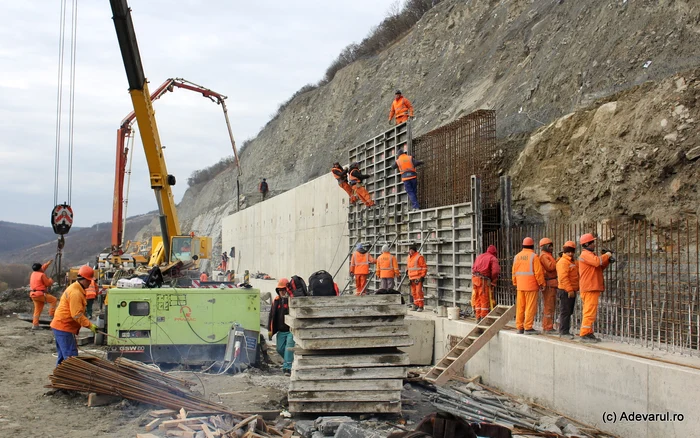
Highway works. Photo: Daniel Guță. TRUTH
The road transport network in Romania has currently reached over 1,350 kilometers of highways and expressways, most of them being built in the last 15 years. There are more than 850 kilometers of high-speed roads in various stages of construction, whose completion is estimated by around 2030.
Their achievement would mean that, in the next four years, Romania will exceed 2,000 kilometers of highways and express roads. Another 500+ kilometers are in the bidding or planning phase. The longest highways cross the southeastern, central and western regions of Romania.
In the coming months, the opening of several highway and high-speed road construction sites is expected, after the Romanian state awarded the design and execution contracts. The new sections are being built in the north-west and north-east of Romania, two regions that have so far been bypassed by such investments. Some projects started this autumn, and the routes of the future rapid roads have already taken shape.
Open construction sites around Oradea
At the end of summer 2025, work began on the 28.5 kilometers of highway between Chiribiș and Biharia, in Bihor county, a segment of the Transilvania Highway (A3) that will complete the Suplacu de Barcău – Borș route, with a total length of approximately 60 kilometers.
The contract, worth 785 million lei (without VAT), was recently awarded by the National Road Investment Company (CNIR) to the association Precon Transilvania – Citadina 98, and the order to start the works was issued on July 24.
“On lot 3C2 Chiribiș – Biharia, 18 bridges and passages will be built, and among the modern facilities are a SPEED system for monitoring and detecting travel speed, a security system equipped with installations and cameras every 2 kilometers for the detection of road incidents, as well as systems for dynamic weighing of moving vehicles”, shows CNAIR.
The works are scheduled for completion in 2027. This highway segment completes the Suplacu de Barcău – Chiribiș section, which is already under construction, with a completion date of 2026.
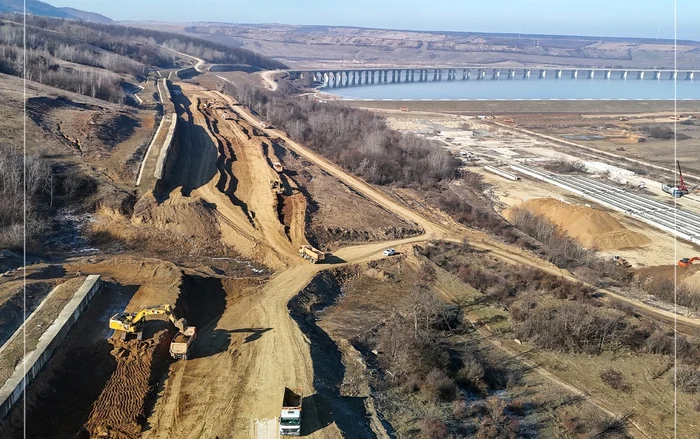
Suplacu Viaduct. Source. Weed. Facebook
The segment, with a length of 26 kilometers, was one of the first construction sites of the Transilvania Motorway: work began in 2004, but was suspended in 2013, halfway through the project. Meanwhile, the 1.8-kilometer viaduct was built at Suplacu de Barcău, considered the piece of resistance of the highway. Construction resumed in 2024.
At the other end of the Chiribiș – Biharia section, the route is continued by the Biharia – Vama Borș section, already completed, and 13 kilometers from the DEx16 Arad – Oradea Expressway, up to the municipality of Oradea.
After the completion of the works on the highway between Suplacu de Barcău and Biharia, Sălaj county will be connected by highway to Oradea and Hungary (via Vama Borș II). Recently, the execution contracts for the three sections of DEx16, with a total length of 120 kilometers, between Arad and Oradea, were also signed.
11 kilometers of the Autostrada Nordului enter the construction site
Also in the north-west of Romania, 11 kilometers of the “Autostrada Nordului” (DEx14), between the city of Satu Mare and the town of Oar, located on the border with Hungary, will be put into operation. On October 22, the National Road Infrastructure Administration Company (CNAIR) announced the signing of the contract worth 720 million lei (without VAT) for the investment financed through the Transport Program (PT) 2021–2027.
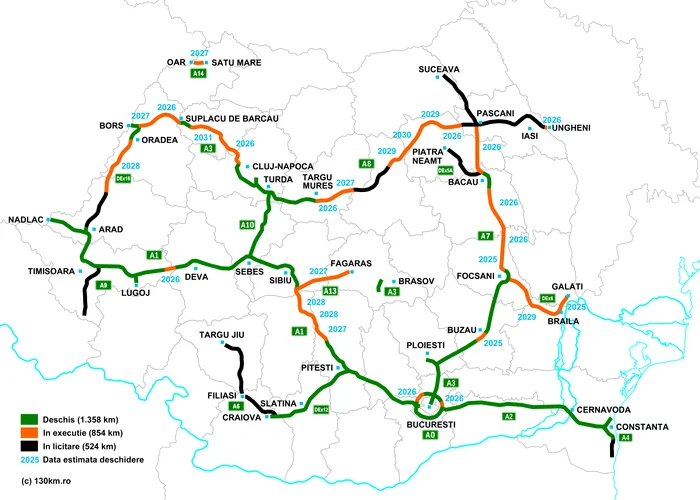
Highway map. Source 130km.ro
“The contractor, Construcții Erbașu, has 24 months to complete this new high-speed road, 10.83 kilometers long. The Oar – Satu Mare Express Road, named “Someș Express”, will have two lanes in each direction, and two road junctions, two parking lots and a Maintenance and Control Center will be built on the route”. informs CNAIR.
The new expressway will start from the ring road of the municipality of Satu Mare and, in the area of the border town of Oar, will connect to the M49 expressway on Hungarian territory.
The segment was planned as part of the “Northern Motorway”, a high-speed road that will connect Romania's northwestern border and the cities of Satu Mare and Baia Mare with Suceava and the historic region of Bucovina. Plans for the “Northern Motorway”, with an estimated length of almost 400 kilometers, date back more than a decade, but, apart from the road in Satu Mare, the rest of the route has remained in the project stage.
The “Northern Highway” route connects the towns of Oar (border with Hungary), Satu Mare, Baia Mare, Dej, Bistrița, Vatra Dornei and Suceava. The law on the construction of the Northern Motorway was promulgated in November 2020 by the former president of Romania, Klaus Iohannis, and the project provided for the completion of the investment by 2025.
The communities in the counties of Satu Mare, Sălaj, Maramureș, Bistrita-Năsăud, Suceava and Botoșani, in the north of Romania, which together have more than 2.3 million inhabitants, but are almost devoid of high-speed roads, would benefit from the investment.
Construction sites expected on Autostrada Unirii
In 2026, several highways and express roads in northwestern Romania could enter the construction site. Execution contracts have been signed for some of them, and others are in advanced stages of public tenders.
In 2026, work is expected to start on several segments of the Unirii Motorway (A8), from the sections Târgu Neamț – Iasi – Ungheni, approximately 90 kilometers long and Miercurea Nirajului – Lenghin, 161 kilometers long.
In October, CNIR signed the contract for the most difficult segment of the future highway, Lot 2B Grințieș-Pipirig, 34 kilometers long. The investment amounts to almost six billion lei, and the works will be carried out by the Association SA&PE Construct – Euro Asfalt doo-Tehnostrade – Spedition UMB.
“Lot 2B Grințieș-Pipirig, the most difficult lot of the Unirii Motorway, is a project of high technical complexity, including numerous structures, but also significant volumes of consolidation and excavation works: 16 tunnels (the longest being 940 meters); 60 bridges and viaducts, two of which are over 1,000 meters long (the longest bridge is the one over the Bistrita River with 1,275 meters); approx. 20 kilometers – the length of the passages and tunnels, representing almost 70 percent of the length of the entire lot; 12.7 million cubic meters of excavations”. informs CNIR.
Thousands of people will have to be employed on the construction sites of the mountain highway
All contracts for the design and execution of the A8 Miercurea Nirajului – Lenghin Motorway were signed in 2025. Most of the route will cross the Eastern Carpathians, and the difficult work on the mountain highway would involve a workforce of over 22,000 people, according to CNIR.
Approximately 22,000 people are needed to build the Sărățeni-Pipirig mountain section on the Unirii-A8 Highway route, according to the estimate from the feasibility study, the company said.
“The Sărățeni-Pipirig mountain section with a length of 116 kilometers, which includes 38 tunnels and almost 200 bridges and viaducts, represents one of the most complex investment projects for the road infrastructure. According to the data from the Feasibility Study, for section 1 C Sărățeni-Joseni (32.4 kilometers) the workforce required during the execution was estimated at approximately 6,000 people, for the next lot, 1 D Joseni-Ditrău (14.4 kilometers) of 3,000 people, and for the longest lot of the mountain section, 2 A Ditrău-Grințieș (37.9 kilometers) of 7,000 people. For the fourth lot, 2 B Grințieș-Pipirig (31.5 kilometers), the designer estimated that another 6,000 people will be involved in the execution”informs CNIR.
Also at the end of October, CNIR awarded the execution contract for another segment of Autostrada Unirii (A8), between the towns of Târgu Neamț (Moțca) and Târgu Frumos in Iași county. It will have a length of 27 kilometers, 36 bridges and passages with a total length of 8.5 kilometers, four tunnels with a total length of 1.7 kilometers and three road junctions.
The works will be executed by the Association Danlin XXL – Groma Hold Ltd – Intertranscom Impex – Evropeiski Patishta. According to CNIR, the association of builders from Romania and Bulgaria was declared the winner with an offer of 4.76 billion lei, and the design and execution contract can be signed if no objections are filed within 10 days. The total duration of this section is 46 months, of which 10 months for design and 36 months for execution of works.
The other four segments of the Târgu Neamț – Iasi – Ungheni highway are in public auction.
The Focșani – Brăila expressway, under construction from 2026
Along with the highway sections in the north-east of Romania, in 2026 the Focșani – Brăila Expressway, 73.5 kilometers long, will also enter the construction site. The contract was signed by the CNIR with the Association of Builders SA&PE Construct – Spedition UMB – Tehnostrade – Arcada Company and has a value of 4.29 billion lei (without VAT).
“The Focșani – Brăila Expressway will ensure the connection between the Moldovei Ploiești – Pașcani Highway (A7), the Bridge over the Danube from Brăila, the Brăila – Galați, Tulcea and Constanța Expressway. This objective was auctioned in a single lot, thus becoming the longest section of high-speed road that will be built under a single contract,” CNIR informed.
The project has a duration of 42 months (six months for the design stage and 36 months for works) and is financed from European funds through the Transport Program 2021-2027 and from funds from the State Budget.
The high-speed road is completed by the Brăila – Galati Expressway 6, 11 kilometers long, whose inauguration is expected at the end of 2025.