One of the most shocking and unreal battles in history. How 65 men managed to hold their own against an army of several thousand

In the 19th century, the land of Mexico witnessed a legendary battle that became a universal symbol of sacrifice and unwavering duty. Considered a real “Thermopyles of Central America”, this confrontation wrote the first page of glory for the Foreign Legion, transforming a handful of soldiers into eternal heroes.
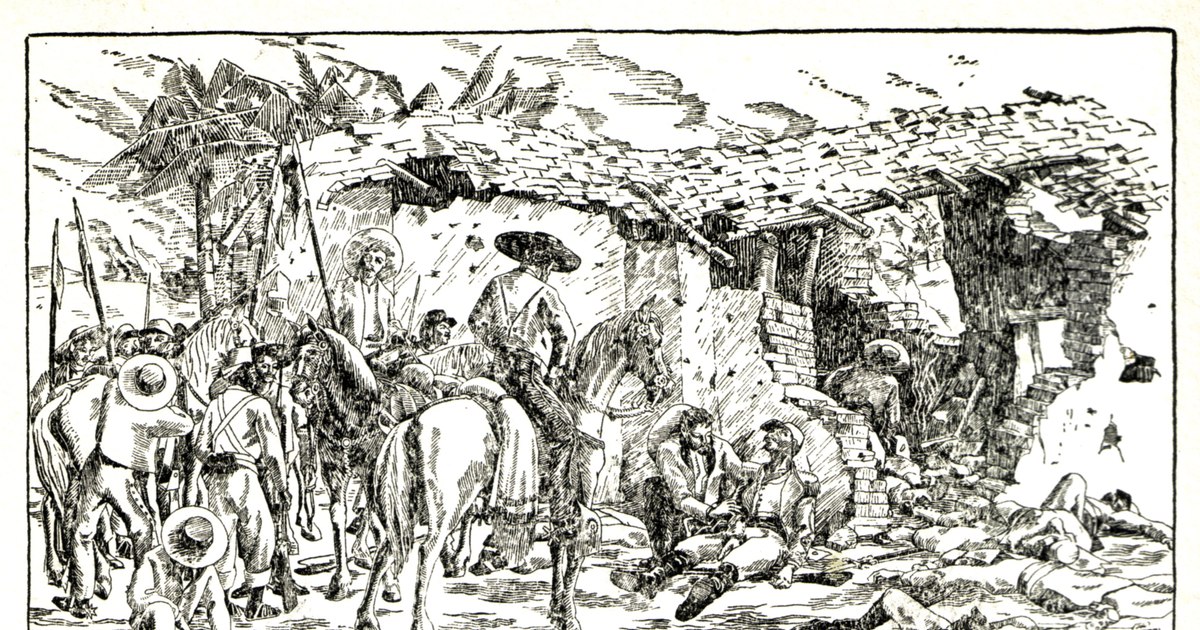
Battle of Camaron PHOTO wikipedia
The Battle of Thermopylae in 480 BC, fought during the second Persian invasion of Greece led by Xerxes I, has remained as an absolute symbol of heroism and extreme courage against the odds. Around 300 brave Spartans, led by King Leonidas I, and a Greek force of around 7000 men blocked the Thermopylae pass to stop the Persian army from advancing into Greece. In the face of thousands of enemies, as the stories say, only 300 Spartans remained who fought to the last man.
However, there are still a few “Thermopiles” in history. Including a battle in which the ratio of forces was so great, and the heroism of the combatants so impressive, that it is said that the bravery and courage of Leonidas' Spartans was finally equalled. It is about the battle of Camarón, in the territory of today's Mexico. The event took place on April 30, 1863, during the French intervention in Mexico, when a small detachment of the French Foreign Legion heroically resisted, for more than 12 hours, in front of an overwhelmingly numerical enemy. More specifically, around 60 Foreign Legion soldiers withstood a Mexican army of several thousand soldiers.
A country drowned in blood and the dreams of Napoleon's grandson
It all started with the colonial dreams of Napoleon III, the grandson of the famous Napoleon Bonaparte. Napoleon III had proclaimed himself emperor, and France had once again become an empire, this time rather colonial. Imperial ambitions made Napoleon III dream of conquests, like his famous uncle. Central America and especially Mexico began to tempt Napoleon III.
And the reasons were simple. Mexico had just emerged from a devastating war with the Americans, but was also plagued by civil convulsions. The Mexican-American War (1846–1848) was an armed conflict triggered by the annexation of Texas by the US in 1845, but also by territorial disputes over borders. The US invaded Mexico, scoring a quick victory that led to the Treaty of Guadalupe Hidalgo. Through this treaty, Mexico lost about 55% of its territory (including California, Nevada, Utah, Arizona, and New Mexico), receiving $15 million in return.
But the country was in chaos and bankrupt after years of civil war. In 1861, President Benito Juárez suspended the payment of debts to the European powers: France, Spain and Great Britain. Immediately, all these great colonial powers set out to seize, each, Mexican territories on account of the debt. Napoleon III had even bigger plans: he wanted to conquer Mexico and establish a satellite Catholic empire in Latin America to counterbalance the growing influence of the United States. In addition, it was also about access to the mining resources of Mexico, but also about the desire to establish new markets for French products.
Initially, the forces of the three great creditor powers landed in Veracruz. When the Spanish and British realized that Napoleon III didn't just want the money, he wanted to conquer the country, they withdrew. The campaign got off to a bad start for the French. In the Battle of Puebla on May 5, 1862, the Mexicans won a surprising victory against the much better equipped French troops. Encouraged, the Mexican armies begin a counteroffensive against the French troops. In this context the battle of Camarón takes place.
A ruined village in eastern Mexico and a band of elite soldiers
In the spring of 1863, Camarón was an embittered village in eastern Mexico on the yellow fever-haunted road from Veracruz to Puebla. In Puebla was the French army, which was trying to recover from the defeat of the previous year. Napoleon III was certain of victory and had asked Maximilian, a prince of the Habsburg family, to prepare to take the throne of Mexico as puppet king of France. The troops of the French Foreign Legion, an elite army founded in 1831, made up of soldiers from all over Europe, had also come to Mexico with Napoleon III. They were extremely well trained.
The Foreign Legion was tasked with protecting the road from Veracruz to Puebla, vital for supplying the French army. The road was in deplorable condition, so that a convoy could advance only 13–16 kilometers per day, and the settlements along the route were hotbeds of disease. Only the soldiers of the Foreign Legion, very well trained physically and, above all, mentally, could face such a mission. The heat was stifling, Mexican raids frequent and violent, and malaria, dysentery, and yellow fever ravaged.
One night in late April 1863, an Indian spy brought word to Colonel Pierre Jeanningros that the next supply convoy for the French army was to be attacked by Mexican troops. Jeanningros could not deploy his unit, affected by the diseases that haunted the area, so he sends Captain Jean Danjou, a very experienced military man, seconded by Napoléon Vilain, but also by the veteran Clément Maudet, to escort the supply convoy to Puebla. Danjou and his two seconds commanded 62 non-commissioned officers and soldiers from all over Europe. Among them were Belgians, Swiss, Germans, French, Poles, Dutch and Danes. It was typical Legion company, united by a legendary loyalty to the unit from which they came, but also to each other.
The story of the legendary Apache Geronimo, the last Indian to surrender to the Americans: 5,000 soldiers were sent on his trail
Shortly after midnight on April 30, Danjou and his men set out on the “fever road” from Veracruz to Puebla to escort the convoy, passing through a series of forgotten villages without encountering the enemy. The company finally arrived at Camarón, a deserted village. Here, Danjou ordered a halt to stock up on water. Then the men on guard saw the enemy: there were several units of Mexican cavalry. Danjou realized that it was only the vanguard.
A Thermopylae of Mexico and the 65 who entered the legend
Danjou ordered a retreat to Camarón to cover the road so vital to the French army. The Mexican cavalry charged. Disciplined, the French legionnaires formed a square. A murderous volley ensued, and men and horses fell like reapers. Another attack, another volley, more dead – only from the Mexican camp. However, Danjou knew that he could not withstand the cavalry attacks for long, especially since there were already hundreds of enemies. He ordered the retreat to Camarón.
The 65 legionnaires took shelter near a dilapidated “hacienda” (Mexican farm). They chose that place because they were protected by a wall almost three meters high. In addition, the construction had two gates that could be easily defended. Danjou quickly deployed his men around windows, through openings, and anywhere that could become a firing point. In Danjou's troop there were people with special experience in war, people who knew this craft well.
“Danjou's company was a fascinating mixture of destinies. Corporal Évariste Berg had once been an officer and decorated with the Legion of Honor, but had been kicked out of the army for disciplinary offences. He had later enlisted in the Legion, which did not value people's pasts. Louis Maine, a veteran of the Crimean War and himself decorated, had given up his sergeant's rank to enlist as a mere legionnaire. Sergeant Vincent Morzycki, a veteran of campaigns in Italy, he was the son of a French mother and a Polish officer. Thus prepared and sheltered in their little makeshift fortress, Danjou's men were on the verge of a confrontation that would go down in legend.”stated Robert Barr Smith in “Battle of Camarón: Legendary Last Stand of the French Foreign Legion“from the Warfare History Network.
Immediately, the 65 legionnaires saw the size of the Mexican army: there were over 3,200 soldiers from the regular army. An almost impossible situation, in front of which anyone would have surrendered. Not the soldiers Foreign Legion. Although they ran out of water and extra ammunition (as the supply mules took fright and fled), the legionnaires began to fight with characteristic discipline and precision. The Mexican fire was deadly, but Danjou's men responded with great calm and accurate fire. The bullet and the victim.
“Each legionnaire was left with only the 60 rounds in his magazine. The situation was aggravated by the lack of water, which disappeared with the frightened animals. There was no source in the enclosure where they had taken shelter, and the thirst would become an almost unbearable torture. For the wounded it was downright terrible; by the end of the day, some would end up licking their own blood to moisten their lips”stated Barr Smith in the same material.
That morning, Francisco Milán, the Mexican commander, offered the legionnaires a chance to surrender. Danjou refused even though the people were suffering and already had great losses. “Legionnaires die better than any other people in the world”he would have said. In the end, Danjou was killed after taking a bullet directly to the chest. Vilain took command of the remaining 40 men and continued the fight.
The Frenchman with Corsican blood who wrote Romania's destiny. He led an adventurous life and turned France into a European superpower
“These are not humans, they are demons”
Vilain refused another offer of surrender. The remaining legionnaires were wreaking havoc among the Mexicans. It was an incredible situation: 65 people stood up to several thousand for more than 10 hours. After lunch time, another 1000 Mexican soldiers came. It was clear that the legionnaires' fate was sealed. But no one was giving up the fight. Vilain was also shot. Almost all the legionnaires were wounded, and the barrels of the rifles had become so hot that they could no longer be touched.
The heat was suffocating, the wounded were dying, and one by one the survivors were falling into the dust. Those who could still fight took the cartridges from the dead and wounded and continued to fire, holding the attackers in place and felling them by the dozens. “The heat oppressed us, the sun reflected off the white walls of the courtyard and blinded us. When we opened our mouths to breathe, it felt like we were inhaling fire”the legionnaire Louis Maine testified.
After a stubborn resistance of almost 12 hours, almost all the legionnaires were killed. Only five remained, including Corporal Maine. They only had one cartridge each. They opened fire, fixed their bayonets, and charged toward the crowd of Mexican soldiers. They were shot, but three of them survived their injuries. They were spared thanks to a colonel in the Mexican army who intervened on their behalf.
The 65 French legionnaires put down no less than 800 Mexicans. That's about 12 men for every legionnaire. “These are not humans, they are demons!”would have exclaimed Francisco Milán, the commander of the Mexican troops.