The spectacular robbery at the Louvre, estimated at more than 100 million dollars, was allegedly committed not by an international organized crime network, but by neighborhood thieves in northern Paris, according to the capital's prosecutor, Laure Beccuau.
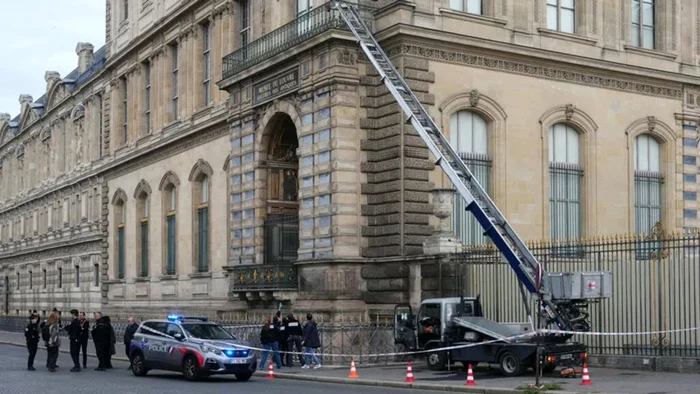
The balcony where the thieves broke into the Louvre/PHOTO:X
“We're not talking about everyday crime, but we're not talking about sophisticated gangs either. It's classic crime, not highly organized.” said Beccuau for franceinfo, quoted by Reuters.
The suspects live in Saint-Denis, one of the poorest Parisian suburbs. Details published in the French press confirm the amateurishness of the operation: the thieves would have lost the most valuable piece during the escape – the crown of Empress Eugénie -, they abandoned tools and clothes at the scene of the crime and did not even set fire to the truck used in the robbery, a common practice among professional gangs.
The incident occurred on Sunday morning, October 19. In less than seven minutes, two men parked a lift near the museum, climbed to the second floor, smashed a window, cut the display cases with angle grinders and fled with eight Napoleonic-era jewels on scooters driven by accomplices. Four people were arrested, but the stolen items were not recovered.
The museum's director, Laurence des Cars, admitted to the French Senate that “the Louvre has failed to properly protect” the royal pieces. An internal investigation revealed that the only video camera facing the balcony used by the thieves was incorrectly mounted, and a third of the rooms in the Denon wing had no video surveillance at all. Budget cuts and staff shortages in recent years have weakened the security system, Des Cars said, promising a broad overhaul of it.
A 50-year-old geometry problem can prevent robberies
Behind this dilemma lies a surprisingly simple question, first posed in 1973: What is the minimum number of 360-degree CCTV cameras or guards needed to fully monitor a museum?
It's what mathematicians call the “museum problem” or the “art gallery problem,” the BBC reports.
Imagine that the floor plan of the museum is a geometric shape with straight walls—a polygon. The cameras are fixed, but can “see” in all directions. The goal is for any point in the museum to be visible from at least one room.
If the museum is in the shape of a hexagon, one room is enough. If it is “L” shaped, positioning becomes more difficult, but still a single camera can cover everything. For a “Z” shaped museum, two are needed.
For more complicated shapes, things become less intuitive. In the 1970s, the mathematician Václav Chvátal found the general solution:
“The minimum number of rooms required is equal to the number of corners of the museum divided by three.”
For example, a hall with 15 corners needs at most five rooms. If the result is not an integer, it is rounded down.
A few years later, in 1978, the American professor Steve Fisk elegantly proved this theorem. His method, called triangulation and three-color coloring, involves dividing the space into triangles and identifying the most effective placement points for the cameras.
The result? Full coverage can be achieved with a minimum number of cameras, regardless of the complexity of the shape.
Lessons for modern museums
For a museum like the Louvre — made up mostly of rectangular rooms — the solution is even simpler: a single room can completely cover a room.
Des Cars also admitted that the outer perimeter of the museum is not fully monitored either: “We did not detect the arrival of the thieves in time. The weakness of our external protection system is well known,” she said.
Mathematics, however, also offers a variant for the outside: the fortress problem or the prison problem, which calculates the optimal positions for the cameras that must monitor the walls outside.
Regardless of the model, the essence is the same — finding the perfect angles for full visibility.
In other words, if a gallery has 15 corners, five strategically placed cameras can cover the entire area, regardless of the complexity of the shape.
The geometry problem behind this rule is based on dividing the museum floor into triangles and coloring the corners in three different colors – a method called “tricoloring”. By choosing one of the three colors and placing cameras only in the respective corners, complete coverage of the space is achieved.
For example:
-A rectangular hall (4 corners) needs only one room.
-An “L” shaped gallery needs two rooms.
-A museum with 15 corners needs five rooms, according to Chvátal's theorem.
This simple model is used today not only in museum architecture, but also in urban planning, in the positioning of surveillance drones, pollution sensors or even in computer vision algorithms.
For museums like the Louvre, which combine wings built over five centuries and dozens of different architectural plans, applying the theory would require complete digital mapping of the spaces—an expensive but crucial process.
“Every uncovered room is a blind spot,” says Sorbonne professor of applied mathematics Alain Fréchet. “In a museum like the Louvre, a single blind spot can be worth $100 million.”
Lessons after the Louvre robbery
The French Ministry of Culture has already announced a national plan to reassess security systems in major museums. But in the long run, the solution could come from mathematics: algorithms inspired by the “art gallery problem” are already being used by some institutions to automatically calculate the most efficient camera positions.
While the missing jewels remain unaccounted for, the Louvre case could bring about a paradigm shift—one in which art and science collaborate to protect the world's cultural heritage.