The history of this exhibition began in the North Czech Republic, on the border with Germany. Five years ago, the artist Erika Bornov and her husband, painter Tomas Cisarovsky, bought a hut in the so -called Valucinian Cypl. The new owner was particularly impressed genius loci related to the dark history of the old Sudetenland. “I had the impression that I wasn't alone in this cottage.” I still saw the shadow of a little girl who could be 14 or 15 years old – recalls the artist. “It may sound ghostly, but I wouldn't think of her, she really appeared before me.”
Thanks to the local chronicle Bornova found out who lived in the house before the post -war displacement of German -speaking owners. It turned out that the family belonged to the girl, after whom there were tangible marks in a brick cottage and her name in the documents. Now he appears in the title of the exhibition of a 61-year-old artist at Galeria Vaclava Spała in Prague, entitled “Shadows of the hot summer of Traudi Schoenfeld”.
We don't know what Traudi looked like. No photo survived, and the trace of her was lost in 1945, when her anti -fascist parents were deported to the east of Germany and she went west. One of the few known details from her life is her belonging to the German relationship of girls (BDM)which, like the boyish Hitlerjugend, from 1932 was the child's arm of the Nazi NSDAP party.
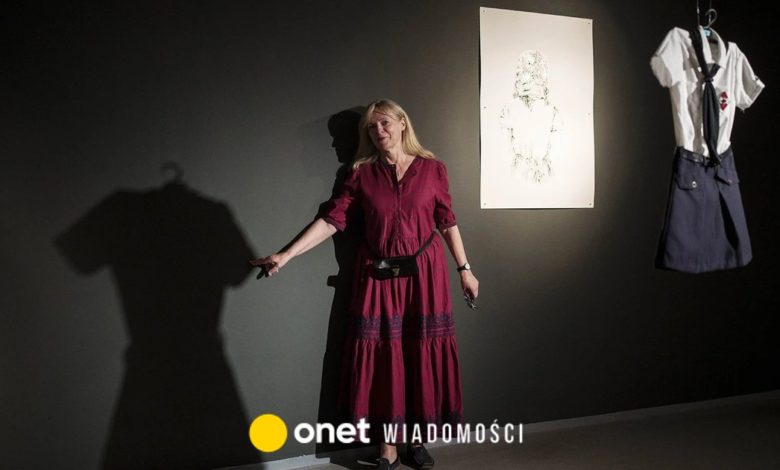
The BDM uniform with a blue skirt, a white shirt and a black scarf is currently hanging in the basement of Galeria Spala. Bornov reconstructed him on the basis of era photos and surrounded it with images of things that little Traudi once touched at home.
The author found most of the items in the basement. They were covered with dust and mold. She immortalized them with the original technique of painting with black sand on paper and She added imaginary portraits of long -haired traudi as she imagined her. – The sand refers to saying “you are dust and you will turn dust.” If I did not use the binder on paper, with time the sand would fall apart, as our memories gradually fade – he explains.
Erika, or German heather
The Schoenfeld House is currently on the edge of the village, where almost 1,000 people lived before the war. Today, even one tenth of that number does not live here, and Most residents come here only occasionally for recreational purposes from Prague. One of them is a musician with the nickname Vladimir 518, whom Erika Bornov asked to arrange for her the infamous Nazi march to her name.
Continued article under video material
The song “Erika” was ordered by Wehrmacht in 1938 and according to experts She was probably the most popular march in the armies during World War II. He talks about a small flowering flower, Erice, surrounded by thousands of bees, which a soldier observes on the way to the battle. His girlfriend, who is the same name, is waiting for him at home. In Czech and Polish this is not a clear association, but “Erika” in German means heather.
The march, converted by Vladimir 518 into a dance version, is currently resounding in the upper rooms of Galeria Spała. He supports the audience in a journey between paintings and other souvenirs related to the prompt prompt. – This place has great power. It is semi -secluded, nothing can be seen in the distance. While in Prague in my block I am surrounded by at most fish, I am fascinated by many animals in the hut that constantly appear there – explains Bornova. Many of these animals immortalize in their drawings and paintings.
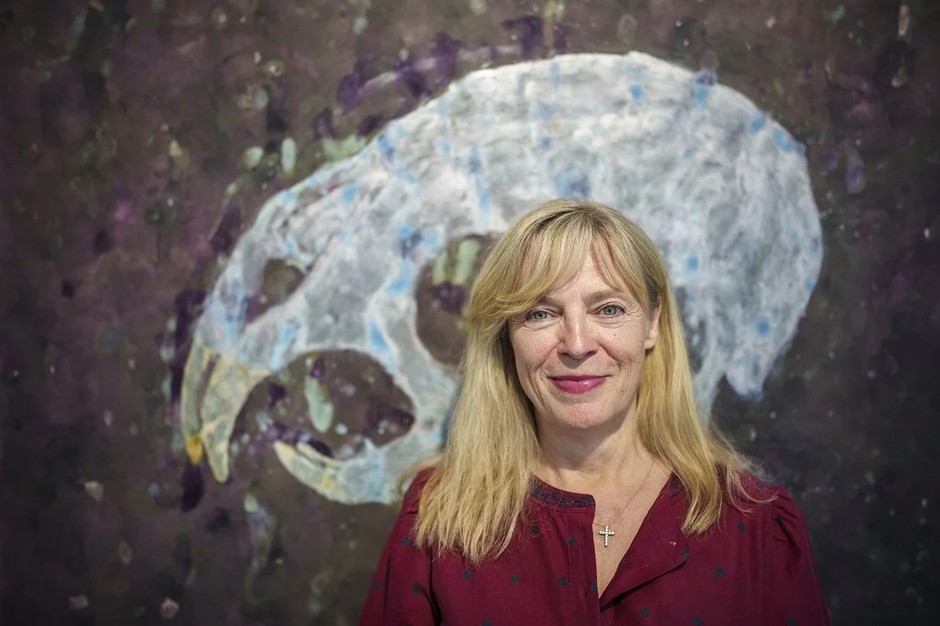
Erika Bornov against the background of her workSource: Respect / Milan Jaros
As a sculptor, she has been known in the Czech Republic for at least 30 years. She became famous for sculptures in polystyrene, in which she ironically commented on the present and the past. This changed diametrically just before Pandemia, when while working with the blindly white material she burst into her eye, and she was temporarily blind. Even after a few years, he cannot fully focus his eyes, which would be risky when working with a sharp chisel. That is why she switched to painting. The current exhibition is the first in many decades, where we will not find a single sculpture.
Tick for two and a half meters
There were many unusual images at the exhibition. These are mainly large formats on paper, to which Erika Bornov uses pastels, acrylics, sand, as well as special paints with crushed pearl that they give The effect is similar to the one when the flying insect flutters with wings, which for a while flash in a strange flash against the sun. The subject of many works are animals that the artist either sees directly in the house, or finds their remains in his surroundings. The mouse skeleton, deer skull, the jacket egg and many strange insects are present.
The artist loved underwater animals, whose wild shapes she found in the encyclopedias and documentary films. – Now I only paint what is alive. I have always had some disgust for spiders, all these spreading skeletons and similar natural attributes. But finally I found a great beauty in them. I love to touch them and feel comfortable with them, it's pure delight – explains Erika Born her life turn.
Scenes with gold buzzles, crickets with long teeth, caterpillars of willow yellow and classic tick, which she pulled out of her own leg, document this best. His portrait is 2.5 m wide And, like other large -format images, the artist painted him sitting, with paper arranged on the floor.
The immersion in the kingdom of insects finally reconciled Bornova with the inhabitants of her basement, to which she was first afraid to enter. The front wall behind the entrance to the gallery is decorated with a portrait of a dark spider with a cocoon, a When the author begins to talk about a spider, it's like she was talking about a good good friend: – This mother's mother is responsible for three cocoons, with five eggs in each. You enter the basement, where there are maybe 50 such cocoons. And you know that more spiders will hatch from them. It's just fascinating for me.
The last part of the exhibition includes small work on handmade Himalayan paper, always in a different color. Bornova captured, for example, a mosquito apparatus, which she watched under a magnifying glass.
Nature and history
He tries to be very accurate in all his portraits of animals. – I imagine various things, but I want to be faithful to this place. Many animals appear there again, despite the fact that experts say that they should not be there anymore – says the author, who, incidentally, has a dog bark as a cell phone. The exhibition was organized together with the curator Radek Wohlmuth. He himself comes from the Sudetes and was born in Cheb, in the Western Czech Republic. The key to her new works is “the hidden beauty of the timetable. And really It doesn't matter if these are the remains of things and bodies or the breakup of history“.
History also dramatically swept through the family of Erika Bornova. Her father, a popular painter and cartoonist Adolf Born, was born before the war in Velenice, where the border with Austria ran at the time, and the local residents – including the Born family – who speak German, called them Gmend. The artist has Jewish roots on the side of her mother, and her great -grandfather was one of Auschwitz's countless victims.
– At first I didn't want this house. But when, thanks to painting and drawing, I got to know the nature there, a kind of “semi -dryness”, I completely succumbed to its charm. You stare at the greenery for a long time, you meditate and suddenly Traudi appears in front of you. I actually returned to my own childhood – sums up the author, adding that I feel sorry for people who once built similar farms on the border and had to leave them overnight.
With his exhibition, which some consider to be cheerful, and others as a depressing, tries to recall their memory. – I tried to capture witnesses of their forgotten history. Traudi could experience these animals. And now, a few generations later, I experience them too – he says.
I’m Ashley Davis as an editor, I’m committed to upholding the highest standards of integrity and accuracy in every piece we publish. My work is driven by curiosity, a passion for truth, and a belief that journalism plays a crucial role in shaping public discourse. I strive to tell stories that not only inform but also inspire action and conversation.