How two large egg cases fell out of the net without you noticing. How much is 100 lei still worth in 2025

Eggs. Photo: Onion | Dreamstime.com
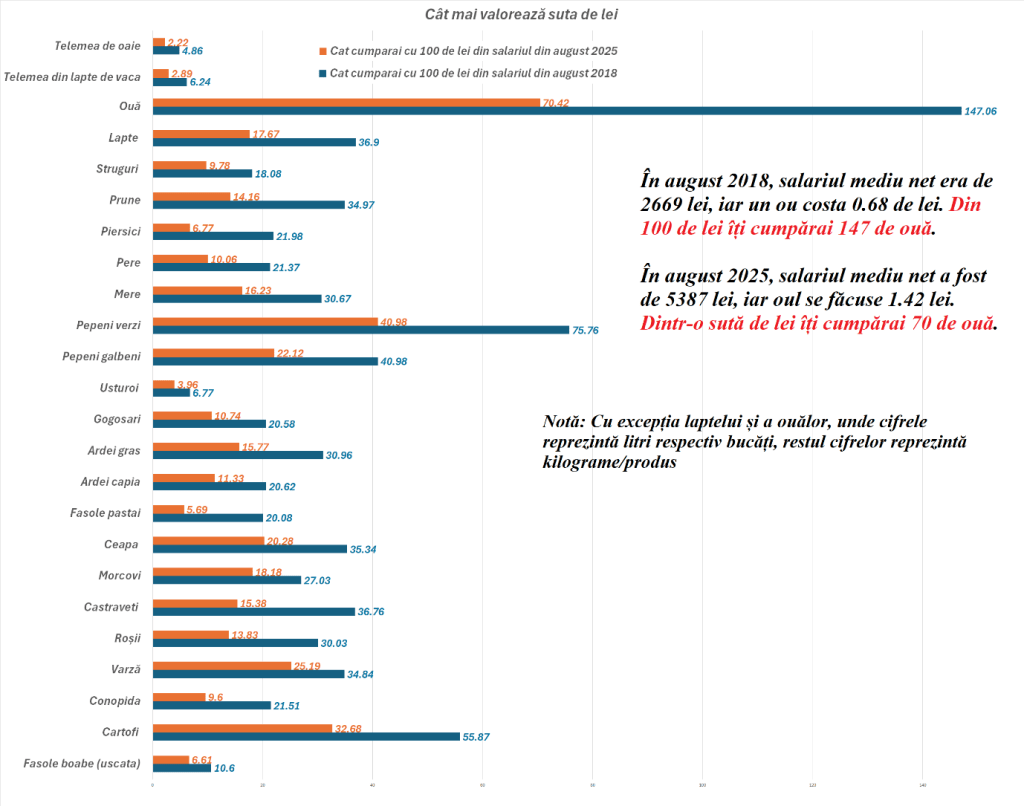
Seven years ago, a hundred lei had a completely different power. In August 2018, 100 lei could buy 147 eggs. In August 2025, with a double salary, you can no longer take even half: 70 eggs.
Inflation doubled incomes but significantly eroded the value of money in the wallet. The data published by Staistica clearly shows that, despite the increase in the average net salary from 2,669 lei in August 2018, to 5,387 lei in August 2025, the purchasing power for basic food has decreased.
A double salary, a half purchase
“Fridge inflation” compares how many kilograms or pieces of food you could buy in 2018 and in 2025 from one hundred lei of the average net salary.
The result is clear: almost all basic foods have risen in price faster than wages have risen.
In 2018, with 100 lei Romanians could buy:
- 147 eggs
- 6.24 kg of cow's cheese
- 55.9 kg of potatoes
In 2025, the same 100 lei only bring:
- 70 eggs
- 2.9 kg of cow's cheese
- 32.7 kg of potatoes
Real purchasing power has halved for eggs and dairy, and for vegetables it has dropped by a third.
The biggest losses in purchasing power are recorded in cheeses, beans, peppers and sheep meat.
On average, 100 lei today buys 40–60% less food than in 2018.
The only category where the difference is smaller is milk, where for 100 lei you buy almost double compared to 2018 (36.9 liters compared to 17.7), but even there the quality and origin of the product matter.
Inflation “eats” wages even when it seems to be low
The annual inflation rate will reach a plateau at the end of September and will decrease very slowly in the last three months of the current year, on a higher trajectory than the one in the medium-term forecast of the NBR in August. According to the National Bank, inflation will reach 8.8% in December 2025.
“The worsening of the near-term outlook for inflation compared to the August forecast is almost entirely attributable to factors/shocks on the supply side, especially the direct effects exerted by the expiry on July 1 of the electricity price cap scheme and the increase from August 1 of the VAT rates and excise duties, which considerably propelled the dynamics of inflation upwards and beyond expectations”, according to the minutes of the discussions in the BNR board.
But food prices – which directly impact everyday life – remain high and volatile.
Even if the inflation rate falls, the price level does not return to previous values, but only rises more slowly.
That's why, from one year to the next, Romanians note that “the salary is higher, but the basket is smaller and smaller”.
Who made your food more expensive? What is hidden behind the numbers
The price increases in recent years have been fueled by several factors:
- rising energy and transportation costs;
- drought and rising prices of agricultural products;
- salary increases in the production and retail chain;
- depreciation of the leu and the effect of food imports.
In short, inflation no longer comes from one place, but from the entire economic chain.
In addition, the fiscal adjustment measures due to the grossly inadequate fiscal policies of the pre-election years were immediately priced in, with the population paying for false government largesse.
What's next
The National Bank warns that the disinflation process will be slow. Even if inflation is falling, inflationary expectations remain high – a sign that companies and the population do not expect price cuts anytime soon.
In practical terms, 2025 remains a year of high prices and low wages.
Romanians no longer feel the economic growth in their wallets, but only read the “net average salary gain” column in the Statistics releases.