He is “Trump's worst nightmare.” He can become mayor of New York


The candidacy has historical significance in a city that is home to almost 900,000 people. Muslims. For many of them, Mamdani's promotion means a chance to prove that Muslim New Yorkers are at the center of civic life. For the candidate's critics, it has become a flashpoint — a test of how religion, race and ideology collide in an era of growing polarization.
“I feel excited to win in a city where every New Yorker's affiliation is unquestionable,” Mamdani said last week. “This also applies to Muslim New Yorkers.”
They are intensifying again across the country prejudice against Muslimsand Mamdani's campaign comes against the backdrop of a renewed global backlash against immigrants and Muslim communities. In New York, where the effects of the trauma of 9/11 are still felt, the candidacy has become a mirror of the city's contradictions – celebrated as a sign of progress and used as a source of fear.
The fact that a young Muslim – born in Uganda, of Indian descent and with an unusual name – can be elected in the current political climate is seen by many as a sign of hope.
The candidate remains the favorite in the mayoral race, with a double-digit lead in every poll over his closest rival, former Gov. Andrew Cuomo. However, as with all firsts, if he wins on November 4, he will have to face the pressure and expectations of those with a similar background.
Targeted by enemies
Mamdani's critics call him an extremist. He is a far-left member of his party who has repeatedly called for a reduction in police funding, introduced a bill to decriminalize prostitution and was part of a protest movement that sought to completely abolish prisons in New York.
This is what happens criticism of Israelincluding support for the Boycott, Divestment, Sanctions movement, and a bill to remove tax-exempt status from charities operating in Israeli settlements.
The article continues below the video
Mamdani took this to the streets many times, joining and leading pro-Palestinian marches and actions. He was arrested during a civil protest outside the home of Senate Minority Leader Chuck Schumer as part of a protest calling for a ceasefire days after Hamas' attack on Israel on October 7. These actions have led enemies to view Mamdani as someone who at least condones Hamas's extremism without immediately, harshly and unequivocally condemning it.
Some of Mamdani's opponents have exploited his leftist political views and faith in an attempt to link him to ultraconservative, extremist Muslim ideology.
Throughout the campaign, social media was flooded with posts suggesting that Mamdani would commit or at least allow a terrorist attack. House member Andy Ogles wrote on X on October 27 that Mamdani should be “sent back to Uganda” because “he came to America for one reason: to transform America into an Islamic theocracy.”
The statement ignores the fact that the state lawmaker immigrated to the United States with his parents at the age of 7.
Identity in the campaign
Mamdani also met with attacks at the local level. Months after Republican candidate Curtis Sliwa appealed on Fox News to his party to “leave religion alone,” he stood on the debate stage and claimed that Mamdani supported “global jihad.”
Images of falling towers on social media and TV ads with the words “global jihad” written on Mamdani's face are intended to shock and provoke. Supporters of the Democratic candidate see this pure, unfiltered Islamophobia and an attempt to link Mamdani to an aggressive and conservative movement solely on the basis of his religion. The creators of this content and their defenders believe that all efforts to stop Mamdani are justified.
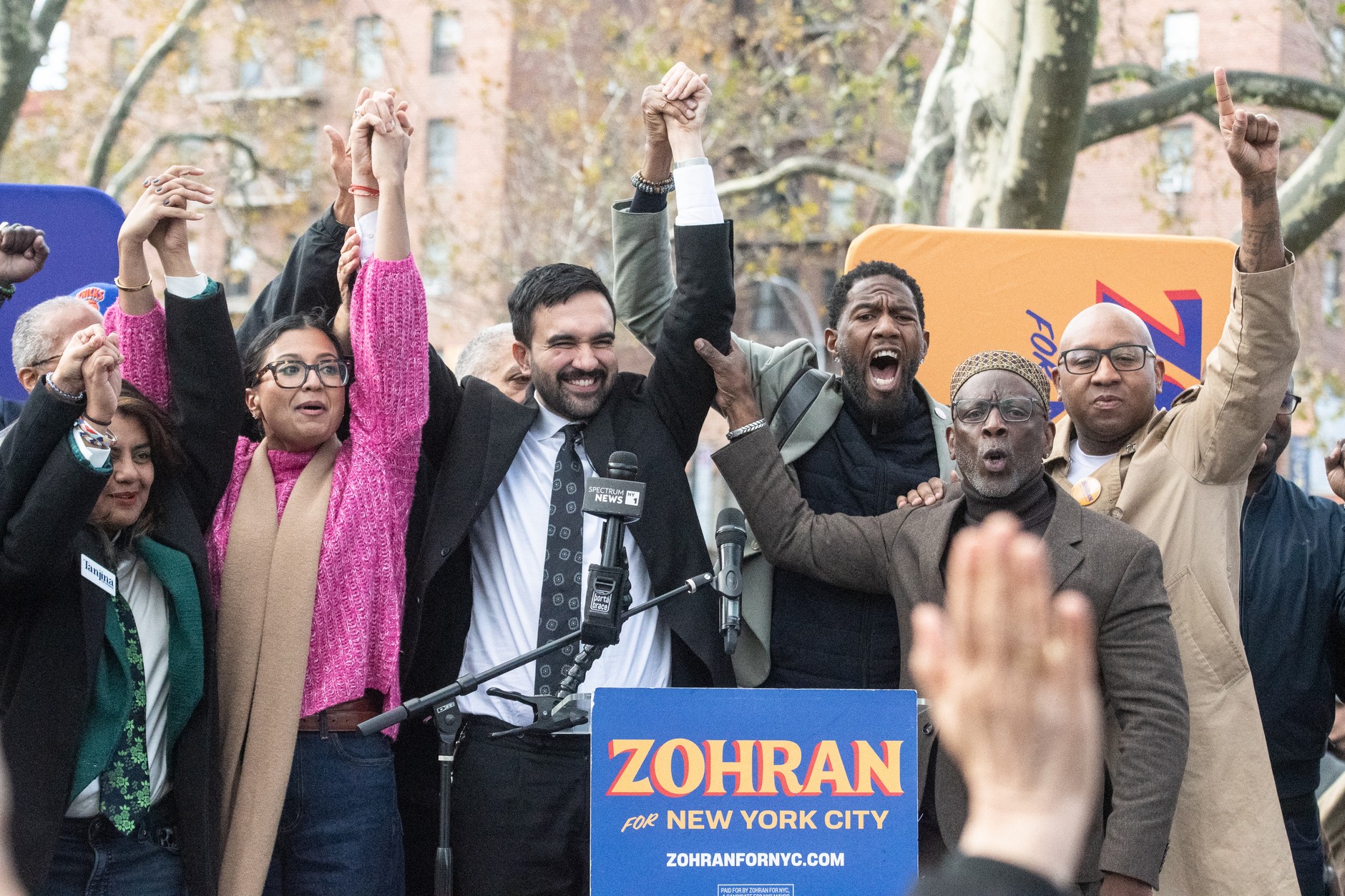
Zohran Mamdani during a rally, New York, November 1, 2025.Stephanie Keith / AFP
Mamdani, 34, was born in Uganda and has Indian roots. His father is Muslim and his mother is Hindu, but he was raised in his father's religion and has embraced and promoted this identity throughout his life. He founded a chapter of Students for Justice in Palestine on his university campus, and pro-Palestinian activism remains a cornerstone of his politics.
Mamdani favored jackets over suits during his state assembly election campaign and posed in South Asian attire in his official campaign photo. Since then, he wears almost exclusively a suit and tie on the election campaign, but still uses Arabic interjections such as “inshallah” and “God willing” in interviews.
Mamdani often drove campaign in mosques — according to a spokesman, he visited 60 of them during the campaign — usually stopping every Friday for traditional services and gradually rising from almost total anonymity throughout the city to the status of a bona fide Muslim celebrity.
However, when it comes to origins, caution prevailed in the campaign. His spokesmen declined repeated requests for an interview about his Muslim identity.
Republicans are grasping at everything
Cuomo's accusations that Mamdani is a “fanatic,” a “radical” and an “extremist,” as he said at an October rally in solidarity with Israel, could easily be interpreted as implying guilt by association.
Although Mamdani did not initially condemn the term “globalization of the intifada”, he has since stated that he does not use the phrase and discourages its use. He was interviewed by left-wing streamer and activist Hasan Piker, a Muslim who stated in a 2019 television program that “America deserved 9/11.” Mamdani called the remark “objectionable and condemnable.” Piker later said it was “inappropriate.”
Mamdani campaigned at Imam Siraj Wahhaj's mosque, which was attended by several worshipers linked to the first attack on the World Trade Center in 1993. Wahhaj was not charged in the case but was considered a potential inadvisable co-conspirator, a designation later criticized as too broad a designation.
Cuomo used all of this to reinforce his narrative that Mamdani is too radical. “He should be ashamed of himself. He had plenty of opportunities to make amends,” Cuomo said at the rally. “We fundamentally dislike the idea that the mayor of New York would be a divisive force.”
Ahead of the primaries, Mamdani ridiculed Islamophobic criticism in a video posted on social media: No, his campaign bandanas weren't hijabs — after all, they had drawings of hot dogs on them. But as Election Day approached, his tone became more serious when it came to faith. After Cuomo suggested that Mamdani would rejoice in another 9/11, the state legislator from Queens held a news conference outside a mosque in the South Bronx, where he deplored attacks on Muslims and promised not to hide his identity. The video of the speech has been viewed 25 million times.
“There are 12 days left until Election Day. For these 12 days and every day thereafter, I will be a Muslim in New York,” he said. “I won't change who I am, how I eat or the faith I am proud of.”.
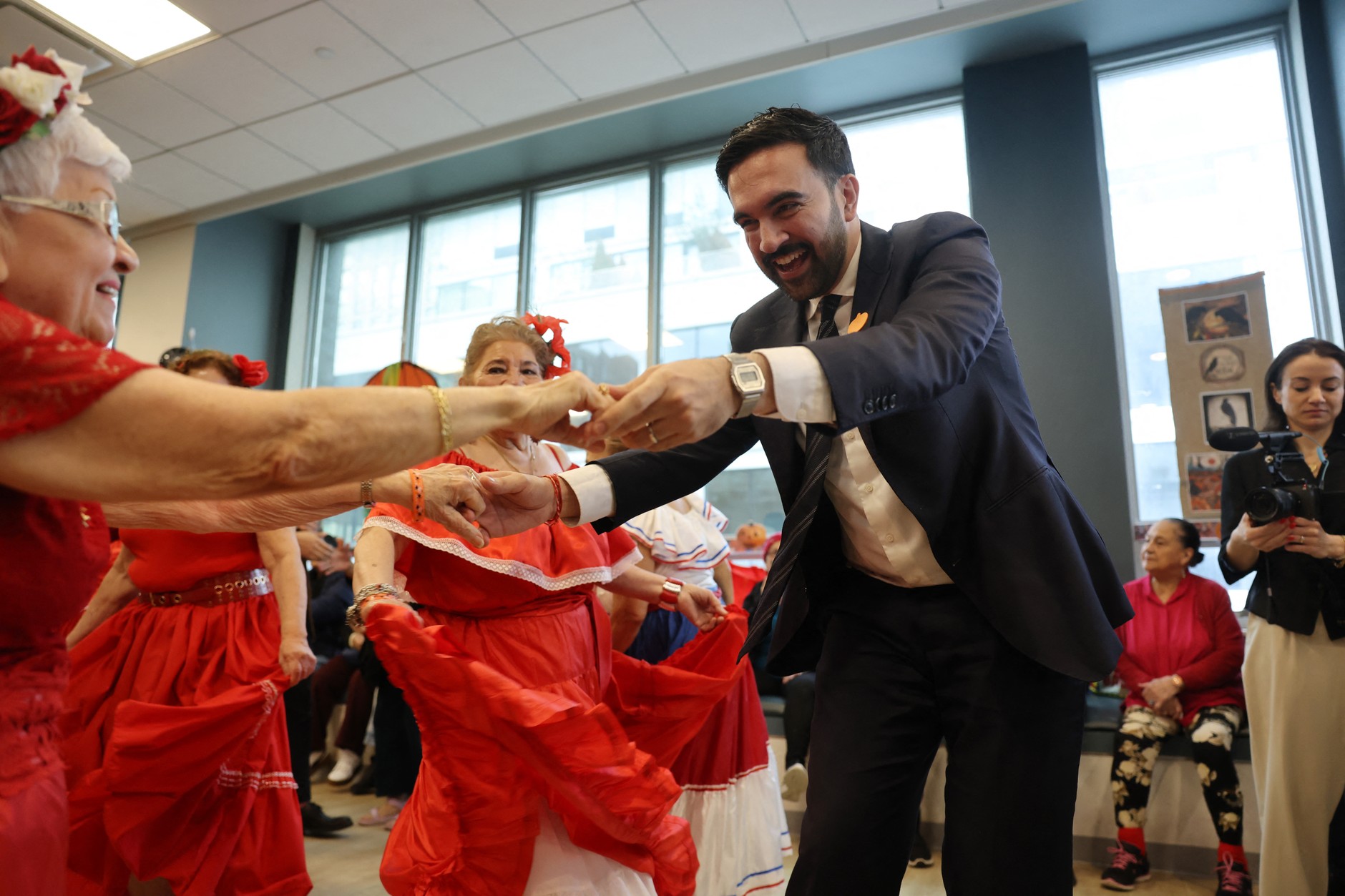
Zohran Mamdani visits a community center for the elderly, New York, October 31, 2025.SPENCER PLATT / AFP
“I am Donald Trump's worst nightmare”
But lingering feelings about the September 11 terrorist attacks have complicated this message. Mamdani's attempt to humanize what many Muslims experienced in New York after 9/11 was undermined by political opponents, including J.D. Vance. The US vice president focused on an anecdote about a relative of Mamdani, whom he initially described as his aunt. “According to Zohran, the real victim of 9/11 was his aunt, who received (supposedly) unfavorable looks,” Vance wrote on X.
When internet sleuths discovered that his father's sister did not wear a hijab, Mamdani clarified that he was referring to his father's cousin — a relatively minor detail that nonetheless sent his critics into a frenzy.
Cuomo also criticized Mamdani for his statements about Islamophobia, arguing that it is a “poison” that “tries to pit people against each other.” During Thursday's press conference, he even stated that “Islamophobia has no place in this election campaign, has no place in this context.” His supporters joined this opinion.
Will the winner unite society or fuel divisions? Mamdani would be the city's first Muslim mayor, first South Asian mayor and first African-born mayor.
The candidate used his identity as an advantage. Both he and his supporters are happy that he is in office contrast with traditional centers of power. “I am Donald Trump's worst nightmare as a progressive Muslim immigrant who actually fights for the things I believe in,” Mamdani said during the primary debate.
However, New York was not always sympathetic to its pioneering mayors. Abe Beame, the first Jewish mayor of New York, lost re-election after one term. So did David Dinkins, the first African-American mayor, and John Purroy Mitchell, the last mayor elected at age 30.
Mamdani will hope to be judged primarily on how he performed his job.