— Foreign intelligence services, such as those of Russia and Iran, are increasingly recruiting ordinary European citizens to conduct espionage and sabotage activities, says Youssef Ait Daoud, director of intelligence and domestic threats at the Dutch Investigations and Special Operations Unit.
The authorities are currently hunting down ordinary, unremarkable civilians. These people, often recruited online, are promised money. Sometimes they are simply tempted by the thrill of the mission.
However, orders no longer require professional intelligence officers. The change in the operation of Russian services indicates a new, key threat.
Ait Daoud says the use of civilian recruits reflects a broader change in the way foreign intelligence services conduct operations. It complicates efforts to counteract hostile services.
— Until recently, activities were carried out mainly by the intelligence services themselves, adds Ait Daoud. “What we are now seeing is that citizens, whether for pay, adventure or other reasons, are volunteering for such assignments.” Ait Daoud describes the method of operation of foreign services as “crime as a service”.
“It's not like that [agenci wrogich państw] they leave a note [potencjalny zleceniobiorcom] with the words: 'Greetings from Russia' or 'Greetings from Iran,'” said Ait Daoud. “Sometimes it's just: 'Do you want to set something on fire for 5,000 euros?'”
The article continues below the video
Already in 2018, the Netherlands expelled four Russian military intelligence agents for trying to hack into an international chemical substances watchdog organization. However, the pace and scale of hostilities against European countries accelerated in the four years since the beginning of the war.
“The Gray Zone Between War and Peace”
Ait Daoud heads a newly formed police team tasked with enforcing the expanded Dutch anti-espionage law.
Intelligence agencies across Europe have started warning their citizens about the risks of recruitment. In September, German authorities launched a media campaign warning citizens against becoming “agents for hire”.
The Netherlands went a step further by tightening its law and creating the Ait Daouda unit to enforce it. Foreign governments need to think twice before interfering, “because now there is a whole team working to stop these efforts,” he said.
Russia typically attracts the most attention when it comes to foreign interference in Europe, but intelligence agencies also consistently warn about threats from China and Iran.
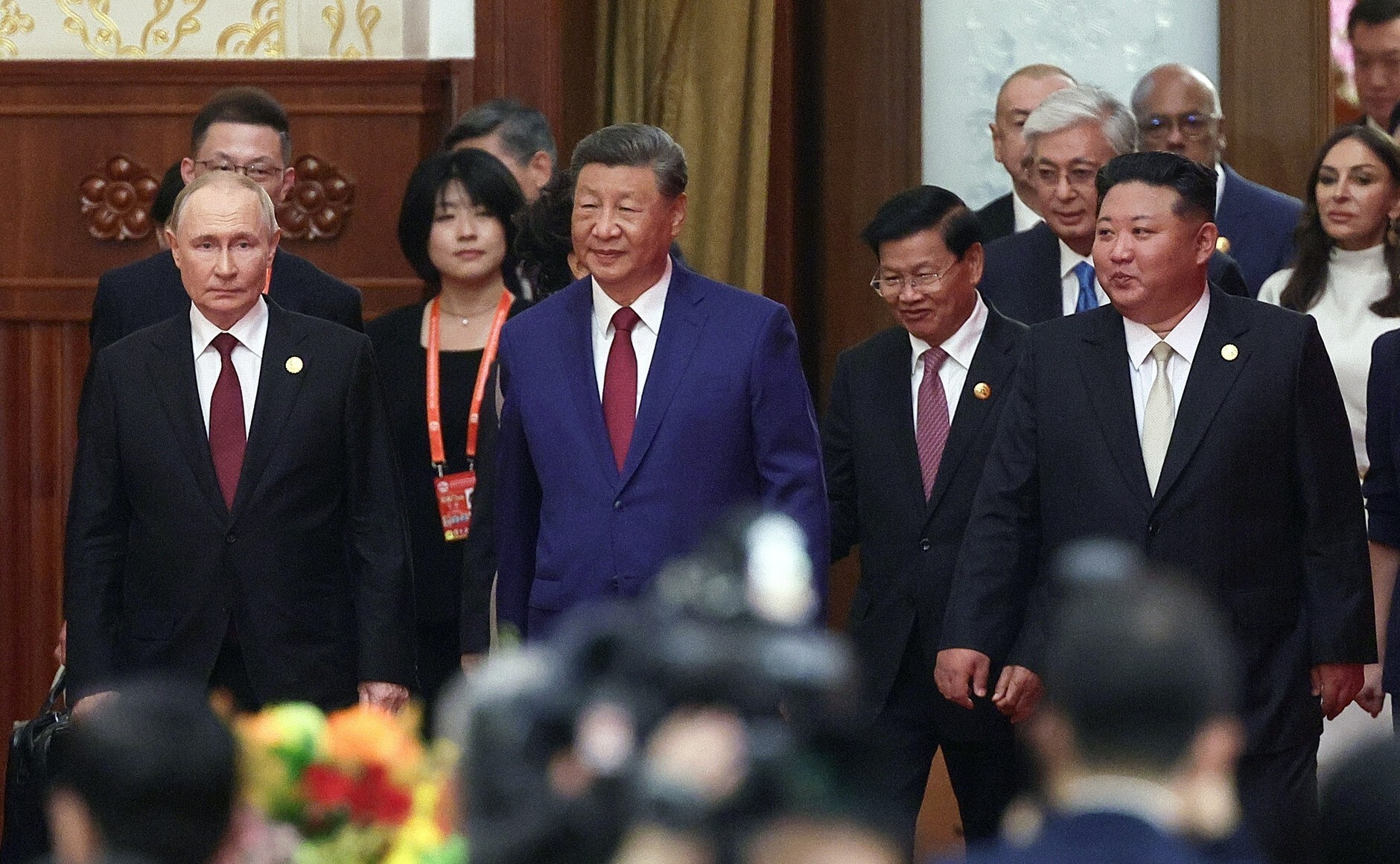
In the first row from the left – the leaders of Russia, China and North Korea: Vladimir Putin, Xi Jinping and Kim Jong Un (illustrative photo)Vladimir Smirnov / TASS/Anadolu via Getty Images / Contributor / Getty Images
When it comes to transnational repression – that is, government action against dissidents and diaspora communities abroad – the list of countries involved in Europe is even longer.
For security reasons, Ait Daoud declined to provide information on the size of the new police team. However, he revealed that it includes a specialized cybersecurity unit.
“Fighting foreign interference is more difficult than fighting terrorism,” says Ait Daoud, who spent three years at the country's counterterrorism institution before taking up his new role.
— If someone wants to commit a terrorist act, they are usually guided by ideological motives, he says. “He moves in certain circles, talks in a certain way, looks for explosives or firearms. All this is visible [dla służb kontrwywiadowczych]”.
“Nowadays, however, intelligence operations increasingly take place in the gray zone between war and peace, largely online,” he says. Intelligence and media reports point to Telegram, a popular messaging platform in Russia, as a key recruitment tool.
In September, Ait Daoud's team was involved in the arrest of three 17-year-olds accused of a Russian-led conspiracy. The young people are suspected of trying to map internet traffic around key facilities in The Hague using a device known as a “Wi-Fi sniffer”, probably commissioned by a hacking group linked to the Russian state. According to Dutch media, the targets included the Canadian embassy and the offices of Europol and Eurojust.
Ait Daoud declines to comment directly on the case, but says it illustrates a broader problem: Many of the people carrying out such operations are “not necessarily hardened criminals or professional spies.”
He adds that people aged 12 to 20 are “overrepresented” in crimes such as drug trafficking and terrorism. However, suspects of involvement in Russian hybrid war plots are often older, usually around 30 years old.
Another challenge for investigators is collecting enough evidence to obtain a conviction. Under the new Dutch Espionage Act, prosecutors must prove that the suspect knowingly acted on behalf of a foreign state.
Such a case occurred this week when a Dutch court sentenced an employee of the country's anti-terrorism agency to 20 months in prison for misappropriating state documents.
Prosecutors argued that the man was secretly spying for Morocco. They sought a 12-year prison sentence in a case that could have led to the first serious conviction under the new law.
I’m Ashley Davis as an editor, I’m committed to upholding the highest standards of integrity and accuracy in every piece we publish. My work is driven by curiosity, a passion for truth, and a belief that journalism plays a crucial role in shaping public discourse. I strive to tell stories that not only inform but also inspire action and conversation.