INTERVIEW “We risk receiving migrants from other countries and treating them as we were treated.” The warning of the Romanian writer ignored at home, but who knew fame in Spain

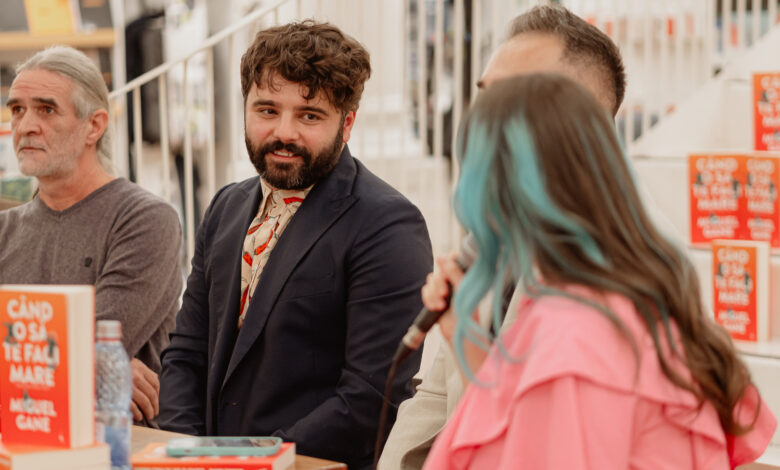
George Mihaiță Gane or Miguel Gane (32 years old) is one of the best-selling contemporary Spanish-language writers. His books of poems, sold in tens of thousands of copies, both in Spain and in Latin America, conquered people and turned the Romanian from the foothills of the Făgăraș Mountains into a real one. However, the first book translated into Romanian did not come until 2025. In an interview for the HotNews audience, Gane speaks sincerely about his life as an immigrant in Spain, about the memories he has from his childhood in Romania, but also about the disappointments that his native country brought him.
- “Nobody took notice of me from Romania,” the writer recalls a moment at the Madrid Book Fair in 2018, when he was already known in Spain, and Spaniards were queuing up to get autographs. “The people at the Romanian Cultural Institute knew about me, because I had written to them since 2015-2016, when I published. I think this moment was the one that hurt me the most,” Gane says now.
Miguel Gane's books of poems are sold in tens of thousands of copies, both in Spain and in Costa Rica, Mexico, Colombia or Argentina. He has been successful since 2016, when he published his first book of poems, “Con tal de verte vola” (“I would fly just to see you”), which has been printed in 18 editions to date.
In 2017, Miguel was nominated for the Spanish National Poetry Prize, and in 2020, his third book of poems, “La piel en los labios”, became the best-selling book of poems in Spain and spent 25 weeks on the ElCultural chart.
Ignored in Romania
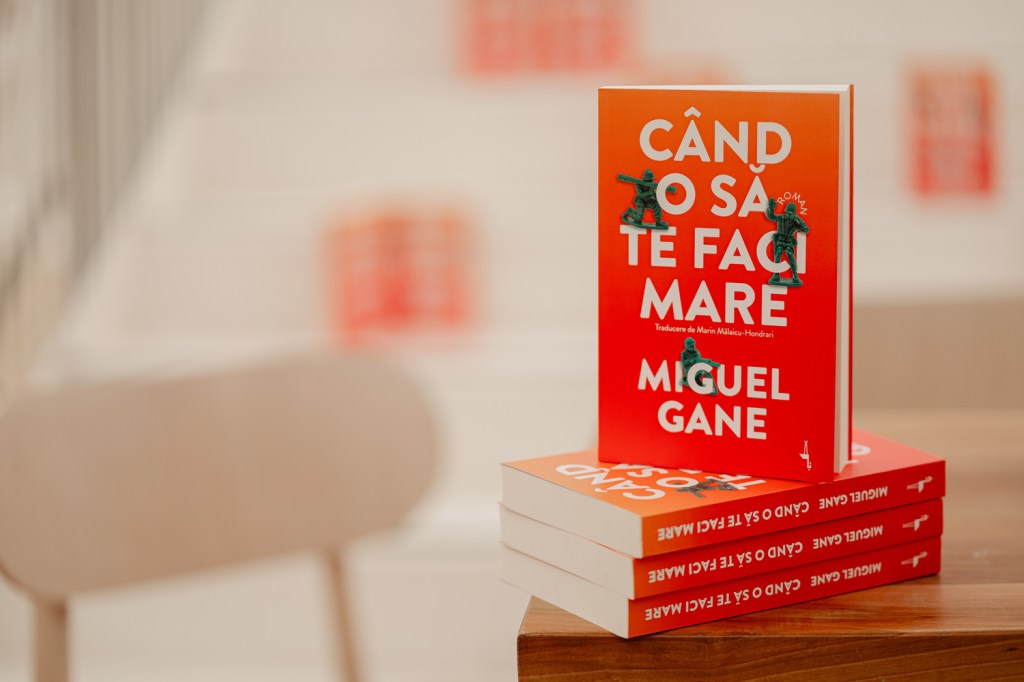
Until recently, Miguel Gane was ignored by publishing houses in Romania. Only in 2025 was it published in Romanian, thanks to Alice Books. On October 16, in front of a large audience, in a bookstore in the center of the Capital, he launched his novel “Când o sa te faci mare” (which he published in 2019), translated by Marin Mălaicu-Hondrari.
Written with deep autobiographical accents, the story takes us into the life of a family of Romanian immigrants in Spain, through the eyes of a nine-year-old child. The writer pays tribute to his birthplace, his Romanian roots, but also to those who went to work abroad, with the hope of a better life.
Gane was born in the village of Lerești in Argeș county, where he grew up, in the care of his grandparents, because his family were away working in Spain.
In an interview for the HotNews audience, the Romanian fondly remembers the times he spent in the country, the period of freedom he lived here, where he did everything he wanted, because, as he says, his grandparents were warm to him.
“At the same time, my parents were trying to send some money home, and that improved our financial condition and quality of life. At the same time, there was also a sense of loss, because I missed my parents a lot, but I wasn't aware of it. I was taking refuge in other things and I didn't talk to them much on the phone,” he says.
At the age of nine he also went to Madrid, to live with his parents. “I was very, very surprised at the size of things. When I landed at Barajas, I was looking out the window and thinking, 'How am I going to find my people in this whole airport?' When I got home, I found a basket of fruit: bananas, oranges, kiwi — things we didn't have in Lerești. I think I've rarely been happier than then,” the author says.
He learned Spanish in just two months, but it was not easy for him to integrate. “It was hard to learn how to play with the children here, to feel part of their groups of friends, and not as some kind of alien who looks at them with the desire to be like them, someday,” explains Mihai.
He started writing poems at the age of 13, but didn't show them to anyone until he was 16: “Then I opened a blog where I wrote what I felt: love poems, identity poems, songs and short stories with a more erotic touch. Among all the readers, I was lucky enough to meet Monica, my first editor. She worked at Penguin Random House, the biggest publishing house in the world.”
Gane is a double graduate (Law and Business Administration), has two masters degrees (Intellectual Property and Law) and in 2018 passed the national bar entrance exam organized by the Spanish state, but gave up this profession in favor of writing.
Miguel keeps his love for his native country alive in his heart, he is aware of everything that happens in Romania and he reads Cosmin Perța and Svetlana Cârstean with great interest. In the interview, the writer talks about the importance of poetry in today's world, his verses that have become emblematic for social and feminist movements in Ecuador, Argentina, Costa Rica or Peru, as well as about the fate of Romanian immigrants from Spain.
The first book in Romanian, a story about Romanians
– How has your poetry evolved over the years and what are the themes you address in your lyrics?
– Miguel Gane: I became much more precise and concrete, I learned to select only the important parts of a poem. I have even more experience and am able to communicate much more clearly. At the same time, I no longer play with such carelessness as at the beginning. I write about longing, about love, about my village, the people around me, childhood, the passage of time, the social situation of young people, poems about family, gender violence.
– How do you see the role of poetry in our development as individuals? Is poetry a necessity?
– It should be, of course. Now I see it as a bed where you feel protected, where you feel at home, but to get to it you have to give it a chance. That chance is the responsibility of poets—we must make readers choose our house. With accessible poems, understandable to everyone, full of beauty and meaning.
– After years of international career, you were published for the first time in Romania. Did you feel the need for this moment?
– I sure would have liked it to happen the first time, but now that I think about it, it's perfect. I was willing to wait until I found a place where I felt good, a publishing house that was right for me. And when I met Alice Books, the need arose. I am glad that Romanians read my first book, which is actually about them.
“I have the duty to make my poetry as good as possible, as special as possible”
– Your success in Spain was spectacular. How did you experience the moment when you realized that your lyrics were reaching tens of thousands of people? Has it changed you in any way?
– With a lot of responsibility, because now I have the duty to make my poetry as good as possible, as special as possible; I have a duty to create a unique voice for myself. It changed me because it made me better, it made my soul more beautiful, because it loaded me with everything I needed to be a definitive “me”.
– Why do you think your poetry resonated so well with Spanish and Latin American audiences?
– Because it is understandable to everyone, it talks about current topics, and readers find in it an answer to their questions.
– During all this time, have you ever had a feeling of regret or sadness that Romanians did not know who Miguel Gane is?
– In 2018, Romania was the country invited to the book fair in Madrid. The day the authorities came, because someone from the royal house was presenting a book and they filled a whole pavilion, I was at the booth because I was signing autographs, with a line of 200 people waiting. Nobody paid attention to me, there were televisions, journalists. Those at the institute (no. Romanian Cultural Institute) knew about me, because I had written to them since 2015–2016, when I published. I think this moment was the one that hurt me the most.
“I wanted to fight against the image of Romanians abroad”
– What place does Romania still have in your everyday life?
– It's a root I always happily return to because it heals me of everything. Here I still have my grandmother, family, friends, who are also family. I have my native village, where I feel like the most peaceful man on earth. I try to come as often as I can. I love Madrid, but also Lerești.
– The novel “Când o sa te faci mare” has a strong autobiographical dimension. Why did you feel the need to tell the story of your family and, through it, the story of the millions of Romanians who went to work abroad?
– I think it was my duty and at the same time I wanted to change the mentality of many people. I wanted to fight against the image of Romanians abroad and I wanted those here to feel proud of who they are, of everything they have done and of their struggle.
– Do you think that literature can give voice to these people who are often not heard – is this a goal or a responsibility that you feel you have as a writer?
– Of course. Now, if you talk to Spaniards and tell them you're Romanian, they all say the same word: “workers”. I want to believe that my project also put a small grain in this image change – Romanians who are seen as hardworking people.
“I had to be someone else to be someone”
– What do we risk if we forget the history of those who went abroad?
– We risk receiving migrants from other countries and treating them as we were treated; we risk not being as beautiful as we are and forgetting that our path was full of stones.
– What a mark he left on your soul. the experience of leaving and reinventing yourself in another culture?
– It turned me into an unknown person and gave me a new identity because I had to be someone else to be someone.
– Your lyrics have been taken up as symbols by feminist and social movements around the world. How do you explain this resonance?
– I was very close to all things gender violence because it was something that created a lot of sensitivity and empathy for me. I tried to be a better man, to break certain stereotypes that were imposed on me and to fight, for my part, so that others have this possibility. And I did this work through writing.
“Our duty is to make poetry fashionable”
– You stated at one point: “We wrote the language of a generation, we spoke through our voice and turned poetry into a mirror where you find yourself with love, with pain, with pleasure, but also with surprise.” What is this language and is it important to write with the new generation in mind?
– Of course it's important because young people need stories that speak to them. The language must be able to cross from the page to the skin, to touch untouched places. And I think an open reader can understand a lot more of what I'm doing than a more classical one.
– Nowadays, what would bring young people closer to poetry and reading?
– We, as young people, want to be understood and understand in turn. An accessible poem, on themes that affect us, is one that brings us closer. It is our duty as a society to make poetry fashionable, talked about, and passed from one to another as a gift.
– What advice would you give to a young poet or writer just starting out?
– To read as much as possible; it's like a kind of practice before the game. Reading is absolutely essential for any author. It will give him inspiration and at the same time make him more attentive to everything that is happening around.
– You said: “My poetry works like a mirror where the reader looks, looks at himself to learn.” What do you hope the reader discovers in this poetic mirror?
– To answer his unanswered questions, to be better, more beautiful and wiser, not to feel alone and always find a place of comfort. What I write is like a mother who can heal your pain.