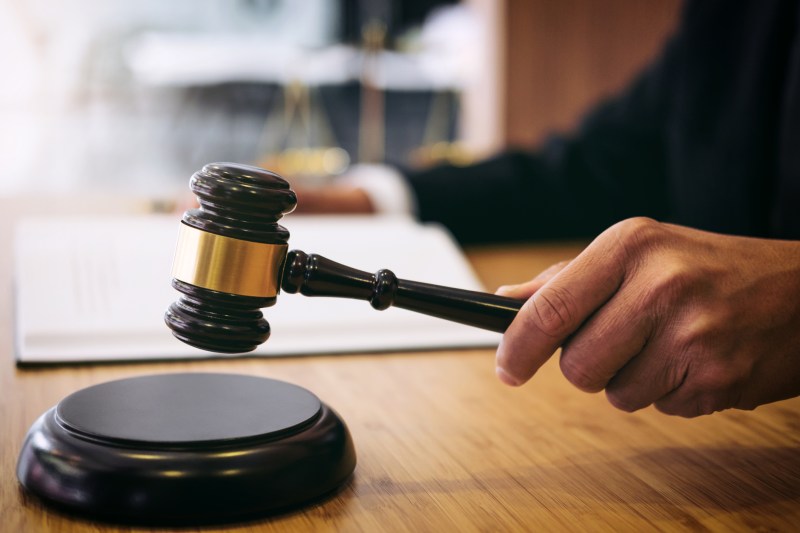
Justice. Illustrative photo / Source: Pattanaphong Khuankaew | Dreamstime.com
Two federal judges admitted in response to a request from US Senate Judiciary Committee Chairman Chuck Grassley that members of their teams used artificial intelligence to draft some recent court rulings, which Grassley described as “riddled with errors,” according to Reuters.
In letters released Thursday by Sen. Grassley's office, U.S. District Judge Henry Wingate of Mississippi and U.S. District Judge Julien Xavier Neals of New Jersey said the decisions in question, issued in unrelated cases, did not go through their offices' normal vetting procedures before being made public.
Both judges said they had, in the meantime, adopted measures to improve the process of verifying court rulings.
Judge Neals, who sits in Newark, said in his letter that a draft decision in a capital market case “was published by mistake — human error — and withdrawn as soon as my office was informed.”
He added that a law school intern used ChatGPT, the system developed by OpenAI, for research without authorization and without mentioning the fact.
Neals also said his office subsequently developed a written policy on the use of artificial intelligence and strengthened its internal document verification process. Reuters previously reported that, according to a person familiar with the situation, that decision included information obtained with the help of AI.
Judge Wingate said in his letter that a clerk in his court in Jackson used the Perplexity platform “as a basic drafting tool to synthesize public information from the record.” He explained that the publication of the draft decision “was an error of human oversight.”
Wingate had previously withdrawn and replaced the original order in a civil rights lawsuit, declining at the time to provide an explanation, citing only “administrative errors.”
The two judges did not immediately respond to requests for comment sent to their offices.
Senator Chuck Grassley had asked the justices to clarify whether they used artificial intelligence in writing their decisions, after lawyers involved in the cases flagged the presence of inaccuracies and other serious errors.
In a statement Thursday, Grassley praised the justices for admitting mistakes and called for the judiciary to adopt stricter rules on the use of AI.
“Every federal judge — and the judiciary as a whole — has an obligation to ensure that the use of generative artificial intelligence does not violate the rights of litigants and does not impair fair treatment under the law,” the senator said.
More and more lawyers in the United States have, moreover, been criticized by the courts for improper use of AI. In recent years, judges have imposed fines or other sanctions in dozens of cases after lawyers failed to verify content generated by these technologies.
Photo source: Pattanaphong Khuankaew | Dreamstime.com