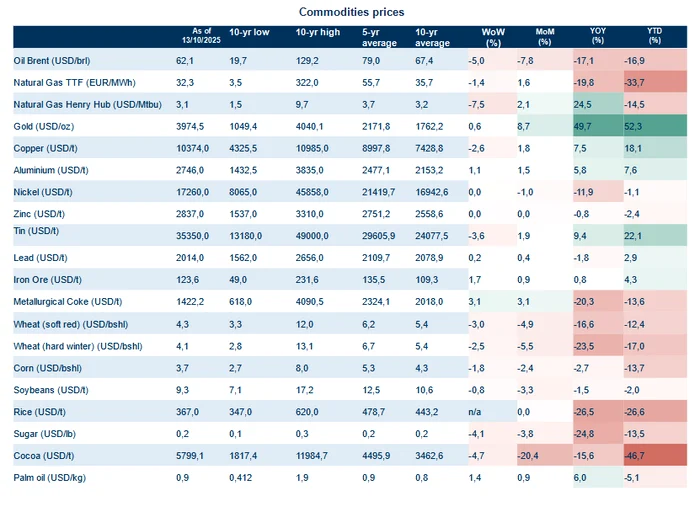
Rice prices have fallen by 35% in a year, reaching the lowest level since 2017 (around $360 per ton), following the lifting of export restrictions imposed by India, a market analysis shows, pointing out that Asia accounts for almost 90% of global production and consumption.
Rice prices fell by 35% in one year. Archive photo
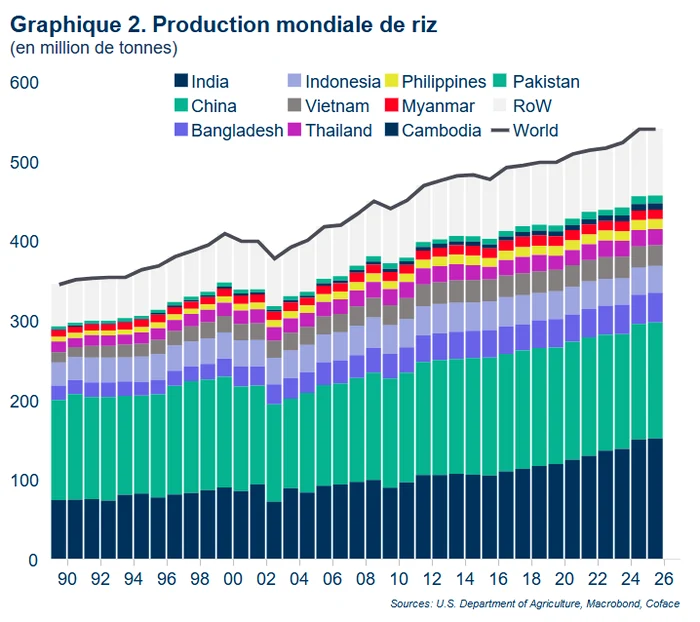
“Rice prices have fallen by 35% in a year, reaching the lowest level since 2017 (about $360 per ton), following the lifting of export restrictions imposed by India. After three years of extreme volatility, the market is facing a surplus (541 million tonnes produced in 2024), which is driving down prices and disrupting the balance for global producers and importers“, shows the analysis carried out by Coface experts.
From 2022, India, the world's main exporter, restricted its export sales to limit the increase in world prices (19% increase in 2022 and 2023), linked in particular to the war in Ukraine and unfavorable weather conditions in Asia.
“The reopening of exports in 2024, combined with record harvests in Asia, has led to a 35% year-on-year price decline. With production growth forecast for 2026 and the possible return of La Niña in the fourth quarter of 2025, we anticipate a growing oversupply in 2026. Prices are expected to continue to decline until at least end of 2025, with a likely stabilization in 2026 at levels not seen in the last 10 years”, the Coface analysis shows.
Rice is the most consumed staple food in the world, ahead of wheat and corn. Despite its importance for food security, it is still little traded on world markets, Asia, which represents almost 90% of global production and consumption, remains the main actor.
Sub-Saharan Africa, in turn, is heavily dependent on imports from Asia. In 2024, five Asian countries (India, Thailand, Vietnam, Pakistan, Cambodia) generated 75% of exports, of which 40% from India, a concentration that increases the vulnerability of these countries to the political decisions of Asian economies.
Rice remains a highly politicized commodity in many Asian economies.
The continued decline in prices threatens the profitability of producers in countries where production is lower than in India. The Philippines, one of the world's biggest rice importers, suspended imports for 60 days starting September 1 to support its producers. Indonesia, for its part, switched to a food sovereignty strategy, prioritizing domestic production to reduce its dependence on imports.
“Emerging economies maintain protectionist policies. This is the case of Japan, which, under pressure from agricultural lobbies, maintains strict import quotas to protect its rice sector. However, the approach risks destabilizing the dynamics of the domestic market. Indeed, Japan's rice sector is facing a supply crunch due to a poor 2023 harvest caused by extreme heat that has reduced yields. Stockpiling and a major earthquake in southern Japan in August 2024 exacerbated the supply shortage. Protectionist policies keep domestic prices very high, especially when domestic production declines. A 5kg bag of rice currently costs about 4,000 yen ($26) in Tokyo, compared to $8 for an equivalent bag of Thai rice in Bangkok,” the analysis reveals.