For years, Polish apartments have been considered among the most overcrowded in the European Union. Although the overpopulation index published by Eurostat is often quoted in the media, it is rarely explained how exactly this institution defines the phenomenon itself. Experts from the RynekPierwotny.pl website remind us that according to Eurostat's methodology, a premises (house or apartment) is considered overcrowded if it does not meet all of the following minimum criteria:
The data show that the overpopulation rate in Poland, calculated according to this definition, is one of the highest in the EU and reaches 33.7%. The situation is worse only in Romania, Bulgaria and Latvia. However, it is worth noting that in our country this problem is gradually decreasing – since 2005 it has dropped by over 20 percentage points (from 54.1% to 33.7%). For comparison, in many wealthier Western countries, such as Belgium, the Netherlands, Germany and Sweden, the percentage of people living in overcrowded apartments has increased significantly over the last 20 years. In Sweden, this rate increased from 10.7%. in 2005 to 16.7 percent in 2024, which is largely the result of the influx of immigrants.
“Nesting” is still going strong
When talking about housing problems, we cannot ignore the situation of young adults. Their prospects in Europe are rather pessimistic, and Poland is unfortunately among the countries with the highest percentage of the so-called “nest nesters” – people who, despite completing education and taking up work, still live with their parents.
— The latest Eurostat statistics indicate that in 2024, 53.8% lived with their parents. people aged 25-34. — The Polish result was therefore well above the EU average, which is 29.7%. – says Marek Wielgo, expert of the RynekPierwotny.pl portal.
The expert reminds that only in 2019 there was a temporary improvement, when the percentage of “nesters” dropped to less than 44%. It was a period of good economic conditions and easier access to loans. Unfortunately, the following years brought deterioration – rising interest rates, apartment prices and rents meant that the share of young people living with their parents increased by 5 percentage points within three years.
However, this problem does not only concern Poland. Eurostat data shows that a higher percentage of “nesters” occurs in Croatia, Greece and Slovakia, although improvement is visible in the first two countries. In 2023, our country was overtaken by Italy and Portugal. Young people are becoming independent the fastest in Finland, Denmark and Sweden, although the nesting rate has also increased there over the last year.
Poles did not go into excessive debt
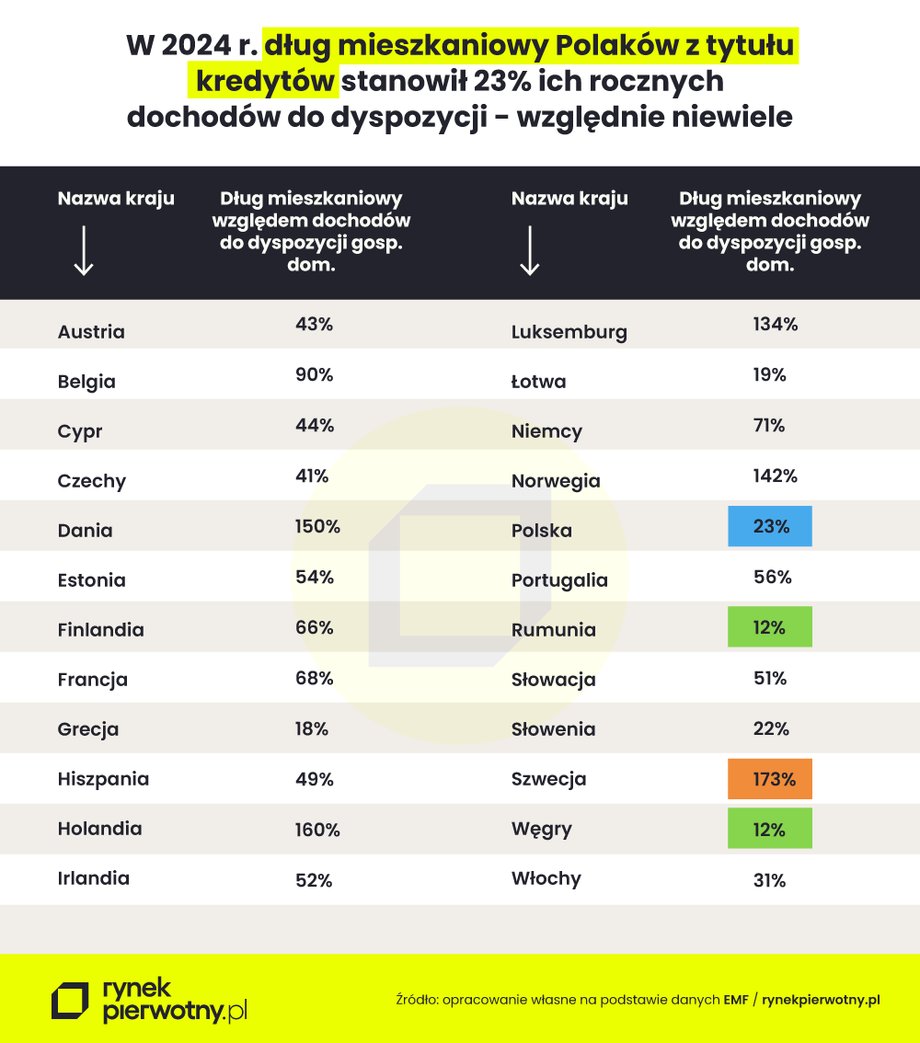
The last two decades have been a time of enormous growth in the housing loan market. In 2005, the total value of unpaid “mortgages” was approximately PLN 50 billion, while today it is almost PLN 500 billion. — Let us remember, however, that gross domestic product has also grown significantly over 20 years. Thanks to this, at the end of 2024, the ratio of Poles' housing debt to GDP was approximately 14%, which was low – explains Andrzej Prajsnar, an expert at the RynekPierwotny.pl portal.
Poles' housing debt due to loans
|
RynekPierowtny.pl
This indicator represents a decrease compared to 2016, when it was 21%. GDP. Moreover, the level of mortgage debt in Poland is clearly lower than the EU average (38%), and also than in the Czech Republic (21%) and Slovakia (31%).
In relation to household income, the data are also favorable – in 2024, the value of all unpaid housing loans corresponded to 23%. annual disposable income of Poles. For comparison: in the Czech Republic it was 41 percent, in Slovakia 51 percent, and in Denmark, the Netherlands and Sweden – as many as 150, 160 and 173 percent, respectively.
The “Franc bomb” has been defused, but loans are still expensive
However, the positive image of the Polish credit market is disturbed by the still high interest rates on housing loans compared to the EU – not only in recent years, but also earlier. However, the advantage is the fact that the problem of Swiss franc loans, which for years posed a serious risk to both households and the economy, was “disarmed”.
However, Andrzej Prajsnar points out that the disarmament of the “Franc bomb” was mainly the result of debt repayments, settlements and lawsuits, because the state's previous legislative initiatives failed. Twenty years ago, the same state unfortunately failed as a credit market regulator.
Data presented by RynekPierwotny.pl experts show a mixed picture of Polish housing. On the one hand, there is a significant drop in overpopulation and a relatively low level of mortgage debt, on the other, there is a high percentage of young nesters and expensive loans. – It is the relatively low overall level of credit debt that creates hope for improving the housing situation of a large group of people who will not be able to take advantage of the offer of social housing – sums up Andrzej Prajsnar, expert of the RynekPierwotny.pl portal.
Most “nesters” are on the eastern border
Andrzej Prajsnar shared with us broader observations about what he considers the most important problem, i.e. “nesting”. — It seems that it would be useful to have a much larger package of data describing this phenomenon, he admits. — Such a broader analysis could take into account, for example, the housing plans of people living with their parents, the area of the apartment they have for their own use and the attitude of these people to “nest nesting”, which is not always a forced decision – explains the expert and gives an example: – A married couple living in a large, renovated single-family house with a single mother/mother-in-law can sometimes be considered “nest nesters”, although their situation housing is not bad at all. Another interesting and non-abstract example is a couple who live with their wife's parents, but have started building a house using the economic system and will move into it within 3-4 years, says Prajsnar.
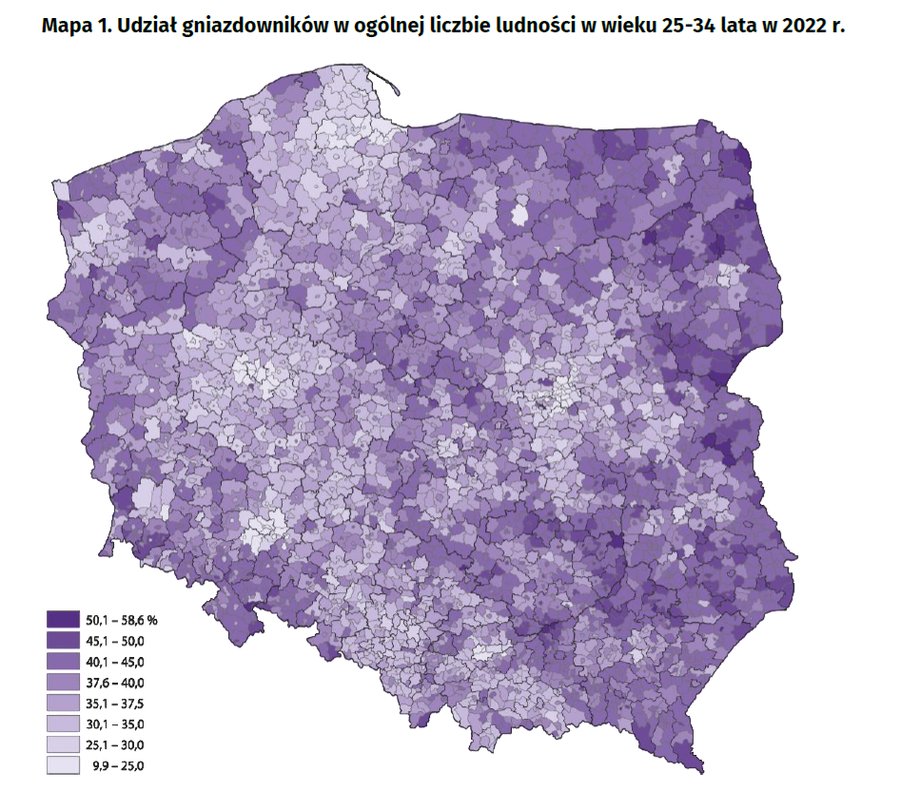
The expert emphasizes that there is another aspect related to the topic of “nesting”. Namely, we face a problem with care services for a rapidly aging population – especially in more peripheral areas. — When analyzing the territorial distribution of nesting, it is worth paying attention to the results of an experimental study published by the Central Statistical Office over a year ago (study: Generation of nesters in Poland).
In 2022, we had approximately 1.7 million nesters in Poland
|
Central Statistical Office
— According to this analysis by the Central Statistical Office, in 2022 we had approximately 1.7 million nesters in Poland, which constituted 33%. the entire population aged 25-34. However, attention should be paid to the definition of people referred to as “nesters” adopted in the analysis. These are people in the indicated age group, living with their parents, not having a spouse and not being parents – explains Andrzej Prajsnar. — The above map shows the share of “nest nesters” defined in this way in the total population aged 25-34 (2022). Research results indicate that “single nesters” are more often men (63%), and the analyzed phenomenon occurs more often in eastern Poland, he points out.
How to deal with housing problems?
We asked the experts of the RynekPierwotny.pl website how to improve the current situation on the real estate market. They admitted that this is not an easy task for specialists examining the actual state of the market.
According to them, it would be crucial to restore Poles' creditworthiness to the level before the war in Ukraine and the pandemic. This means the need for a further decline in the cost of loans and an increase in the purchasing power of citizens through rising wages.
Equally important could be the development of social housing, financed by the government and local governments. This solution could reduce rental costs, because not everyone who needs an apartment has to buy it straight away.
Experts estimate that the most difficult challenge remains changing social habits – both the comfort of young people and the overprotection of their parents. This is an area that should be addressed by sociologists and psychologists.