In the USA, where TikTok Shop has only been operating for two years, sales in one quarter reached USD 4–4.5 billion. This is an increase of approximately 125 percent. quarter to quarter. Analysts estimate that throughout 2025, TikTok will generate over $15 billion in this market alone. transaction.
This pace of growth means that eBay, a company with a 30-year history, has for the first time a strong competitor in a completely new field: social commerce. Why has TikTok become a rival to eBay? And why are more and more people buying directly from creators on TikTok, instead of looking for offers in traditional e-commerce stores?
Check also: AI avatars better than humans. They earned over $7 million in seven hours.
TikTok. From funny video apps to global marketplace
TikTok was designed as an application for short, maximally engaging videos. The effectiveness of his algorithm lies in the fact that suggests content that the user wasn't even looking for, but is likely to be of interest to him. This is the exact opposite of eBay, which is based on consciously entering the product into the search engine.
The next part below the video:
The introduction of TikTok Shop meant in practice that a shopping layer was added to the endless entertainment feed. Products appear occasionally – in a guide, a review, a video from the kitchen or the gym. There's no need to switch between apps, look for discount codes, or manually enter the name of an item on another website. Purchasing is literally just a few taps away from the moment we see something.
It is also a scale that cannot be ignored. TikTok Shop is not only growing faster than eBay, but is also part of a broader trend. In 2024, already 42 percent. Internet users in the USA made purchases directly on social media, and the number of buyers in social commerce there is in the tens of millions.
For younger generations, this is the new norm. Research shows that approximately 82 percent consumers use social media to discover and research products, and 97 percent Gen Z representatives indicate social media as the main source of shopping inspiration. TikTok is one of the biggest beneficiaries of this shift. In Great Britain, 44 percent app users have already made a purchase directly on TikTok, and a significant number do it regularly.
At the same time, TikTok itself has been investing heavily in this segment. The launch of TikTok Shop in the US was preceded by an extremely aggressive discount campaign – deep discounts, coupons, promotions for Black Friday and Cyber Monday. Changes in the regulatory environment also played a role. When popular Chinese websites such as Temu and Shein began to lose their cost advantage due to the limitation of cheap shipments from abroad, some of the impulse purchases began to naturally shift to TikTok Shop, where cheaper, less known brands dominate.
An explosion of purchases directly from creators
The biggest change, however, is not at the level of platforms, but at the level of relationships. People increasingly buy from specific creators, not from anonymous stores. This trend can be seen throughout the entire social media ecosystem – on TikTok, Instagram and YouTube, but it was TikTok that combined it in one place with a shopping cart attached to the video.
Data shows that creators are one of the main drivers of sales today. Almost half of TikTok users admit that influencers inspire them to discover new brands and products. According to some analyses, 50 percent American consumers using TikTok Shop rely on influencers' recommendations when making purchase decisions. Over 58 percent app users were supposed to make a purchase directly through TikTok Shop, a sales on this platform in the US in the first half of 2025 reached approximately USD 5.8 billion.
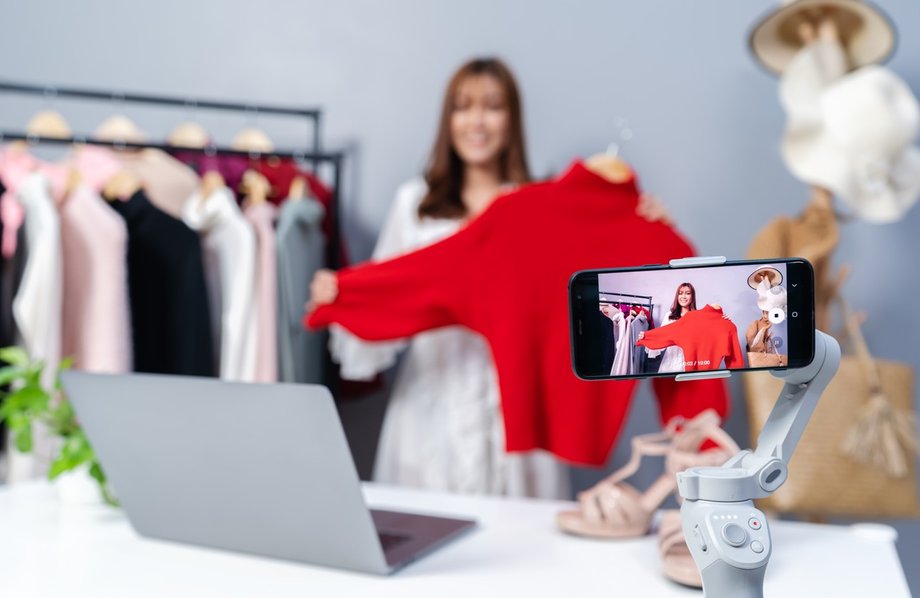
Social commerce is gaining importance
|
BaLL LunLa / Shutterstock
This is not the result of a passing fad. Research on the influence of influencers shows that consumers trust the recommendations of creators, friends and family much more than brand communications. In one study, 69 percent respondents declared greater trust in this type of sources rather than in official marketing messagesand the global influencer marketing market exceeded USD 20 billion.
Why do people prefer to buy from creators? The first reason is the sense of relationship. Creators build communities around themselves, share their everyday lives, show behind the scenes of their work and private lives. The user has the impression that he “knows” someone. When such a person recommends a product, the recipient interprets it as advice from a friend rather than an advertisement. The second factor is the content format. On TikTok, the product almost always appears “in action”, i.e. in makeup, training, a dinner recipe, an apartment renovation video.. The creator shows what something looks like, how it behaves, and often compares it to other solutions. It's much more tangible than a photo on a store's website. In many categories, especially beauty, fashion, home products and lifestyle gadgets, this context sells better than even the most refined product card on eBay.
Social proof also works here. Below the videos you can see other people's comments, opinions, questions and answers. In the case of live events, there are immediate reactions, viewer counters, and often “sold out” product variants. This creates the FOMO effect – if something appeals to so many people at once, it must be worth attention.
Finally, there is a simple argument: the purchase is very easy. There are a few seconds between seeing the video and clicking the “buy now” button. The data shows that up to 92 percent users take some action after seeing a product on TikTok (from entering the brand's website to the actual purchase), and over 60 percent bought something after seeing it on the app or in a TikTok ad.
For many users, the very fact of supporting the creator is also important. Buying from an affiliate link or TikTok Shop means that part of the margin goes to your favorite influencer. This turns a simple purchase into a form of voting with your wallet, where we reward someone we like to watch.
Read also: TikTok is a new way to become a thought leader and build a personal brand that sells [WYWIAD]
TikTok vs eBay and other shopping platforms
From a user's perspective, the difference between TikTok Shop and eBay isn't just about the interface. This two completely different ways of thinking about shopping.
eBay is the place we go to when we know what we are looking for, e.g. a specific model of equipment, car parts, a collector's album or limited edition sneakers. Allegro operates similarly in Poland. It is dominated by a search engine, filters, and comparison of offers and prices. A large part of the transaction takes the form of an auction, which requires patience and bidding strategy. Shopping on eBay is largely rational, focused on price or rarity of the product.
In 2026, TikTok Shop will also be available in Europe, including: in Poland
|
IB Photography / Shutterstock
TikTok Shop does the opposite. The user doesn't come in for a specific thing, but for entertainment. And the products themselves catch his eye, embedded in the creators' narrative. Shopping is impulsive, often for cheaper products – cosmetics, accessories, clothes, home gadgets. As some analysts say, TikTok sells small pleasures that are easy to add to the cart without much thought.
At the same time, TikTok, like markets in Asia, is gradually developing a live commerce format in which creators conduct live broadcasts presenting products, answer questions, conduct tests and offer limited-time promotions. In Asia, it is already a huge market, in the USA and Europe it is growing slower – in the 12 months to April 2024, approximately 10%. consumers made a purchase during the livestream. However, all forecasts indicate that the share of this channel will grow.
For social media creators, this is a natural step. TikTok Shop and similar solutions remove most of the technical barriers – there is no need to set up a store, integrate payments or build traffic from scratch. Platforms offer increasingly extensive affiliate programs in which the creator can subscribe to products of various brands, and the commission is calculated automatically. For example, some brands build communities of several dozen or even over 100,000 people. active creators who regularly promote their products in exchange for a share of revenue.
The effect can be seen on both sides of the equation. On the demand side, the percentage of consumers who openly admit that they bought a product because they saw it from an influencer or their favorite creator is growing. On the supply side, there is a growing number of D2C brands, microbrands and companies that they consciously give up building a classic store as the main sales channelfocusing on TikTok or Instagram. Times like these.
Author: Grzegorz Kubera, journalist of Business Insider Polska