Is the AUR electorate returning to PSD? How experts explain the drop in the polls of the party led by George Simion


The monthly barometer by Inscop Research shows, for the first time, a drop in AUR below the 40% threshold in voting intentions. At the same time, PSD gains two percentage points, a sign that part of the electorate lost in the past is returning to the social democrats.
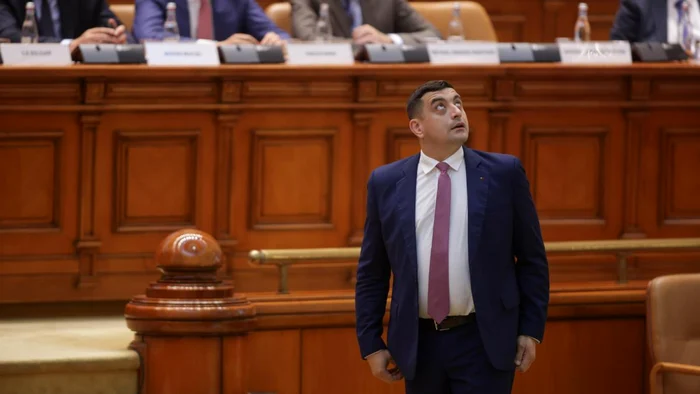
PHOTO Inquam Photos / George Călin
Analysts consulted by “Adevărul” show that at least PSD could be on the right track.
The director of INSCOP, the sociologist Remus Ștefureac, points out that the AUR party recorded a drop below 40% for the first time after the 2025 elections. However, the formation “remains at double the score compared to the next ranked, the Social Democratic Party, which is growing slightly”.
“For now, it is a one-off, isolated phenomenon. For 4-5 months, AUR remained stable at a score of approximately 40%. It seems now that it is decreasing, if it will be confirmed in the next period, then we can also talk about the causes. Otherwise, for now it is a first moment such a moment and it is really premature to look for causes”. explains Remus Ștefureac for “Adevărul”.
A survey “it captures a snapshot, and even the dip this barometer captures is within the poll's margin of error. So at the moment it is hard to say, it would be incorrect to say that the voting intention for AUR is decreasing. We do not know this. This can be confirmed by the following surveys. What the previous ones confirmed was that AUR was somewhere around 40%. If in the next two months that 38% consolidates there, then yes, we can say that there is a small downside for GOLD. But within a margin of error of these polls. It is premature to talk about this”also shows the political consultant Adrian Zăbava.
However, he emphasizes the difference also recorded in the case of PSD, where the survey can “shows that PSD is growing”:
If we think that AUR and PSD share a certain electorate, not entirely, i.e. not all those who vote for AUR could also be PSD voters at a given moment, nor vice versa, but part of the electorate is divided between AUR and PSD, depending on the situation probably. We could speculate that a small drop in AUR would translate into a possible return to PSD, but that would be pure speculation for now. This should be confirmed in the coming survey months.
at present “the electorate, broadly speaking, remains in the same proportions as before”explains political analyst Ion M. Ioniță, editor-in-chief of Historia. AUR is quoted around 40% and is now the strongest in voting intent:
Let's see if any trend will continue, if an increase in the PSD will be confirmed that is not only conjunctural, if it becomes one of substance, because this Congress will not change much, everything is known in advance, Grindeanu will be president, so we do not have an electoral competition that will attract the attention of the PSD electorate.
PSD could recover its electorate especially in case of a victory in the elections for the Capital City Hall on December 7. “It would be a prestigious victory for PSD. And it might actually have an effect. In fact, any party that has a candidate would win from a victory in Bucharest. But for the PSD it would be very important indeed, because it could bring the party to growth”.
Incidentally, the growth recorded by AUR in recent months “it was in a way expected after what happened with the elections, after the period of electoral tumult, of agitation, but it is possible that things will start to calm down after the PSD congress and then and then the AUR will also be less attractive, because in crisis conditions the radical parties grow. As a result, they also start to lose the electorate”.
at present “we have a normalization, to some extent. We still have a stable government, we do not have the political crisis and we do not have the economic crisis that is foreshadowing. It is true that we are not in a good economic situation, that we have inflation, that we have the freezing of salary incomes and pensions, but still it is a situation of stability. We have not plunged into a crisis, into instability, into a political crisis and into an economic crisis. So, compared to the much worse situation in which we could have found ourselves, we are in a stable situation at the moment. And this stability matters enormously, because we see that Romania is already starting to get better interest rates than before”.
The parties forming the government coalition accumulate 51% of the voting intention, while the parliamentary opposition parties approximately 43%. In October, the Power parties had reached 49.1%, and the Opposition had 44.6%. In September, the Power's score reached 46.9%, and the Opposition's at 46.9%, increasing compared to July 2025, when the Power had 49.3% and the Opposition 46.3%.
Thursday's poll numbers
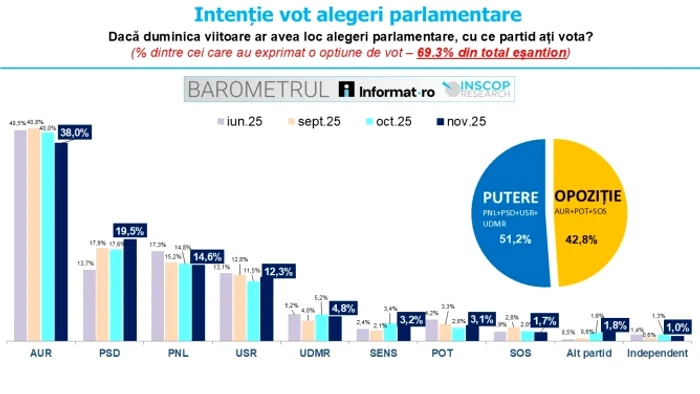
The survey carried out by Inscop Research between October 25 and November 2 shows that 38% of voters would vote with AUR, 19.5% with PSD, 14.6% with PNL, and 12.3% with USR, these being the parties that would enter Parliament at the moment, with a required percentage of over 5%.
Significant differences compared to the previous months are noted in the case of the USR, which increases by almost one percent (12.3% from 11.5% in October), in the case of the AUR, which falls by two percentage points below the 40% level at which it has been maintained in recent months (38% from 40%) and in the case of the PSD (19.5% from 17.6%). The maximum allowed error of the data is ± 1.8%, at a confidence level of 95%.
It is important to note that the Social Democratic Party is currently in a moment of transition and reinvention, with a Congress that is about to change its status, the party abandoning the mantle of progressivism for conservative values. The formation is, in fact, in a race to recover the electorate that emigrated to the AUR, even the colleague from the UDMR government, Deputy Prime Minister Tanczos Barna, shows in an interview for “Adevărul”:
“The PSD still has more parliamentarians than the AUR, but the polls are certain, so it is no longer a single poll and it comes out of the equation, the trends are clear (no – the increase of the AUR). And the objective of the PSD is to regain that electoral pool that it lost and which went to the AUR. And the objective of the PNL is the same, to regain voters from the AUR area. The USR must regain the electorate from the diaspora, for example, a electorate that they largely lost. So both, or the three parties, have a common goal, beyond these contradictory discussions, to regain their electoral pools, the voters who have supported them so far and now many of them have gone to AUR”.