Poland responds to the growing threat from Russia with massive armaments. According to last year's government assumptions, military spending in 2025 was to reach 4.7%. Gross Domestic Product (GDP), i.e. PLN 186 600 million. This is the highest percentage in NATO relative to GDP.
But how well is Poland prepared for a Russian attack? And would Putin even be able to take over our country? — The Russian Air Force would probably try to attack as many Polish airports and logistics hubs as possible in the first phase, says Klemens Fischer. The geopolitics expert draws attention to key factors that, even in a difficult situation, would fundamentally change Poland's position.
As a professor of international relations at the University of Cologne emphasizes, NATO member states always act togetherwhich allows Poland to defend itself. The ongoing arms campaign, costing billions, is intended to strengthen Poland's role as the military leader of NATO's eastern flank. The concerns of countries close to Russia are not unjustified.
For months, experts and intelligence services have been warning against a Russian attack on NATO. Moscow is already testing how far it can go in provoking NATO, using drones and fighter jets. Prime ministers and presidents of European countries openly talk about the “hybrid war” that Russia has declared on Europe.
The article continues below the video
In September, approximately 20 Russian drones entered Polish airspace. According to some experts, apart from the Baltic countries, Poland is considered a potential target of a Russian campaign on NATO territory – if only because of its geographical proximity to the Russian Federation.
— No NATO member state can repel a Russian attack on its own, explains the Austrian, adding that there is no reason for pessimism. Poland is a member of the NATO military alliance. This means that Member States cooperate and help each other in the event of an emergency.
— This can be seen in the example of drones that invaded Polish airspace. In addition to Polish forces, Italian, Dutch and German units also participated in the defense against these drones, explains Fischer, giving a current example. “Poland alone would not be able to resolve this situation so effectively and efficiently.”
As the expert notes, Poland does not intend to rely solely on other member states.
— Poland has developed its own plan to deter and defend its eastern border, known under the code name Shield East. It is supported by NATO, Fischer says. “The plan includes the construction of anti-tank barriers, mine strips and other military fortifications with a planned investment value of PLN 10 million to militarily strengthen the entire Polish border with Russia and Belarus.”
“NATO's first line of defense”
One of the potential flashpoints on the eastern flank is the Suwałki Isthmus, called by some experts “NATO's Achilles heel”. If Russia seized this important land connection between the Baltic countries and other EU member states, it would be a disaster for Western security policy.
In such a case, the Baltic countries would be cut off from other NATO member states, becoming easier prey for the Russians.
— The Eastern Shield plan is of great importance for the defense of NATO's eastern flank because it is NATO's first line of defense against Russia, says Fischer.
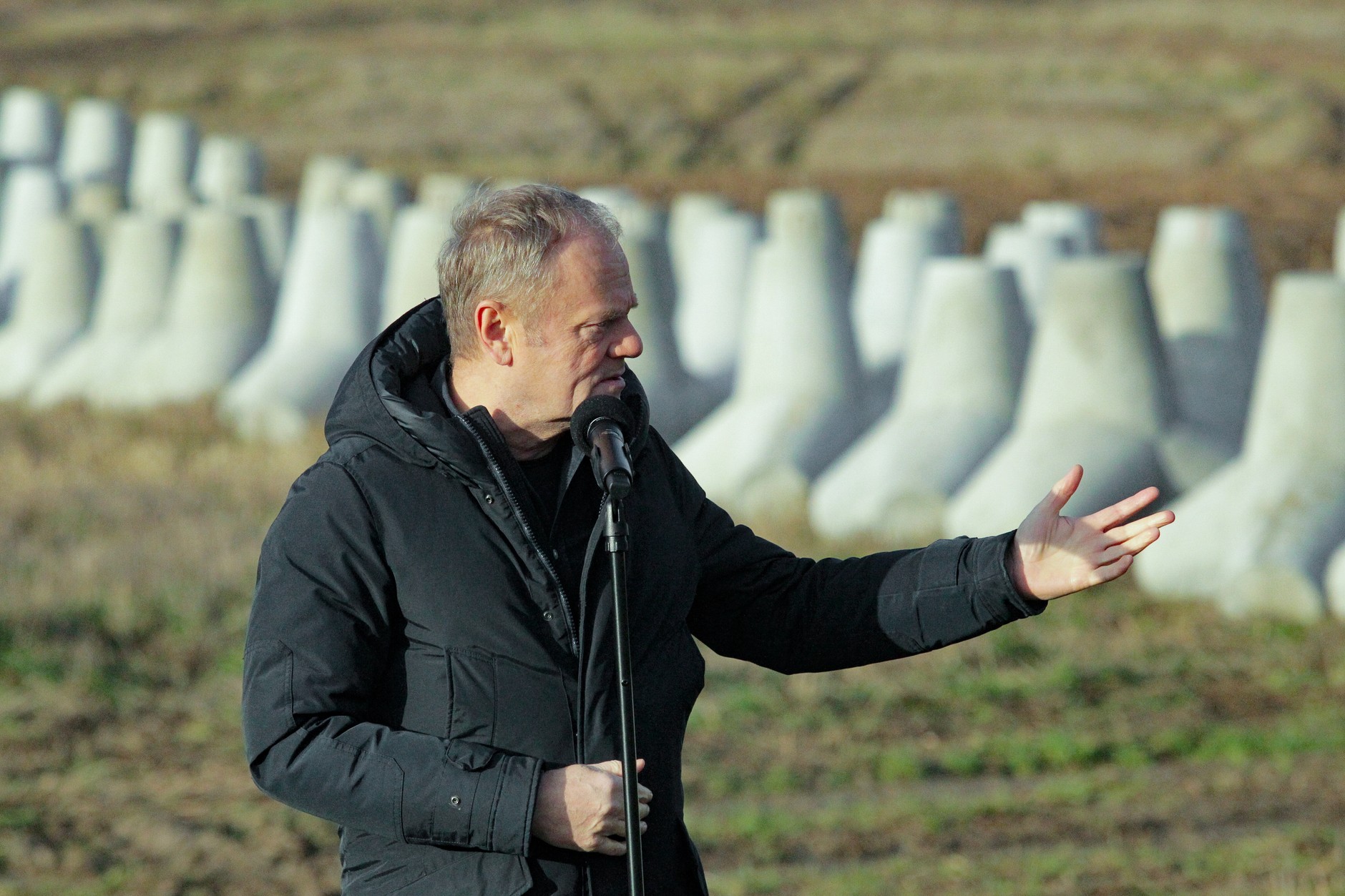
Prime Minister Donald Tusk during a visit to the first constructed section of the East Shield, on the Polish-Russian border near the town of Dąbrówka (illustrative photo)PAP/Tomasz Waszczuk / PAP
Compared to the Baltic countries, Poland has a clear advantage: it has all three types of armed forces – land, sea and air.
— This army, consisting of all branches of the armed forces, is uniformly equipped, has excellent morale, which results, among other things, from very strong patriotism. It enjoys huge support from the public. It is perceived as a stronghold against Russia – Fischer lists the advantages of the Armed Forces of the Republic of Poland.
According to the expert, Poland poses a big challenge to Putin's expansion plans. The Austrian indicates what the Russian army would do. — Naval forces would play a rather smaller role here, because in the event of an attack on Poland, they would automatically have to face the naval forces of NATO countries in the Baltic Sea area – explains Fischer.
Fischer considers it likely that the Russians would try to take over the Suwałki Isthmus to create a land corridor to the Königsberg Oblast. However, according to the expert, it is unlikely that Putin's troops will occupy all of Poland. “The Russian army would face a heavily armed NATO adversary who would not be alone on the battlefield.”
I’m Ashley Davis as an editor, I’m committed to upholding the highest standards of integrity and accuracy in every piece we publish. My work is driven by curiosity, a passion for truth, and a belief that journalism plays a crucial role in shaping public discourse. I strive to tell stories that not only inform but also inspire action and conversation.