I waited until I reached an altitude of about 600 m and pulled the ejection lever. I then had less than a second to live
– says Lieutenant Colonel Pete Smith, former US Air Force pilot.
This is Lt. Col. Pete Smith, an Air Force veteran who spent his 28-year military career as a fighter pilot and experienced ejection firsthand. On TV and in the movies, a pilot ejection from his jet appears to be a simple procedure. In reality, the process is complicated and violent, and most pilots are seriously injured. About 20-30 percent fighter pilots experience spinal fractures as a result.
What does the pilot's ejection look like?
In most cases, catapulting technology is the difference between life and death. How exactly does this technology work and what is it like to experience catapulting?
— That's a complex question. The ejection seat is probably the most complex piece of equipment in a fighter jet. As soon as you pull the lever, a signal is sent to start the ejection process, Smith explains.
This lever, which is located between the pilot's legs, sends an electrical impulse to the aircraft to release the screws that hold the cockpit canopy in place. A set of small rockets placed at the front push the shield upwards, moving it out of the pilot's path.
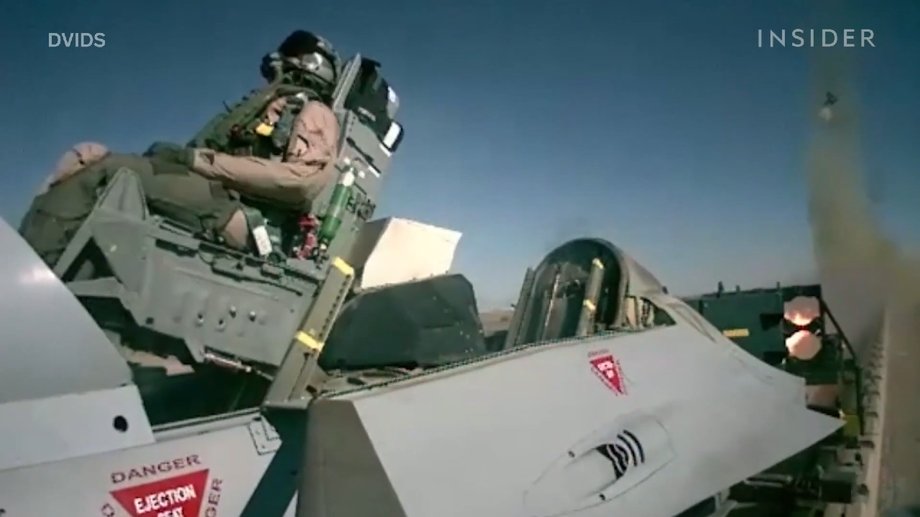
The pilot's decision is crucial during catapulting
|
Business Insider
Then, a pyrotechnic charge placed under the seat is fired, catapulting the pilot out of the cockpit. This launches booster rockets that carry the pilot to an altitude of 30 to 60 m.
Sensors in the seat measure the aircraft's speed and ambient air pressure to determine whether the pilot is at a low altitude and the parachute must deploy immediately, or if he is at a higher altitude and parachute opening must be delayed until thicker air is reached.
In the latter case, the seat will deploy a smaller parachute, known as a drogue parachute, which helps reduce the pilot's rate of descent and stabilize the seat before it goes into fatal spins.
Once the main parachute is deployed, the engine automatically starts, ultimately freeing the pilot from the seat. This entire process exerts 14 to 16 times the force of gravity on the bodies of fighter pilots.
—If you have time to prepare, it's better to do so. The best thing you can do in preparation for ejection from one of these seats is to get into the right position. The appropriate position is to position the body so that it is as “lean”, stiff and straight as possible. The catapult moves on guide rails. It launches you at 15 m/s and then the rockets launch. Depending on where you are and what seat you are in, the G-force ranges from 5G to 20G when launched along the rails. Within two to four seconds, depending on the flight mode, the parachute will fully open. However, the game is not over yet. This is what's important for survival once you're parachuting down. Is it just training or are you in combat? You also need to be aware of what to expect. Are you in the mountainous Himalayas at an altitude of 6 km? You may have to separate the seat yourself, explains the former US Air Force pilot.
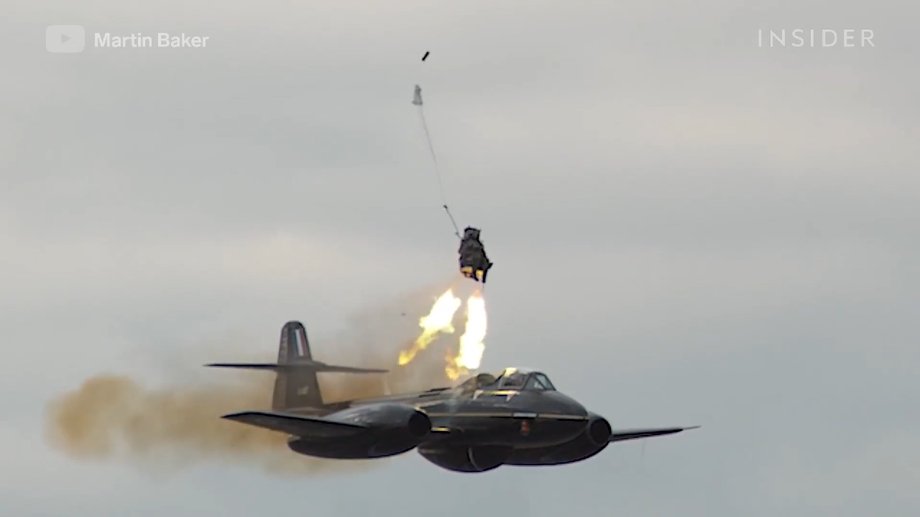
“The catapult moves on guide rails. It launches you at a speed of 15 m/s, and then the rockets are launched,” explains a former US Air Force pilot
|
Business Insider
The pilot's decision is crucial
In 2007, Smith had a harrowing experience while practicing a high-risk maneuver while training off the coast of Florida.
— I was at a low altitude and flying at high speed. I was spatially disoriented, we were fighting over the water at night, and I turned the plane around and didn't notice from the visual cues outside that I had done so. When I reached an altitude of 1.8 km, I decided to continue the flight. We were supposed to abandon the plane if we lost control at 1.8 km, but I decided to continue flying. “I was trying to slow down because I was going over 600 knots,” Smith recalled.
That's incredible speed. 600 knots is equivalent to approximately 1,110 km per hour.
The mortality rate when ejected at speeds above 500 knots is approximately 90 percent. You may get injured or break your neck. Many things can go wrong at such high speeds. The slower the better. The ideal speed is 180 knots. I waited until I reached an altitude of about 600 m and pulled the ejection lever. I have less than a second to live. I ejected while flying at 645 km per hour. Any such action, whether you are flying fast or slow, is extremely violent. I still remember the position of my body when I left the plane. I was thrown to the right and I gasped for air. It was as if the wind had hit you as you fell from the tree. Everything took less than nine seconds – from recognizing the situation to being in the water. I was about 100 km from the shore, but it was very dark and I couldn't even see my hand in front of my face. I was injured, but I didn't realize it because the adrenaline was pumping through me
says Smith.
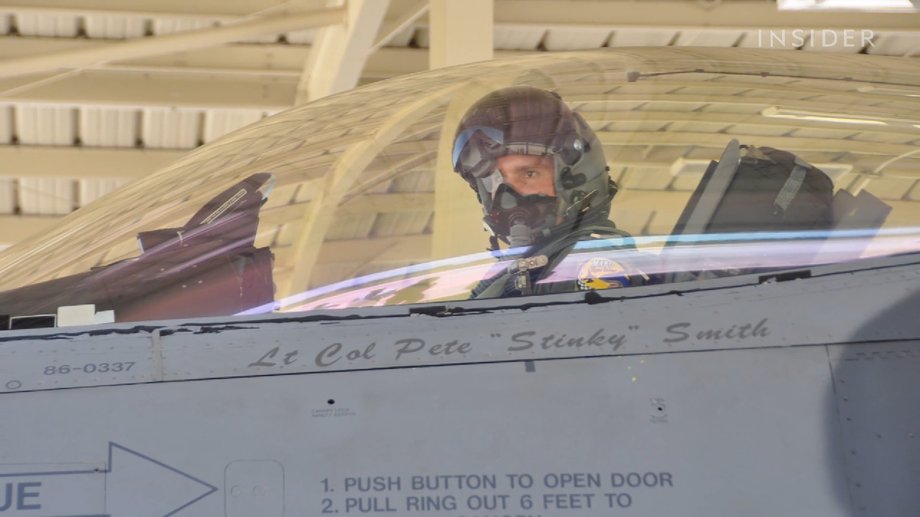
The profession of a fighter pilot involves enormous risk
|
Business Insider
Only after he was rescued by a Navy helicopter an hour later did Smith discover he had cervical and spinal disc herniation, as well as a strained anterior cruciate ligament and tibial collateral ligament. Despite the danger, technological progress has led to a survival rate of 90 percent. for all types of catapulting.
According to Smith, the most dangerous obstacle remains indecision.
— The only thing that can get in the way is a decision. Should I do it now or later? Should you try to save the jet? This type of thinking can get you into trouble. You have to be confident in your actions and that's why we have specific rules. If something goes wrong, you can't hesitate. You have to do it. You have to be willing to pull the lever. And trust the process. explains Smith.