The deposit system in Poland since October has led to a 66% reduction in countries that have implemented it. beverage waste in landfills. The main problem was PET packaging, because the collection of bottles and cans in Poland was already at a decent level. “It is estimated that recycling one tonne of plastics saves approximately 2 tons of CO2,” says the “European Strategy for Plastics in a Circular Economy” prepared by the European Commission.
Read also: The deposit system will actually come into effect in January. Experts warn against a repeat of Hungary
There is a profit in recycling itself, but elsewhere there is a loss. Experts and co-founders of BioVeradi, former researchers at the Institute of Environmental Protection, calculated that on balance the deposit system is responsible for up to three times more carbon dioxide emissions.
Duplicated transport operations
This is all because the deposit system involves consumers' individual transport and duplicates the operations performed by municipal garbage collection. Its operation in rural and peripheral conditions is particularly burdensome for the environment, according to the report.
As the authors of the study write, in the deposit system, emissions are approximately 11 g of CO2 per PET bottlewhereas in the case of a fully effective municipal system, emissions drop to approximately 4 g of CO2.
And since approximately 13 billion PET bottles are used annually in Poland, this means that servicing the entire stream in the municipal system would generate approximately 55,000. t CO2 per year, a with the deposit system, this burden increases to approximately PLN 150,000. tCO2.
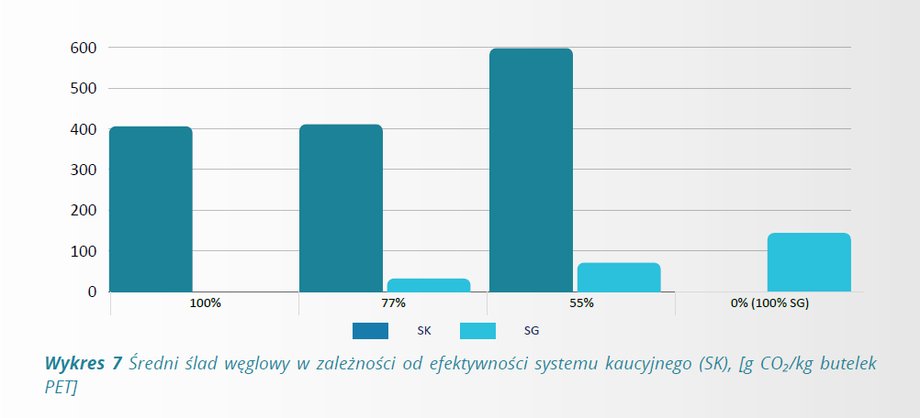
The deposit system and CO2 emissions depending on the percentage of bottles entered into the system
|
BioVeradi / BioVeradi
Why such big differences?
The deposit system needs more transportation
In the municipal system, the dominant factor influencing the environment is: distances between waste treatment installations and recycling plants. In areas with high density of logistics infrastructure, these distances are short and do not exceed several dozen kilometers. In peripheral regions, they can reach values of around four hundred kilometers. Regardless of these differences, route consolidation and mass transport of municipal waste allow the unit carbon footprint of packaging to be kept at a relatively low level.
“In the deposit-refund system, emission sources have a more complex structure. The key element is the consumer's mobility, which in urban conditions may be limited to walking or cycling distances of one or two kilometers, while in scattered communes it means having to travel several kilometers by carwhich significantly increases specific emissions,” we read in the analysis.
“The second critical element is additional transport stepcharacteristic only of the deposit system, viz transportation from collection points to counting and distribution centers. Distances in this respect are significant and generate additional burdens that do not occur in the municipal system,” it was further stated.
Read also: The deposit system is a problem for small shops. The operator describes how to get out of this
Sorting operations are also an important “producer” of the carbon footprint of the deposit deposit system.
“The packaging collected in RVMs (recycling machines) does not go directly to the recycler, but requires further separation – aluminum and steel cans are separated from PET bottles, and in the case of PET, colors are additionally distinguished, which determine the possibilities and quality of recycling. This is light waste, the process of their separation, interstitial transport and preparation for recycling involves with significant energy consumption and emissions,” argue the authors of the report.
In practice, this means that the deposit system, in addition to consumer mobility and additional logistic routes, generates additional emissions related to technological operations, which are not present to this extent in the municipal system.
According to the researchers, the worst-case scenario would be a system in which 50 percent PET bottles are collected through deposit machines, and the other 50 percent. would be thrown into garbage containers as before. The decisive pro-CO2 emission factor would then be the low stability of logistics. The closer to 100 percent bottles in deposit machines, the better for the deposit system and the amount of carbon dioxide in the air. Although it is still more than if the municipal system had remained without the introduction of the deposit system, the expert opinion noted.
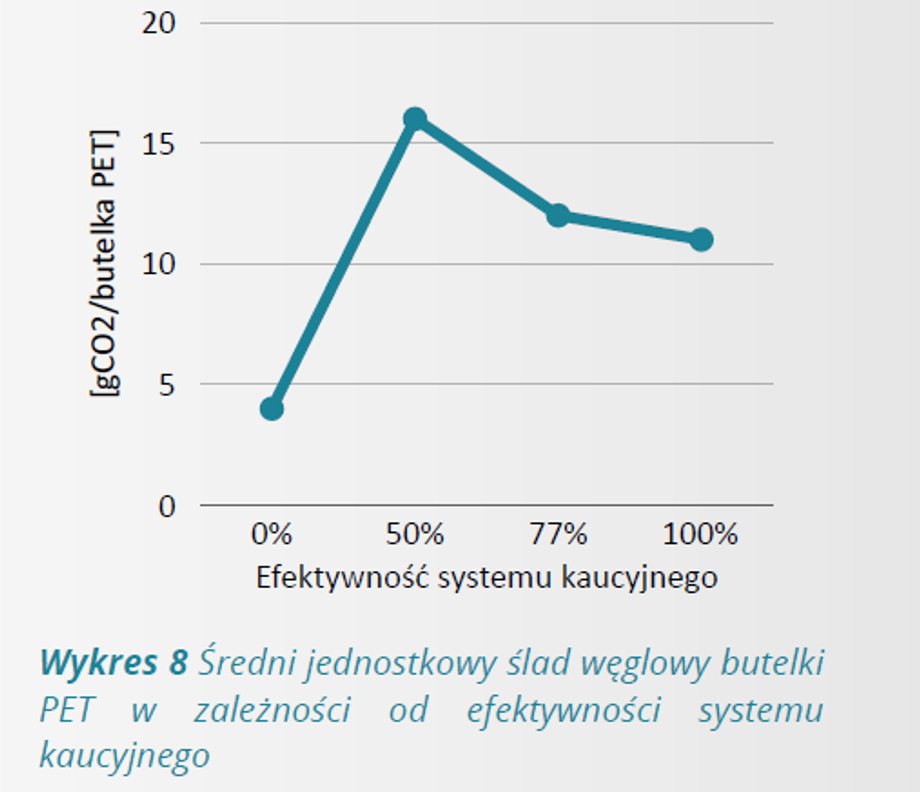
The effectiveness of the deposit system and the carbon footprint of a PET bottle
|
BioVeradi / BioVeradi
The analysis also took into account the structure of fuels and drives in the national and EU vehicle fleet. “The results confirm the dominance of diesel engines in heavy and delivery transport, with a simultaneous significant share of gasoline and liquefied petroleum gas in the passenger car segment,” write Dr. Eng. Beata Waszczyko-Miłkowska and Dr. Eng. Jolanta Kamińska-Borak.
Their analysis took into account all stages of waste management in both systems. Researchers examined the operation of municipal and deposit systems in three regions: urban, urban-rural and rural. Each of them has its own specificity: a different commercial network and access to recyclers. A total of 109 scenarios were analyzed, each of them examined taking into account realistic and representative data and then subjected to sensitivity tests.
Dr. Jolanta Kamińska-Borak is until recently the main engineering and technical specialist at the Institute of Environmental Protection and the director of the consulting company Ekoaudyt, as well as the co-founder of BioVeradi together with Dr. Beata Waszczyko-Miłkowska, a company specializing in waste morphology research and audits of waste installations and systems. The second woman was until recently the head of the Waste Management Monitoring and Forecasting Department at the Institute of Environmental Protection and has been associated with the waste management industry for 20 years.