


Unlike many of his Ukrainian colleagues, historian Jarosław Hrycak still lives, lectures and conducts research in his homeland, where he is a professor of history at the Ukrainian Catholic University in Lviv. However, he is also well known abroad – not only in Poland his books on the history of Ukraine and Ukrainians are published regularly and highly valued by readers.
Welt: Professor Hrycak, in our previous interview in December 2024, you said that the situation of Ukraine must first get worse before it can improve – because it takes time before Donald Trump has enough of Vladimir Putin. At what stage are we?
Jarosław Hrycak: It all depends on Trump's humor. Yes, there is probably a field to negotiate with Putin. However, I think it is very limited. I'm not very optimistic. When Trump took office, there was hope that he could help find a solution. Currently, most Ukrainians have abandoned this hope.
Welt: What role does the story of Putin's motivation play for this war?
This war is primarily about history. Most of his arguments, if not all, have a historic core. False, assembled, but still of a historical nature. In short, Putin claims: Russia has always existed and Ukraine never. Ukraine is not a nation, but an ethnic group that should be part of the great Russian nation …
Welt: … Empire.
Exactly like Chechens or other ethnic groups living in this region of the world. Putin denies that Ukrainians can be a separate nation. However, this was not new, it was so from the beginning of the Soviet Union.
Continued article under video material
“Sooner or later Ukraine will fall”
Welt: Please explain it a bit more accurately.
Aleksander Zipko is largely forgotten today. He was an advisor to Mikhail Gorbachev and at that time a rather famous figure. He later wrote an article in which he described the history of the Ukrainian referendum of December 1, 1991, in which most Ukrainians were in favor of independence. In the circle of the then President of Russia Boris Yeltsin there was a discussion about what to do now. It was obvious that Ukraine would leave the Russian zone of influence.
So the authorities came to the conclusion that it would allow Ukraine to leave – but with the expectation that it would not be able to become a functioning state. Because she was an artificial creation, she would fail. Sooner or later he will fall and will beg Russia to receive Russia. Not only the communists, but also Yeltsin and his people had this approach. Putin began his career in this environment. He was part of Sobczak's circle.
Welt: You talk about Anatolian Sobczak, Mera Saint Petersburg and former head of Vladimir Putin [w latach 90. Putin był jego doradcą, a później zastępcą].
Exactly. If you see recordings from that period, Sobczak was then extremely anti -Ukrainian. Even among the Russian elites considered liberal, there was no consent that Ukraine was an independent state.
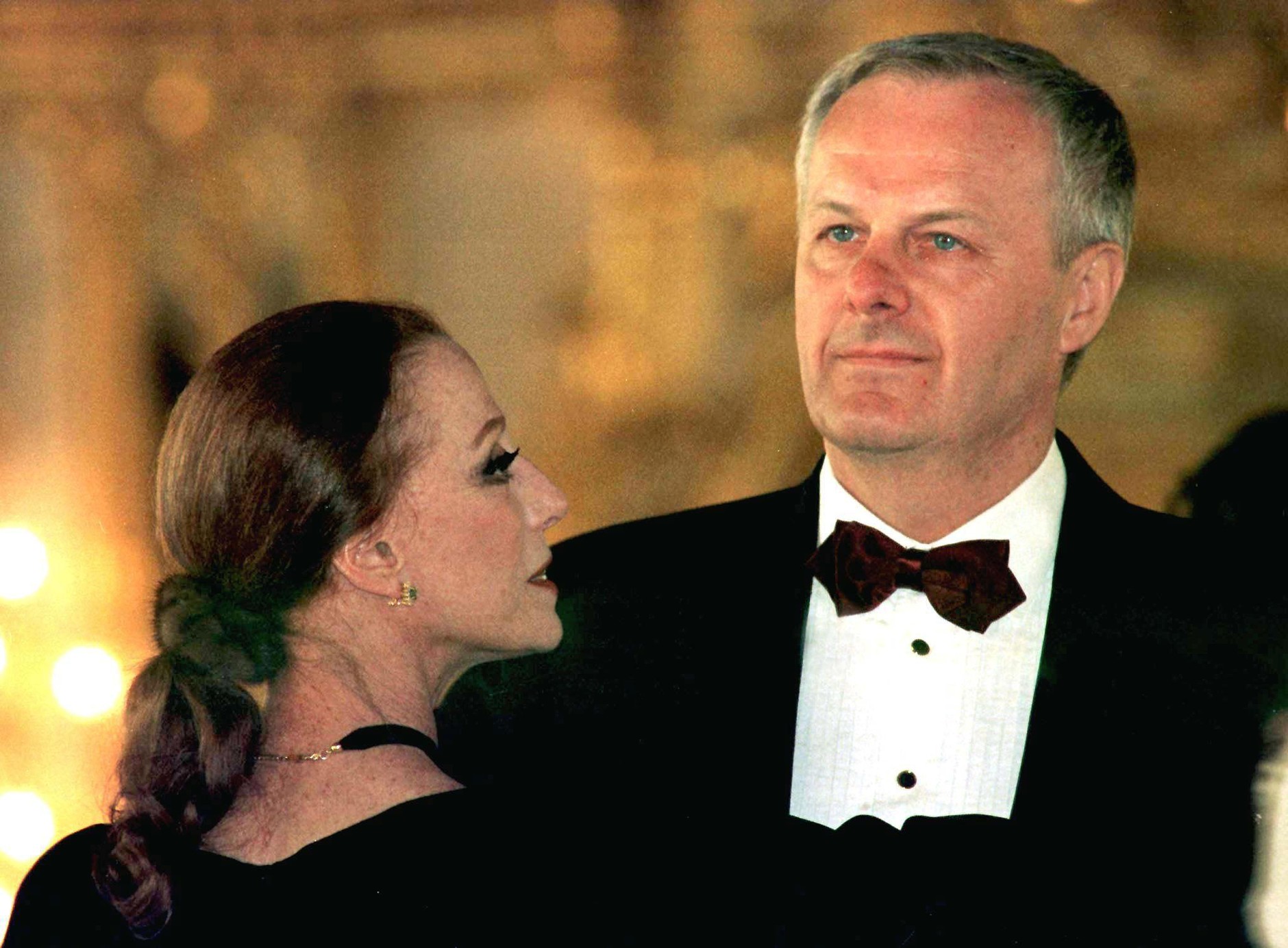
Former Mer Saint Petersburg Anatolij Sobczak while dancing with the famous Russian ballerina have a plezieckie in the palace in Tsarian Siole near St. Petersburg, Russia, February 20, 2000.Anatoly Maltsev / PAP
Welt: And Putin continued this way?
From his perspective, time escaped. Ukraine did not return. That's why Putin had to help, or at least he saw it. He tried unsuccessfully in 2004, during the first Maidan [protestów po sfałszowaniu wyborów w Ukrainie]. He also failed during the second Majdan in 2013 and 2014. So he decided to act. From what we know, the plan of broadly invasion of Ukraine was approved at the end of 2008 or at the beginning of 2009 immediately after the war with Georgia.
Welt: Why?
Because Putin had the impression, or rather the illusion that the West would not support Ukraine. It happened in the case of Georgia. That is why he probably decided that he would have a free hand. The strategy consisted of stopping Ukraine with military measures as soon as it began to approach the West. That's what it was about. This would result in the division of the country.
Welt: What would it look like?
There would be three parts. One of them would be “New Russia”, Russian -speaking territories on the Black Sea coast, from Odessa to Mariupol. Together with the industrial heart of Ukraine, Dnieper and Zaporży. In turn, Western Ukraine has never been interested in Putin. In his opinion, she was too nationalist, too toxic and did not match his vision of Russia. He believed that the annexation of Western Ukraine and the Baltic countries was a mistake of Stalin. These regions were a kind of Trojan horse if you can say that.
He proposed to the then prime minister of Poland [Donaldowi Tuskowi]to regain Lviv [informował o tym szef MSW Radosław Sikorski, ale później te informacje zostały zdementowane]. And what would remain, i.e. mainly the agricultural center of the country, would be transformed into a puppet state, at least as depending on Moscow as Belarus with (President Aleksander) Łukaszenka.
So this was the plan. Donbass was not Putin's main goal. It is a small part. His plan is much more ambitious. So we have no reason to think that Putin will stop after acquiring specific territories. It would be a short break before he started a new war to achieve his goals.
Welt: You are also critical of Wołodymyr Zelanski. In the past, you accused him of autocratic trends. So what?
First of all: now political life in Ukraine is negligible. It was largely monopolized by the Zelanski party. And that suits him. If he put pressure on his party, he will support him unanimously.
In addition, he decided not to close opposition television stations … what [i tak] It would not be possible. But it weakens them. The channels are still united under the so -called A umbrella of the war marathon, so they show the same news.
Finally – and this is the most important thing – he considers personal loyalty to be the main criterion when employing staff. Not professional skills.
Welt: How dangerous is this?
HRYSAK: I must say that I do not consider it authoritarianism. It's a trend. Because democracy works. There is an opposition, there are alternative mass media, there is free access to the Internet. There are lively discussions in society. Zelanski is constantly severely criticized. There were large protests against the new anti -corruption act. They were organized mainly by young people, which is extremely important. They gathered everywhere. I want to say that you should not attach too much importance to this trend. Because he won't survive.
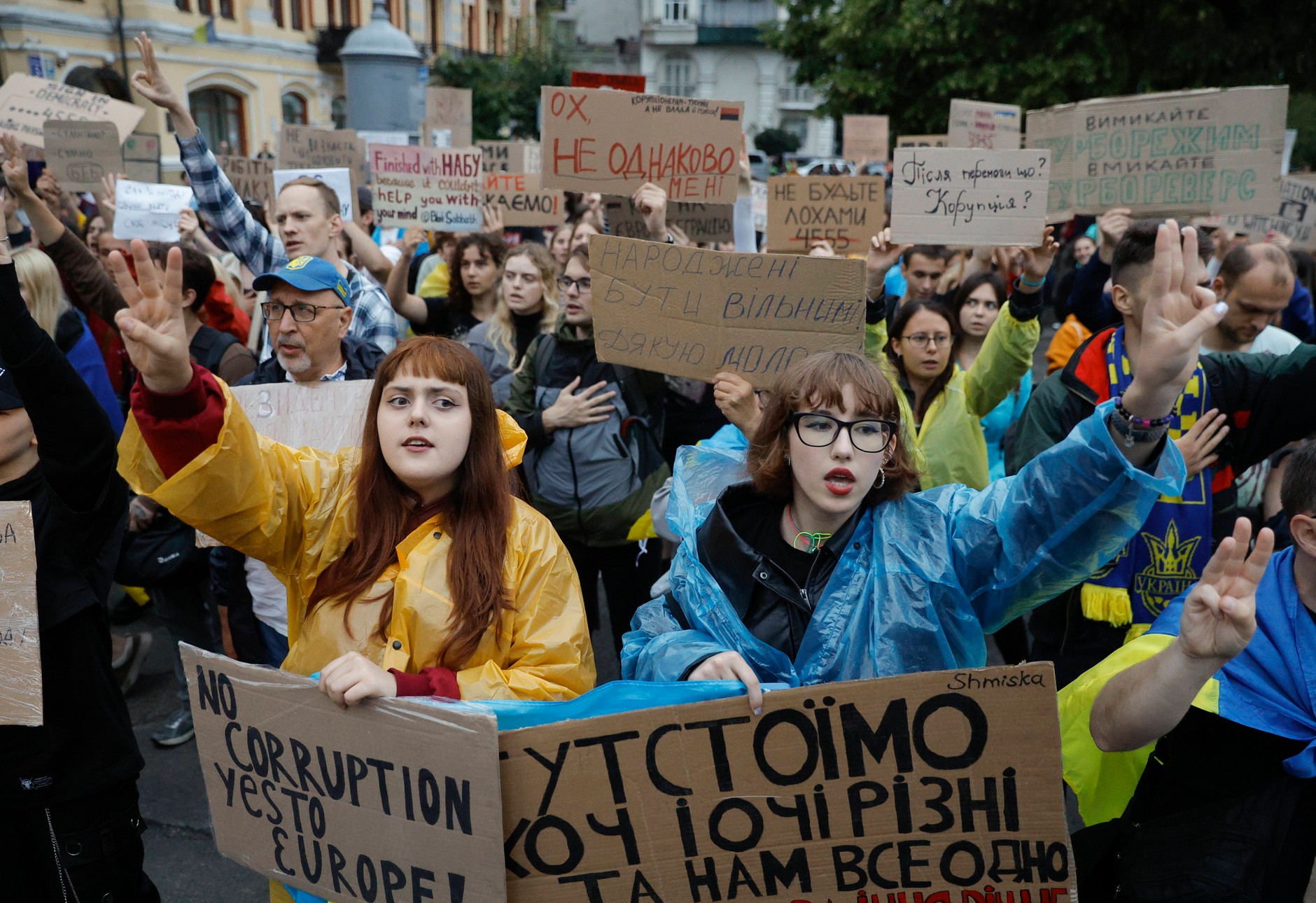
Protest against the limitation of the autonomy of Ukrainian anti -corruption bodies in Kiev, Ukraine, July 30, 2025.Sergey Dolzhenko / PAP
WELT: How do you know this certainty?
Because Ukrainians do not have the same attitude towards the state as the Russians. In addition, Ukrainians know that we are at war. They may be dissatisfied with some Zelanski's actions, but they will not try to get rid of it during the war. Ukrainians still trust him. Especially when he is attacked. He still represents Ukraine on the international arena and is seen in the country. Every time he is criticized, for example, by Donald Trump, his popularity is growing.
Welt: Why is the Ukrainian society regularly manage to oppose the authoritarian tendencies of its leaders, while this is not happening in Russia, at least not so successful?
That is why history is so important. It explains various historical trajectories. The main difference between the Russians and Ukrainians is not about language or religion. It lies in political traditions. Ukraine has long been a strong tendency to what we call civil society today. In addition, she always maintained the distance to power. To you. There was also no state church. The state and the church were two separate institutions, as in the West. Ukraine is much closer to the West than Russia. He believes that the authorities must be limited. And this is the essence of European political tradition.
“It will surprise many readers”
Welt: Due to the influence of Poland and Lithuania, which for centuries controlled the significant parts of today's Ukraine?
Correct. There is an illusion that Ukraine has always remained in the shadow of Russia. That's not true. The Russian factor is relatively new in Ukraine: in the east from the 17th century, in other parts only from World War II.
The Polish factor is much stronger. Many readers will be surprised by this, but the most popular language in Kiev at the beginning of the 19th century. He was neither Ukrainian nor Russian, but Polish. The king was elected in Poland, and his power was limited by the nobility. There was agreement among the nobility: nothing that concerns us without us. This is exactly what Ukrainians demand today. Ukrainian identity was created between the Russian Empire and Polish nationalism. It can be said that the equipment was Russian and the software was primarily Polish. The first line of the Ukrainian hymn is the same as in the Polish anthem.
Welt: It says more or less: that the country has not yet collapsed …
However, there is a third country whose anthem has the same first verse: Israel. The composer of the Israeli hymn was born in today's Moldova, a border region very similar to Ukraine. This is just a short reminder of how these ideas have spread. We tend to forget about it.


