Although the system is just moving, Poles still do not know about it. According to the IBRIS study conducted at the request of the Clear Communication Group, 47 percent Poles declare that they know how the system will work. Last week, the results of the poll were published by the Polish Press Agency.
Another 25 percent respondents heard about the system, but knows no details. However, more than a quarter of the respondents did not come across the subject of the system.
In the report describing the study, the authors pointed out that SThe low level of knowledge applies to the youngest age group 18-29 years. Almost half of people of this age have never heard of the issue of introducing the system in Poland before, and its principles understand 28 percent. In the case of respondents aged 30-39 and over 70 years old, 57 percent declared knowledge on this subject and 59 percent
In the publication, the authors also indicated that 37 percent Poles expect visible markings and posters about the deposit system in stores, and less than one fifth counts on the help of service.
Cause system. How will it work?
In theory, the matter is simple. Poles will have to pay a deposit for:
- Plastic bottles with a capacity of up to 3 liters (deposit 50 gr),
- metal cans with a capacity of up to 1 liter (50 gr),
- glass bottles of reusable use up to 1.5 liters (PLN 1).
The latter, however, will not be covered by the bail only from January 2026. All due to the transition period planned by the authors of the Act.
As a result, for a half -liter carbonated drink, which until now cost PLN 3.99, now we will pay 4.49 PLN, because 50 groszy will be added at the cash register. If we keep the bottle and return it to the store, we will recover the 50 groszy.
And here the first “but” appears. Due to the transition period, hardly any bottle will be “ubinated “on Wednesday. So that the store could charge 50 groszy such a deposit, it The packaging must be marked with a special stamp on the label. We present it below.
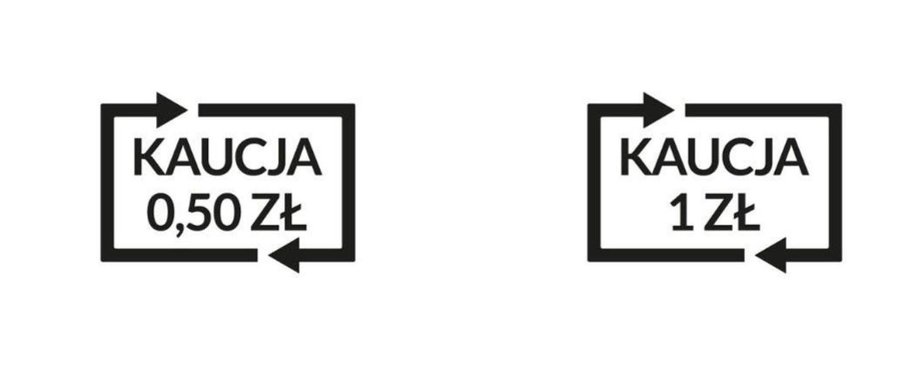
This is how the labeling of bottles and cans covered by the deposit should look like.
|
Gov.pl
Packaging with a deposit at the beginning will be rare
You have to remember that in October on store shelves Only the deposit -covered packaging will start appearingwhich means that for some time drinks in “old” bottles and cans will remain on them.
Producers of beverages supplying goods and stores themselves as part of the transitional period got time for Sale of stocks by the end of this year.
See also: Two types of packaging on shelves. The transition period will last three months
The process of replacing “old” new packaging – to which representatives of the Ministry of Climate and Industry pointed out – will take place gradually. – I think that in six months we should have most of the new packaging on the market – said Deputy Minister Anita Sowińska a few days ago.
The representative of the climate ministry admitted that it is also possible that from October 1 “there will be no packaging” covered by the deposit on store shelves. It is very likely that no deposit on Wednesday will be charged yet.
What's more, regardless of the three -month transition period, the drink manufacturer may also decide that He will not start the deposit system at all, agreeing to pay the so -called product fee, i.e. de facto penalties. Precisely because of the process of withdrawing old packaging, it can last longer.
According to the Chaos industry, which may arise because of this, it is a ministry error. Manufacturers appealed to postpone the entry into force of new regulations, as we wrote about last week at Business Insider Polska.
See also: The deposit system will realistically come from January. Experts warn against a repeat from Hungary
You will not give the bottle everywhere
Once the system starts to operate in full swing, and in stores there will be “bailed” bottles, many questions among Poles will arise. In view of the above, it is quite obvious that we will not get the money for the drink bottles that we bought before the system enters into force.
But that's not the end. Until January, the deposit will not be subject to glass bottles of reusable (usually after beer). Here, the producers got more time to adapt.
What's more, you will not be able to return bottles and regain the deposit everywhere. The regulations impose the obligation to collect bottles and cans for shops with a commercial area higher than 200 sq m. This automatically excludes almost all frogs, but the network has already announced that it will join the system voluntarily, and for bottles and cans customers will receive additional ŻAPPS (even for those not covered by the sacrum, without the stamp presented above).
See also: Żapps for bottles. Żabka joins the deposit system
Importantly, we will be able to recover the deposit not only in grocery stores or discount stores, but wherever you can buy drinks in returnable packaging. Provided that these branches have at least 200 sq m of commercial space.
As a result, we will return not only in Biedronka or Lidl, but also in sports stores, drugstores or large pharmacies. Of course, provided that you can buy drinks in “bailed” packaging.
The pros and cons of the bail system
To regain the deposit, you have to be very careful. From the pros: You will not have to have a receipt or other proof of purchase for a refund.
As for the minuses, when returning A bottle or can can not be damaged or crushed in any wayand the label is detached. This means that storing more packaging and giving away, for example, once every few weeks will require a large amount of storage space. In small apartments, this can be a great nuisance.
Depending on the store, the return can take place either in special vending machines or by a store employee. Sometimes retail chains, instead of giving cash, will print special vouchers, which can later be used at the ticket office to pay for at least part of purchases.
Interestingly, some retail chains took bottles and cans before the start of the deposit system. Lidl, for example, paid 10 groszy for each such packaging (even without special marking). Żabka, in turn, rewarded customers bringing empty cans with Żaps, i.e. points in the mobile application of the network.