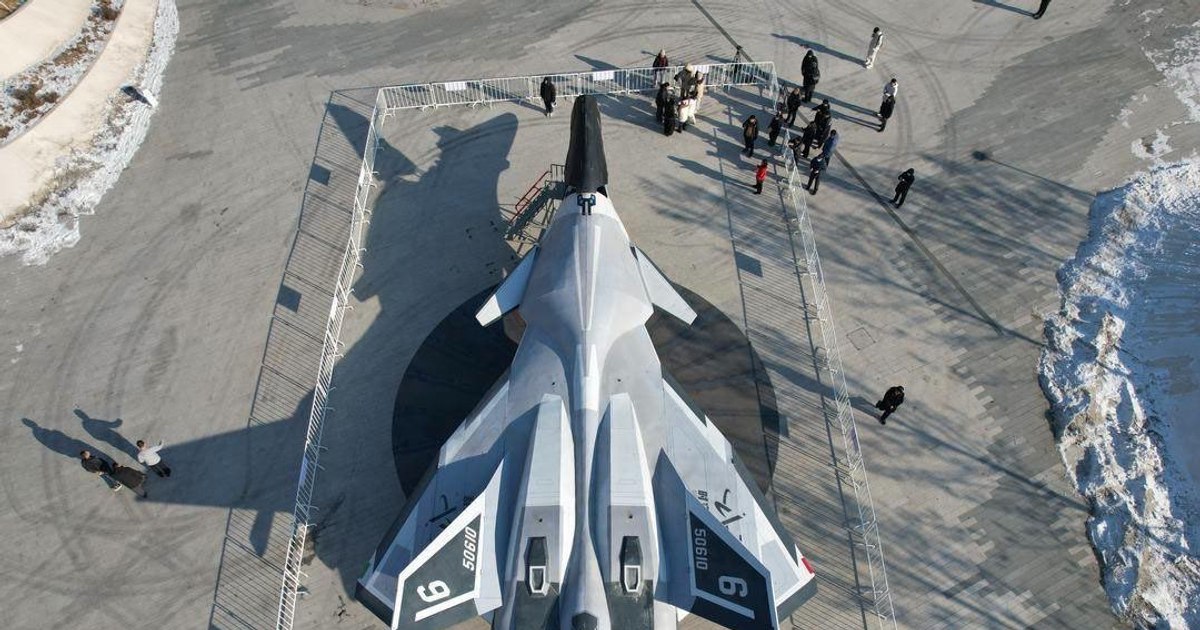
At the beginning of September, Beijing organized a new force demonstration. On the streets of the Chinese capital, they paraded some of the most sophisticated weapons in the popular release army: DF-5C intercontinental missiles with a radius of 20,000 km, torpedoes with the length of a bus and ballistic launchers JL-3. But what has not been seen at the parade was even more grateful: the lack of an intensely announced prototype in recent years – the sixth generation hypersonic plane, called the “white emperor”.
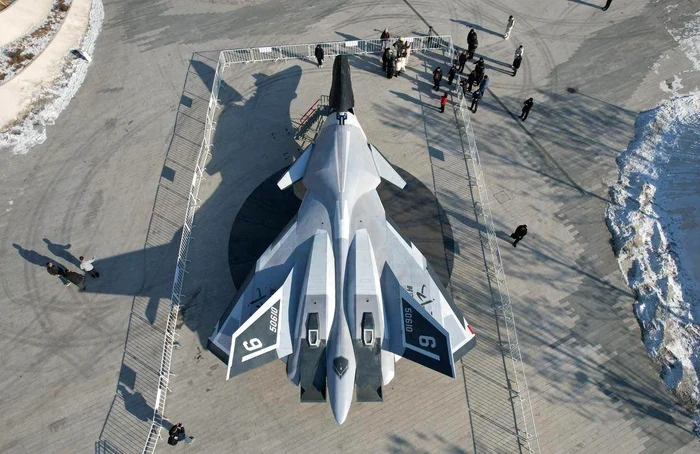
The white emperor, the Chinese hypersonic plane/photo: x
His absence has fueled speculation. Is this militaro-spatial project really really witness or witness a sophisticated influence operation, meant to trigger a strategic-and financial reaction-from the United States?
A project between reality and myth: “Gates of South Heaven”
In recent years, China has constantly fed, in the state-controlled media, the idea of a technological revolution in the field of air and spatial defense. The Nantianmen project (literal: “The gates of the South Heaven”), carried out under the umbrella of the Avic industrial giant, promises the total integration of hypersonic technologies, orbital flight capacities and artificial intelligence in a unique fighting platform.
Since 2019, various conceptual models have been presented at military exhibitions and demonstrations, depicting unanswered space vehicles, aircraft equipped with particle accelerators, mesonic generators or electromagnetic armament. Some names, such as “Luanniao” or “Xuannv”, seem rather detached from an SF film than from the industrial reality. These mythological allegories were interpreted by Western analysts as part of a psychological strategy of misleading.
“White Emperor”: a platform, many questions
The most tangible piece of the project is the so-called “white emperor” (Baidi), a hypersonic space prototype presented for the first time on a real scale in 2024, within the Zhuhai Aeronautical Salon, on the occasion of the 75th anniversary of the establishment of Chinese Air Force.
According to official sources, this device should be capable of maneuvers at hypersonic speeds, operate at the limit of space and hit targets outside the terrestrial atmosphere – including satellites or orbital infrastructure. Version B would include data fusion systems, modular aircraft and advanced stealth architecture, with an internal compartment for high caliber armament.
And yet, despite all these details, the “white emperor” remains in the stage of non -functional prototype. There are no flight images, public demonstrations or clear evidence of technological viability. In other words, beyond spectacular models and video rancids, what we have is a concept – and a campaign.
A trap for the American budget?
Several Western analysts, including the former councilor of the American Congress Brandon J. Weichert, warns that the stakes of this type of propaganda is not only regional. China could try to trigger an exaggerated response from the United States, causing them to allocate colossal budgets to compete a technology that does not exist (yet).
It is a mechanism similar to the one who, in the 1980s, caused the Soviet Union to allocate huge resources to keep up with the strategic defense initiative of the Reagan administration – with a devastating economic and political cost.
How far is China?
It must be said clearly: China is already a major actor in the field of advanced defense technologies. Mass produces fifth generation aircraft, such as J-20 and J-35, while Americans are still facing difficulties in operating the F-35 fleet. This imbalance raises the question: Why would Beijing risk investing massively in a program with a huge level of technological uncertainty?
And more important: even if the “white emperor” would become a reality, how much would change the rules of the game?
Tranquility and caution
For the US-and for its allies in the Asia-Pacific region, such as India or Japan-it is not the time for panic, but for cold and calculated evaluation. If the Chinese project will advance, it will require years of testing, validation and integration. But even in the absence of immediate results, China's technological developments indicate a clear strategic direction: dominating the future of the militarized space.
Therefore, between myth and reality, the “gates of South Heaven” are not (yet) open. But they remain a mirror of Beijing ambitions – and a signal that American technological superiority can no longer be assumed, but must be permanently reconfirmed.