Value oil imports to the EU In the second quarter it fell by 12.7 percent. rdr. On the other hand The volume of imported oil fell by 0.1 percent – Eurostat said. Meanwhile Import of natural gas in a gas state It increased in the second quarter of 2025. Compared to the second quarter of 2024, it increased by 7.2 percent. according to the value, a The volume dropped by 5.9 percent Imports of condensed gas in the second quarter of 2025, compared to the second quarter of 2024, it increased by 39.0 percent. according to values and It increased by 22.9 percent according to volume.
This means that although gas pipelines are reduced less, mainly because of the gas embargo from Russia, we bring more and more gas balance, but by ships.
Still significant amounts of gas boils down to the EU from Russia. As much as 7.8 percent were brought in gas pipelines. In the second quarter of this year, but a year earlier it was 15.8 percent. – says Eurostat. Norway became the main supplier. In the case of liquefied gas, Russia supplied 12.9 percent. gas compared to 16.4 percent a year earlier.
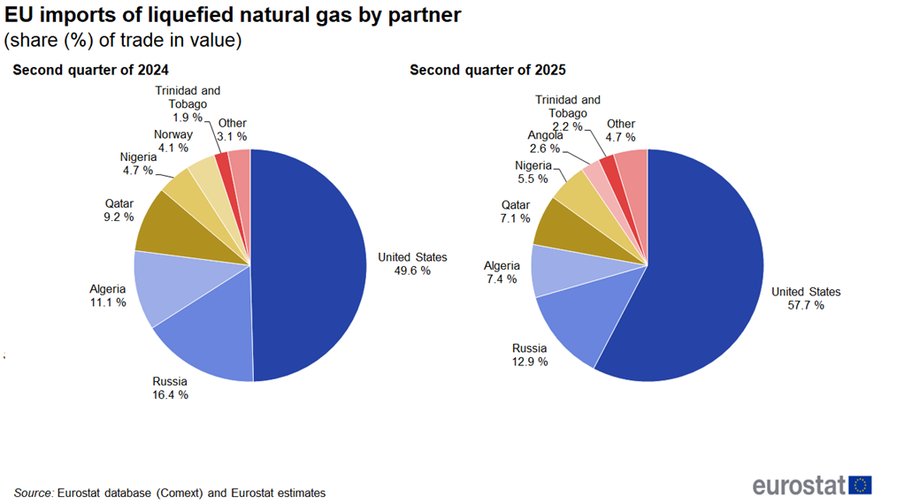
Directions of condensed gas imports to the Union
|
Eurostat / Eurostat
In the second quarter of 2025, Norway (15.2 percent), the United States (14.2 percent) and Kazakhstan (12.7 percent) were the largest sellers of petroleum raw materials to the EU.
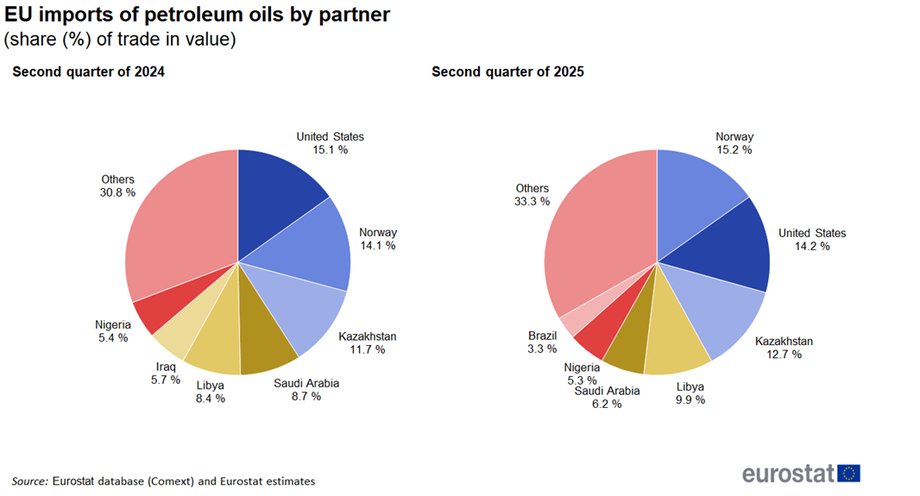
Directions of imports to the EU petroleum products
|
Eurostat / Eurostat
Norway was the largest supplier of natural gas for the EU in the second quarter of 2025, with a share of 50.8 percent. Algeria (17.8 percent) and Great Britain (12.1 percent) were in the following places. Compared to the second quarter of 2024, Norway's participation increased by 7.2 points. percent
In the second quarter of 2025, the United States (57.7 percent) was the largest supplier of liquefied natural gas to the EU. Russia (12.9 percent), Algeria (7.4 percent) and runny nose (7.1 percent) were in the following places.
Electrics begin to dominate
The decrease in oil import, although for now small, is more and more a consequence of structural changes in buying passenger cars. According to ACEA data from January to July this year. In Europe (EU+EFTA+United Kingdom), 4.8 million passenger cars were bought at least in electric part (+20 % yaws), of which battery electricians 1.4 million (+26 percent rdr), plug-in hybrid 0.7 million (+25 percent rdr), and Hybrid of ordinary 2.8 million (+15 percent. rdr).
The decrease in the prices of battery electricians means that customers are increasingly willing to decide in the salons just to buy them. They constituted 17 percent. new car registrations in Europe this year, and in total all cars at least in electric part are already 61 percent. market. Poland applies to a small extent, because although the sale of BEV battery cars increased by as much as 80 percent. RDR, this sales of over 18,000 until July accounted for only 5.4 percent. market, and ordinary hybrids (48 percent registration) and gasoline (31 percent) dominate.
Although, according to ACEA data for 2023 (the latest available) electrics and hybrids, it was only 7.1 percent in total. passenger cars driving around Europe, 50 percent They are gasoline, and 39.5 percent Diesels, this situation changes very dynamically. This will gradually change the structure of the consumption of energy raw materials and we are probably just observing this effect in the form of shrinking of oil imports. Gradually, there will be less and less fuel refineries.
However, there is a growing demand for gas, which is used more and more commonly by power plants, but also as fuel for gas cars. The current from gas power plants is an important way to balance the instability of windmills and solar panels, so the demand is growing. WITH The railways will also need more and more as the electricity fleet will grow.
Less and less import of coal
The demand for coal is shrinking. Charged with great taxes (ETS) Energetyka Węglowa reports less and less demand and coal importmeasured in value, fell by 35.2 percent and fell by 7.4 percent according to volume – Eurostat said. Mainly Poland still produces in Europe from hard coal, and mainly such carbon is transported at greater distances (brown is mined right at the power plant), so it is largely our data.
In the second quarter of 2025, the United States (35.3 percent) was the largest coal supplier to the EU. Australia (33.2 percent) and Colombia (12.5 percent) were in the following places.