Ukraine develops new shields against shahed drones. Kiev's plan to effectively combat drone swarms


Kiev has the necessary interceptors to counteract the fastest Drone Shahed, reports Business Insider, citing Ukrainian sources. Ukraine has the goal of reaching 1,000 interceptors per day, according to Ukrainian Prime Minister Denîs Șmîhal.
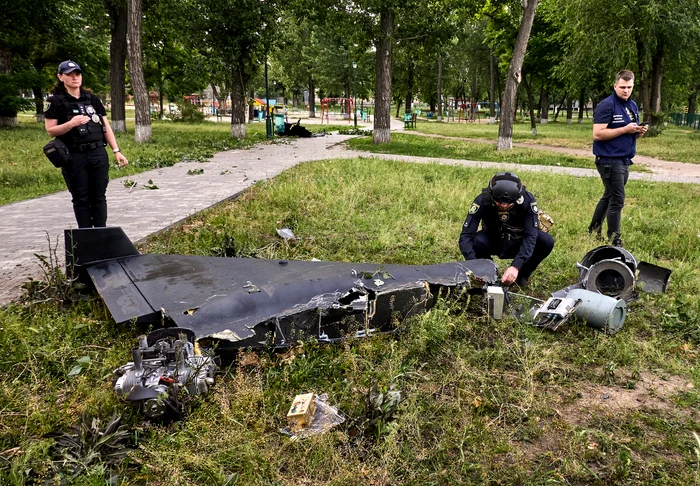
The wreck of a shahed drone in the Kharkov region of PHOTO EPA-EFE
A high -ranking Ukrainian official has revealed that Kiev forces already have intercepting drones capable of destroying the latest models of shahed drones, an emerging threat that worries Kiev from the point of view that these drones can reach.
“We have intercepting drones capable of fighting against the shands equipped with reaction engines. The enemy is developing, but we are not in place,” said Pavlo Palisa, the deputy head of the Ukraine Presidential Bureau, in a video interview given to the local public public.
The official declared Ukraine continues to develop more and more drones (FPV) that can contribute to the creation of an “optimal” air defense system to cover different altitudes and distances.
“Russia in turn changes its drones; they are already flying with reaction engines, but we also have solutions and protection against them in our FPV projects,” he told Novine Live.
Palisa did not publicly provide details about these intercepting drones, but his statement indicates that Kiev continues to develop a technology needed to counteract the next generation of Moscow's long -range attack drones.
The newest Russian drones are Geran-3, a version produced internally by the Iranian Kamikaze drone Shahed-238.
Geran-3 uses a turbojet engine, which allows it to fly much faster than the Geran-2 model, the Russian analog of Shahed-136 and currently the central element of Russia's large-scale bombing against Ukraine.
While Geran-2 flies about 185 km/h and has an action range of about 1000 km, Geran-3 would have a speed of 370 km/h and an action-range at least equal.
On the other hand, its reliable combating could prove a major challenge for Ukraine, which is already experiencing difficulty in defending the At attacks with Drone-2, Russia launching hundreds of such drones, together with baits, to overwhelm the aerial defense.
In this context, Kiev works on maximum speed speed to increase the production of FPV interceptor drones – cheap, but fast enough to bring down the Geran -2 drones with a small load.
If they were in the mass, these FPV drones could fill the gaps in Ukrainian air defense, releasing more advanced systems to target more important threats such as ballistic missiles.
Interceptors have become increasingly important after Russia began to launch Shahed drones at high altitudes, to bypass the teams armed with machine guns in charge of their breaking.
The new Shahed drone could be developed on a large scale
But Geran-3 is a truly difficult challenge for Ukrainian intercepators, who have to create FPV drones twice as fast, but which are still enough to make a profitable air defense.
There is no information about the fact that the Geran-3 drone was currently on a large scale, but that could change soon.
The new attack drone has been observed sporadically since January, but appears with an increasing frequency in the air defense reports in Ukraine. It is not clear whether they are prototypes or a final version of the Geran-3 variant.
On Tuesday, the Ukrainian military intelligence services have made new details about Geran-3, namely that it is equipped with a new satellite navigation system that makes it immune to the electronic war targeting radio frequencies, the most encountered type of jamming.
At least 50 of the parts of the Geran-3 rocket come from abroad, has recently shown a report of the intelligence services.
The presence of Geran-3 missiles indicates that Russia continues to engage in the development of long-range attack drones, pushing war in air space.
Ukraine needs a capacity of 1,000 interceptors per day
“We have proposed the goal of 1,000 drones. It is not just that, it is a necessity to be able to break all the Russian drones effectively,” said Ukrainian prime minister Denîs Șmîhal at a press conference.
According to him, Russia has shown that it has the ability to launch up to 800 drones per night, and this situation forces Ukraine to develop a flexible and scalable air defense, based on modern technologies: “Consequently, we must have at least 1,000 intercepting drones, and this level will be reached.
However, the Ukrainian official stressed that the problem Esye is more than the production of drones itself.
“We can reach this level very quickly. Immediately. But the question is linked to the number of soil control complexes, radars, elements that use artificial intelligence for guide,” he explained.
Thus, the interception system is the “peak of the iceberg” from a whole defense complex, involving other components, such as electronic war, radar systems of early detection and artificial intelligence, for data integration: “It is a vast complex, and its implementation requires time. But we are confident.”