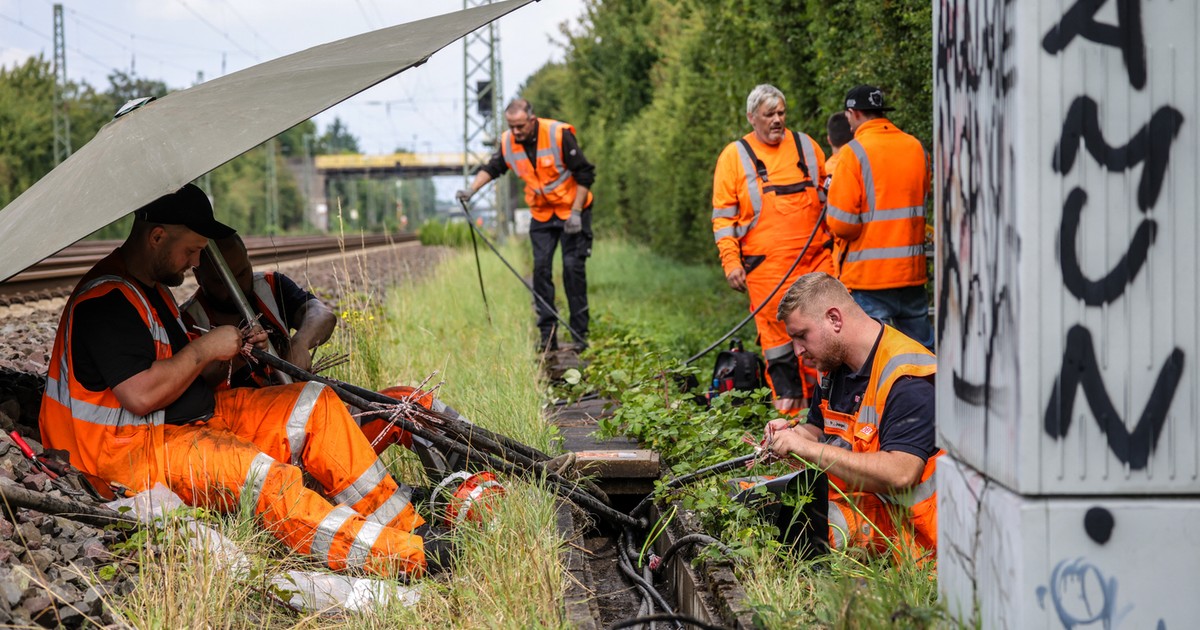
A fire in a cable glass near Duesseldorf at the end of July It was enough to paralyze rail traffic in the middle of Germany: express trains to Berlin and Frankfurt were delayed or did not run at all, connections with the Netherlands and northern Germany were canceled.
Shortly thereafter, a letter appeared on the leftist information platform Indymedia in which the perpetrators pleaded guilty. According to the letter, the attack was carried out by Kommando Angry Birds, an opening group referring to the “Switch off – destruction system” campaign. Their goal was to sabotage German infrastructure. Attacks of this kind have become more frequent in the last two years. In the summer of 2024, cable systems were set on fire between Brem and Hamburg, and a few months later a railway line in Berlin was attacked. In April 2025, the purpose of the attack was the German-Swiss borderland near Basel.
The German counterintelligence of BFV explains that Switch off is “currently the most important combat campaign among leftist extremists”. The movement was created in 2023 and combines classic anti -capitalist slogans with climate policy issues. Campaign clearly rejects all actions of the state to solve the climate crisis. Instead, according to BFV, activists demand the attack of “infrastructure of capitalism” and people responsible for “destroying nature” and overcoming “current conditions”.
By attacking cable windows, power lines or railway systems, leftist extremists wanted not only to harm a given companies, but also shake the entire capitalist system. The public staging is particularly dangerous: “Switch off offers brutal leftist extremists the opportunity to gain fame with its actions, place them in a common ideological context, and thus attracting potential imitates” – explains BFV.
Continuation of the material under the video
In September 2024, the Kommando Angry Birds group published instructions to imitate their Switch Off slogan. Title: “Lighting cables for beginners”. The 23-page textbook describes how to sabotage the infrastructure with delayed ignition-A All this using materials that are freely available in supermarkets or DIY storesas the leftist promise extremists. Instructions are publicly available.
“They are annoyed by citizens who want to get from point A to point B every day”
North Rhine-Westphalia is one of the Lands most affected by a series of attacks. The local Interior Minister Herbert Reul warns: – Anyone who attacks critical infrastructure, attacks our society. Attacks on the railway do not weaken you or help nature, but they annoy citizens who want to get from point A to point B every day.
The ministry believes that The threat from leftist extremists has increased significantly. The perpetrators choose those objects that “promise the greatest possible damage at the lowest possible risk.” Many objects have not been sufficiently or secured at all. And investigations are particularly difficult due to “complex evidence and perpetrators acting in the conspiracy”.
Felix Neumann, an expert for extremism at the Konrad Adenauer Foundation, also emphasizes that the state itself is not able to guarantee the protection of critical infrastructure. – Critical infrastructure protection can only be achieved through a package of funds, individual methods are insufficient – he explains in an interview with Die Welt. In addition to strict federal and state coordination between the police and intelligence services Therefore, international cooperation, investigation and prevention are needed.
Neumann also warns against social effects. Left -wing extremist groups effectively publicized the issue of climate protection with combat forms of protest. – As a result, there was a greater sabotage of climate policy, and at the same time justified and peaceful demands of climate protests without violence were sometimes presented in a negative light – he says. The more important is the determination of a bright limit: – Politicians should fundamentally oppose the use of violence as a legitimate measure. When it comes to leftist extremism, there are still voices that say: a good thing, bad means. This relativization is dangerous.
Germany wants to better protect critical infrastructure
In turn, Deutsche Bahn reminds that he is already using advanced technology. “Mobile and stationary video technology is increasingly used, as well as impact sound sensors and thermal imaging cameras,” in accordance with the statement of German railways in response to our inquiry. In addition, fast routes, such as Cologne-Akwitran and Cologne-Frankfurt, They are regularly offended by drones for faster detection of damage and theft. The railway, however, excludes a network fence with a length of 34 thousand. km – it would be enough “to circle the earth with almost one and a half times”.
Christoph Reichwein / DPA / DPA Picture-Alliance via AFP / AFP
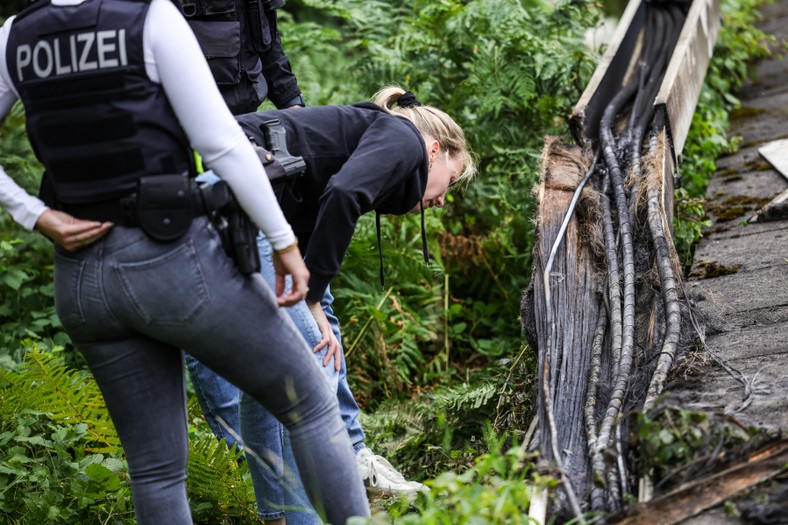
Police at the cable setting at the tracks in Duesseldorf, 31 July 2025.
Without better protection, railwaymen will probably continue their activities. The Federal Ministry of the Interior therefore refers to the planned Critical Infrastructure Act, which for the first time is to establish binding protection standards. This is intended to save in law not only the requirements of IT security, but also physical protection measures. In the future, operators of facilities serving over 500,000 persons will be required to submit risk analyzes and implement specific resistance measures. For Deutsche Bahn, this would mean providing additional security concepts for lines and signaling systems.
Experts believe that railway infrastructure remains susceptible to threats despite the planned legislation. Manuel Atug, founder and spokesman for the Independent Working Group “Kritis”, calls on state operational structures such as federal police or counterintelligence, to provide publicly available and automatically analyzed image of the situation. – We cannot prevent sabotage acts on railways, but we can drastically reduce their impact, if well -equipped crisis management teams will be able to repair damage very quickly – says Atug. This is the only way to minimize downtime to such an extent that the attacks will lose their effectiveness.
Hans-Walter Borries, vice-chairman of the Federal Association for Critical Infrastructure Protection, also criticizes too long time intervals between risk analyzes and no standards for technical security. – Checking every four years is not enough. We need annual ratings and clear specifications for drones or peripheral protection – says. He is about protecting railway areas with fences, cameras or sensors. In connection with hybrid threats, including those created by state entities from abroad, he calls for a targeted supervision extension at sensitive points, such as substations and repair plants.
I’m Ashley Davis as an editor, I’m committed to upholding the highest standards of integrity and accuracy in every piece we publish. My work is driven by curiosity, a passion for truth, and a belief that journalism plays a crucial role in shaping public discourse. I strive to tell stories that not only inform but also inspire action and conversation.