Wave of strikes in administration, education and justice. What is hiding behind the protests and how healthy they are for society


Several mayors suspended their activity, some of the courts stopped their court hearings, and the teachers go out. Is Romania block? Is it a legitimate form of protest or just a brake for society?
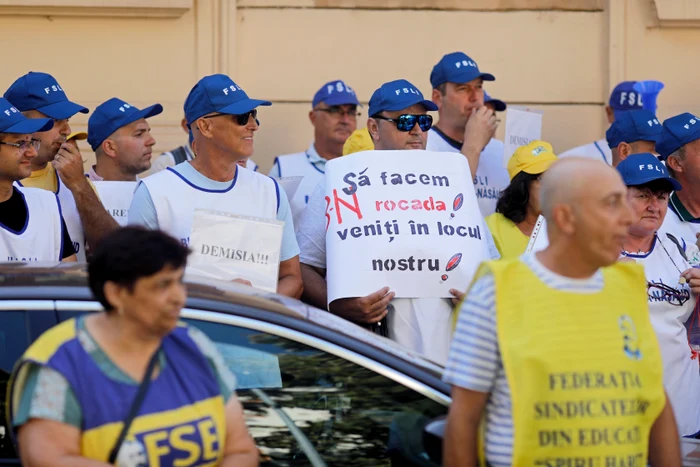
Protest FSLI at the Ministry of Education, August 13, 2025. Inquam Photos / Mălina Norocea
The wave of protests of the last weeks from the mayors to the magistrates and teachers, raises essential questions: is the country block through such strikes? Is this form of protest okay in view of the economic crisis we are in? Who helps and who affects the strikes in public institutions?
“What will the mayors, magistrates and other protesters do when Romania will reach the IMF hands? Will they continue to claim that the expense cuts are absurd and that the economy has to produce the money needed to increase salaries and other benefits? A question that we hope we do not have to find out. Be even tougher than those announced by the Bolojan Government ”, He declares for the truth, Adrian Negrescu, economic analyst.
The IMF will cut as at the previous crisis, with the ax
Unfortunately, he adds, it seems that many continue to live in a parallel reality in which milk and honey continue to flow after the model patented by former premiers Nicu & Marcel. “For years, the idea that the economy dudes has been induced for years, that salaries can only grow and that it is absolutely essential to reach the wage earnings in the West. The bad news is that it was just an election, and that all the salary, pensions and other benefits were made from loans, not taxes, not money, no tax, explains the specialist.
In his opinion, the budget reality confirms that we deepen in an unprecedented crisis in recent history. “Proof of the data from the Ministry of Finance showing that, instead of gathering the belt, the state continues to spend more, above the level of income, so that the budget deficit after the first 7 months increased compared to 5 billion lei, at over 4%. At this rate, we will lightly beat the negative record of 2024, The state, the risk of reaching the IMF hand becomes an inevitable one, as we have anticipated 2 years ago ”, warns the analyst.
Tax increases will not be enough, and the IMF will cut as the previous crisis, with the ax, he believes. “25 or 30% of the salaries of the budget, the freezing of all investments, VAT at 24 or 27%, higher consumption taxes, properties and income (a 20 percent salary tax is not excluded). People have the right to protest. It is understandable, after all, this reluctance to austerity. But other solutions? It draws the attention of Adrian Negrescu.
According to him, beyond protests, inequalities, the normal frustrations of the people related to the problem of special pensions, the incredible revenues of the budget aristocracy, the financial reality is a harsh one. “The Romanian state has reached the bottom of the bag, we live from loans and we risk a national bankruptcy. When we will wake up to reality, when we understand that our life has no way to be the same? Maybe over 3-4 years we will return to normal, we will see taxes, we will attend the salaries, etc. completes Adrian Negrescu.
Lawyer: “Every citizen has the right to express his dissatisfaction with the measures that affect him”
For his part, lawyer Denis Offea shows that blocking some essential public services, through simultaneous strikes in administration, education or justice, “can produce significant effects on society as a whole, directly affecting the life of every citizen”.
The Romanian legislation clearly states that certain professional categories, for example: judges, prosecutors, police, military personnel, emergency medical personnel or transport and energy employees have restrictions on protest forms.
“However, as a principle, every citizen has the right to express his dissatisfaction with the measures that affect him”, emphasizes Jurita.
In the case of magistrates, the law forbids the declaration of the strike, but the lawyer shows that it remains questionable if other forms of protest, such as suspending activity in courts, can be considered illegal. “It cannot be ignored that the good course of the judicial activity and the independence of the magistrates also depend on the economic content of the wage and other rights granted to them”, he says.
The right to protest and the rights of others
An essential question is whether the protests follow a constructive dialogue or just the publicization of a perception of injustice.
“The cessation of public services directly affects the fundamental rights of many citizens. As a fundamental principle of law states that the exercise of a right must be done without damaging the rights of others, it is difficult to establish, in the current context, the limit between the right to protest and the protection of the other members of the company”, explains the lawyer.
In his opinion, it is necessary to maintain the balance between the right to protest and the need to ensure the functioning of public services, in the spirit of respecting the rights and freedoms of all citizens.
Psychologist: “By protest, you reaffirm your values, beliefs and limits in front of an external reality that violates them”
The wave of protests that cross Romania has not only social and economic implications, but also psychological. Psychologist Anca Elena Bolca explains, from a psychodynamic perspective, why people feel the need to go out and how they affect this experience both participants and those who remain spectators.
“The need to protest is a psychic health indicator of the nation”, says disease. It emphasizes that economic and social instability functions as a collective stressor that reactivates the “old archaic anxieties related to survival, safety and belonging”. In psychodynamic terms, this is translated by weakening the ego, the conscious part of the psychic that maintains the connection with reality. “The social instability and the lack of continence exhaust the psychic. In this social context, people become more prone to connecting with the primary area of the psychic, to the regressive processes-more primitive, childish emotional reactions and to split: I see the world in black and white,” we “versus” they “, she says.
The psychologist also shows that in times of crisis the “collective narcissistic traumas” are reactivated, because a nation has its own “self -esteem”. Economic and political crises can generate feelings of humility, collective failure and powerlessness. In addition, the loss of stable attachment objects also appears. “When the state institutions: a symbolic” parent “: they are perceived as corrupt, weak or absent, people feel abandoned. This generates an anguish of abandonment and a desperate need to cling to other structures, charismatic leaders, protest groups, online communities, different causes. “
For those who choose to protest, the streets have a psychic catharsis effect. “The protest allows the outsourcing of anxiety and internal anger. It transforms a tense state into a visible and measurable action, the anguish acquires a voice by which it is expressed”, says disease. At the same time, this experience contributes to reconstructing the self -image: “The transfer from passive behavior to an active one repair some of the narcissistic wounds. ”
But those who look from outside live another type of tension. According to the psychologist, the observers face a conflict between Supergo and Ego: “The Supergo says 'I should be there', while the ego evaluates the risks. This conflict can generate strong feelings of guilt, shame and self-defense.” The defense mechanisms are manifested by rationalization (“nothing changes anyway”), identifying with the aggressor – justifying passivity by adopting a cynical attitude, similar to the authorities – or by reactive training, when the person develops an exaggerated contempt for protesters precisely to suppress their own desire to join them.
The question whether the streets are going out to make people feel that they regain control over their lives, according to Ancăi Elena Boalcă, a clear answer: “Yes, deep, but in a specific way. You transform a passive, victim, into an active state. This is vital to mental health. By protest, you reaffirm your values, beliefs and limits to an external reality that violates them. It is an act of massive self-affirmation that counteracts the feeling of powerlessness.that where you recap your voice and power.“
Anthropologist: “There is a risk of blocking many administrative processes”
For his part, anthropologist Alex Dincovici, an associated lecturer at SNSPA and the University of Bucharest, believes that the protests must be understood and treated as part of a necessary democratic mechanism: “The protests help everyone and represent a democratic tool of dialogue and construction of the consensus that we must treat properly”, says Dinacovici.
He draws attention that Romania is facing again with “A governance that comes with austerity policies, created mostly from the center, in a very short period, with insufficiently understood consequences on very large communities, which risk deepening more existing structural inequalities and will vulnely more of a significant number of citizens.”
In the absence of real consultations and solid analyzes, the protest becomes the only form in which people can make their voice heard. “In the absence of appropriate lasting consultations with all the actors concerned and of serious impact studies, the protests remain one of the few tools available for certain actors to make their voice heard ”, explains the anthropologist.
Of course, he recognizes, there is a risk that collective actions will lead to institutional blockages. “Indeed, there is the risk of blocking many administrative processes and not only, essential for the good progress of the society, but it is difficult to estimate at this time if this risk is greater or lower than the risks related to some of the measures already initiated by the Government.” says Dinacovici.
His message is clear: the protests are not only a brake for the administration, but also a mirror of society and an essential channel of dialogue between citizens and power.
Sociologist: “The political costs of ignoring the teachers are small”
For his part, the sociologist Marius Wamstedel, from Duke Kunshan University, explains the power differences between the categories now in protests. “Apparently paradoxical, the teacher's protest, the most entitled, has the lowest chance of success. Although well -organized, teachers do not have the same negotiation power with magistrates or mayors. The horizon of politicians is short, while the consequences of the strikes are seen in time. Therefore, the political costs are low.”
He shows that compared to teachers, other categories have a much harder word to say. “Through their strike, magistrates can grip the government and the rule of law. The mayors control the clientele networks and influence votes. Therefore, the power of these two social categories is much higher than that of the teachers.”