Mobilized – what a word! In the future, Germany's contribution to NATO is to amount to 460 thousand. soldiers: 260 thousand active plus 200 thousand reservists who are to quickly join their units in case of danger. It seems a lot. That it is a program focused on huge growth. Bundeswehr is far from achieving this goal. At the end of July The Ministry of Defense announced the state of 182 984 active soldiers. It has been a “real” number for years. Even the previous, modest “goal” 203 thousand He remained a frustrating mixture: always as far from the actual state. There is a lack of staff in the German army.
There are no official monthly statistics regarding the number of reservists available. Experts estimate that he may quickly be appointed approx. 35 thousand, which is 17 percent mobilization demand propagated by the Minister of Defense. There is a simple pattern to increase the reserve: the more active forces and the more soldiers leave each year after the end of the obligation, the more reservists available.
Compared to previous periods in the history of the Bundeswehr, the ambitions of the new government in the field of military growth are not as gigantic as they may seem today. During the Cold War until 1990, the active force (West German) of the conscript army was 495,000. soldiers. In the times of the chancellor of Willy Brandt, Helmut Schmidt and Helmut Kohl, the Federal Republic of Germany was able to mobilize 1.3 million soldiers against the Warsaw Pact – next to half a million Americans, British, Canadians, Dutch, Belgians and French stationed in Western Germany.
Berlin today offers NATO less than half of what in the times of the old confrontation of two blocks. However, the number of births in the United Germany has also decreased by half. Incidentally, Bundeswehr never needed more than 250,000 young men in one year. The fairy tale about the excellent justice of the “in the past” military service and allegedly a huge problem with justice today, if the military service became obligatory again, is a legend.
Continued article under video material
And the fact that the government of Friedrich Merz and Lars Klingbeil is now estimated only by a mini -pilgrimage by 5,000. Active soldiers a year, in no way reflect justice to his own strategic ambitions. It would mean that “New Volunteer Military Service” would exceed the old target number of 200,000. in 2029 – which is far from 260 thousand. considered necessary to stop Russia. Another Miraż? A lot of valuable time has already been wasted, from 2014, from 2022 and now again. Always not enough, always too late. There is a lack of political will, not weapons, rooms and trainers.
You must not save on national defense
At the same time, however, financial expenditure on the German army is growing dramatically with immediate effect. The regular defense budget will get off until 2029.from EUR 50 billion [ok. 213 mld zł] in 2024 up to up to EUR 150 billion [ok. ok. 640 mld zł]. This is the medium -term financial plan of the CDU/CSU and SPD coalition. In addition, funds from the special fund of the previous government in the amount of EUR 100 billion [ok. 426 mld zł] They will continue to flow. When it comes to financial policy, the motto is: don't save, just invest.
Germany will therefore achieve a new goal of 3.5 percent. GDP, not in 2035, as agreed for all NATO members, but in 2029. In this way, the third largest world economy demonstratively meets its The promise of quick equipment of the strongest NATO armed forces in Europe against the aggressive imperialism of Vladimir Putin. At least materially.
It is expected that in the next few years 1000 Leopard basic tanks and 2500 wheeled Boxer armored vehicles, as well as more artillery, drones, military air defense and logistics will be added. The army is planning almost 60 new battalions. In the case of the Navy, contracts for 14 new frigates will be signed or soon. The number of air defense rocket systems in the Air Force will be tripled, including defense against medium -range nuclear missiles.
The new force takes on the conceptual shape in the armed forces branches and in the order office. But who is to support all new weapon systems? Training and development of additional military units should start a long time ago. But as long as politically forced personnel deficiencies remain a factor limiting the growth of the Bundeswehr, with the creation of new structures that will remain empty anyway, it will probably not be worth hurrying.
“The federation maintains the armed forces for defense”
Of course, the defense minister Boris Pistorius knows that without serious steps in recruitment of staff, he announced a phrase in the direction of “readiness to war” the German armed forces may fail, or at least delay. It can be boldly included in the camp of realistic supporters of compulsory military service. However, it seems that he has difficulty strengthening his position in his own party, both in the previous and current coalition.
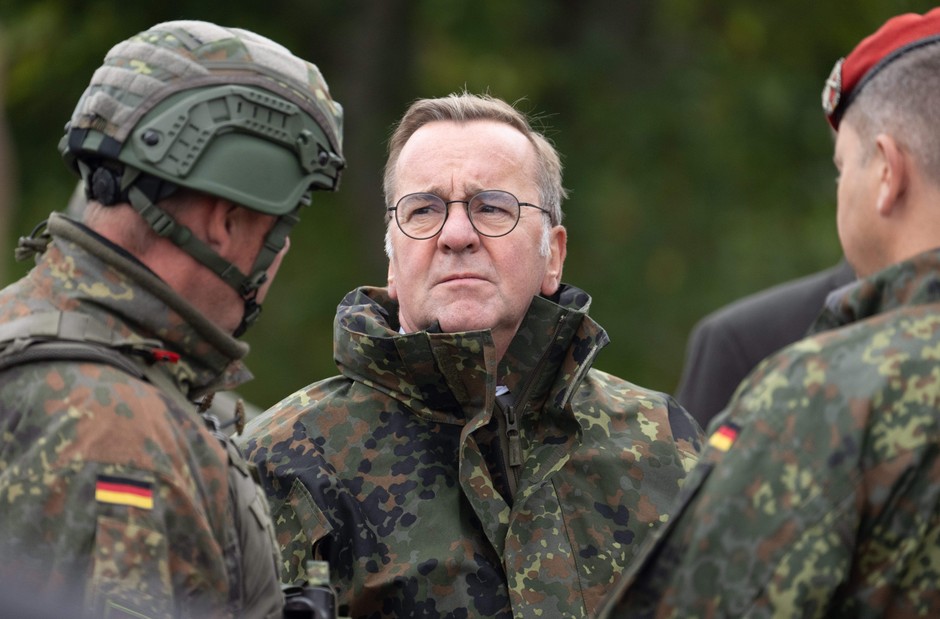
The German defense minister Boris Pistorius talks to soldiers during a visit to the Bundeswehr artillery school at Idar-Oberstein, September 16, 2024.Boris Roessler / DPA / PAP
Perhaps he is also not familiar with the history of this war debate. In the end, CDU/CSU and FDP in the era of Chancellor Angela Merkel and the Minister of Defense Karl-Theodor Zu Guttenberg forced the decision to suspend compulsory military service in 2011. The SPD parliamentary group in the Bundestag clearly did not agree at that time at that time, but instead suggested it own model that would maintain military registration and consumption, even for the Bundeswehr then shrinking.
Voluntariness would have priority – but with the option of reactivating the obligation at any time if the calculation did not work. Finally, the Basic Law clearly states: “The federation maintains the armed forces for defense.” He does not add: “If there are enough people who feel like it.”
Hans-Peter Bartels was the representative of the Bundestag for armed forces in 2015-2020. Since 2022, SPD politician has been the president of the German Association of Security Policy.
I’m Ashley Davis as an editor, I’m committed to upholding the highest standards of integrity and accuracy in every piece we publish. My work is driven by curiosity, a passion for truth, and a belief that journalism plays a crucial role in shaping public discourse. I strive to tell stories that not only inform but also inspire action and conversation.