President XI Jinping has orchestrated the largest sewage sewage of Chinese generals at Mao Zedong


This year, on a cool April morning in Beijing, China's tallest military leaders gathered for a regular tree planting ceremony, which would have a rare look in the secret world of power under President XI Jinping, Bloomberg reports.
Prior to the event, rumors were circulating that HE Weidong – the second officer in the people's release army – had become the latest victim of a large treatment, who had already shot down three defense ministers. Less than three years ago, XI had appointed Hello Vice -President of the Central Military Commission (CMC), passing over more experienced generals, a sign that he was one of the president's trusted people for the leadership of the Communist Party.
The annual tree planting event brought together all the top members of the CMC since XI took over in 2012, a tradition dating back four decades. While a state television show broadcast in the evening showed participants, dressed in camouflage uniforms, shoveling earth, the observers quickly noted the absence of He. It was the clearest sign until then that he had become the general with the highest rank since 1976, when Mao Zedong's chaotic regime ended.
Although surprising, HE's disappearance was enrolled in an increasingly visible model under XI. The leader of China has dismissed almost a fifth of the generals he had named during the time he led the country, something that his predecessors had never done, according to a large analysis by the Bloomberg agency.
Moreover, Xi's purification reduced the CMC to only four members in total, from seven, as many as they were at the beginning of his third term. It is the smallest number in the post-mao era, Bloomberg analysis shows.
The Chinese army is preparing for the largest military parade of recent years
As more and more peak military leaders of China CAD, those who try to understand what is happening are facing an almost impossible question, given the opaque nature of the communist party: are all a sign of XI's political power or weakness? The implications are expanded worldwide and in the global economy.
Next week, when XI will supervise the first military parade organized by China after 2019 to mark the founding of the popular Republic by MAO, external observers will not only follow the new tanks, missiles and other weapons that could be used to attack the Taiwan and threaten the US military supremacy.
They will also look for clues about how much the XI has in its own generals to take a war and will try to understand what the recent earthquakes mean, in the context in which XI approaches a possible fourth term in 2027.
“There is no doubt that there is a lot of turbulence at the top of the hierarchy,” says James Char, associate professor at the Nanyang Technological University in Singapore, who studies the army of China.
XI Jinping wants the army to be able to “fight and win wars”
When Xi first took over the mandate, he warned that the corruption in the army represented an existential threat to the Communist Party. Buying the positions was an open secret: the newcomers paid up to $ 16,000 to pass the admission exam in the people's release army, while the officers bribed the generals for promotions and recovered their debts through illegal commissions.
As XI has launched a campaign to combat unprecedented corruption, which also eliminated political rivals, began and restructure the army of liberation of the people so that it could “fight and win wars”-a tacit recognition that it did not have this capacity.
A decade after the beginning of that effort, a gloomy government announcement, published on the Wechat social media platform, showed that he intensified his remodeling.
The Department for the Development of Army equipment, responsible for the purchase of weapons, warned in July 2023 to investigate eight problems, including leaks and “private clici” dating from 2017. It led to the dismissal of high rank leaders and, subsequently, to generals directly below XI.
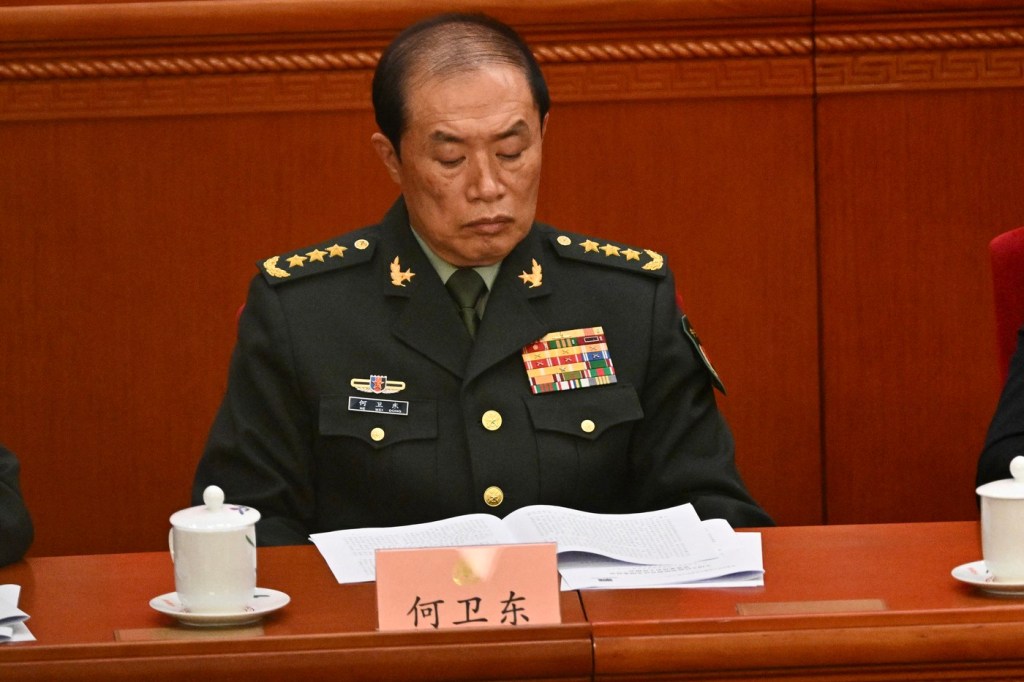
Chinese generals, secretly dismissed
The army of China is even more opaque than the government, which makes it difficult to evaluate the size of the purification. Usually, the fall of a leader becomes known only when he is missing from a public event, such as the absence of HE from the tree planting ceremony. And even then, it is not always clear what happened.
The senior officers who were also national parliamentarians had the dismissals recorded in the legislative documents. The first signs of problems for former Defense Minister Li Shangfu appeared when he suddenly missed an annual meeting with his Vietnamese counterpart.
The fate of his predecessor, Wei Fenghe, became known after being ignored in the Lunar New Year's messages.
These are high profile victims. During XI's third term, 14 of the 79 generals promoted by him disappeared or were investigated, according to Bloomberg analysis. By comparison, Presidents Jiang Zemin and Hu Jintao have not investigated any generals promoted during their leadership.
The Central Military Commission is not strong just because it holds the command of the largest permanent army in the world. The organization is controlled by the Communist Party, not by the Chinese government, which means it is the key to exercising power over the 1.4 billion people of China.
Although the leaders of China usually have three titles – president of the country, secretary general of the party and president of the CMC – the last of them has always been seen as essential for strengthening power.
China had periods without president, and some general secretaries of the Communist Party were weak. But the position of president of the CMC was generally held by China's most powerful leader, starting with Mao, who has famous “political power is born from the rifle pipe”.
Another unprecedented situation in China from Mao
The recent measures of XI reduced the CMC to four members from seven, the three vacancies being unprecedented from Mao, whose cultural revolution from 1960-1970 has overturned all China's institutions. The body is currently consisting of XI, Vice President Zhang Youxia, 75, and two other members: Zhang Shengmin, 67, and Liu Zhenli, about 60 years old.
Just a few weeks after the military parade on September 3, XI has the opportunity to renew the CMC at the fourth plenary of the Communist Party, where over 300 cadres will meet with the closed doors in Beijing to establish the next five -year economic plan and make key decisions on the cadres.
“XI seems determined to keep the allies and rivals in the suspense on the succession, maybe even until the last moment,” says Neil Thomas, Chinese researcher at Asia Policy Institute in Washington. “If XI would raise a civilian in the CMC to the fourth plenary, it could signal an heir potential. But it would be extremely unusual and extremely unlikely,” he says.

Will I give Xi Jinping the signal on a successor?
Despite the persistent speculation, XI, 72 years old, did not show any sign that he would like to call a successor and any mention of the subject is strongly censored on the Chinese Internet. More likely, it will complete the CMC by choosing between the small group of 29 generals still in office.
Even though some younger members of the people's release army can look at Xi's expulsions as a cleaning of corruption in the system, older officers have the incentive of hiding equipment defects, from procurement scandals, which could become visible than in fighting, says Joel Wuthnow. US defense.
“It is difficult to say how much the level of training has affected,” he believes. “The main idea is that XI itself can probably not be fully confident in the quality of the army equipment-even while the people's liberation army is preparing for a large parade in Beijing, meant to display its new capabilities in front of a global audience,” he concludes.