Putin and Trump can build a new axis of evil. We have one output


It was enough for a few days for two similar -thinking colleagues, Russian president Vladimir Putin and the President of the United States Donald Trump, outsmarted Filip II Macedonian.
The father of Alexander the Great has developed the famous strategy “divide and rule”, considered by over 2,000. years for the most effective pattern of conquest and exercising power. But this is the past. Now a new strategy applies: unite and humiliate.
First, on August 15, Trump welcomed Putin with great respect on the red carpet in Anchorage. Then, on August 18, he accepted key European leaders in the White House, including the President of Ukraine Volodymyr Zelanski. During these three days, the presidents of the US and Russia decided deprive Europe of any significant influence.
Surprisingly, European leaders seemed relief, seeing that someone else was leading them to unity and deprives them of their remaining influence. However, they should actually feel anxiety. Together with their citizens and economies, they will now pay the price for many years of devoting to small -term, short -term interests and nationalist matters instead of building stronger EU.
This price will be even higher after the collective mistake, which was an attempt to satisfy Trump's appetite for flattery and concessions in the hope of moderately when concluding contracts.
The law of a stronger one
Europe would actually have reasons to have a trauma to Trump and feel temptation to distance themselves from the United States – but it should not do it. Hostility would now be as harmful as the initial rush in flattery. Instead, the block needs to regain sobriety, confidence, and above all dignity.
Since Trump's return to the position, some European leaders seem to suffer from a kind of Stockholm syndrome, enjoying being hostages of such a dominant personality. Similarly, the new generation of intellectuals believes that their mission is to make us a difficult truth, that the law of a stronger quickly replaces the rule of law and that we, Europeans, should accept this new wave, not fight with it.
Continued article under video material
I have a different opinion. It is a matter of civilization. Europe has the potential to resist such calls for self -destruction. He is also obliged to do it – not only in his own interest, but also in the interest of the rest of the world.
It is too early to predict what the full influence of Trump will ultimately be. It is worrying that the US president and Putin have a lot in common – whether it is a tendency to authoritative rule, sympathy for the oligarchic economy of subordinate political power, not to mention their concept of truth. The name chosen by Trump for its official media platform (Truth Social) even refers to the official newspaper of the Bolshevik movement (“truth”).
It is therefore not excluded that there will be a place between Trump and Putin authoritarian axis. Considering his innate sense of superiority and the poor condition of the Russian economy, the American leader would of course be convinced that he is the leader of this axis. Putin, however, would be happy to allow the US President to believe it, while manipulating the course of events – the days from Anchorage, unfortunately, confirmed this narrative.
Victim of Trump and Putin
Similarly, Trump's enthusiasm and determination – although they may be an additional motor that drives the global economic and political power of the United States – seems completely incompatible with the direction in which the country has been going on since World War II.
For the President of the US, the rule of law, division of power, supervision over conflicts of interests and independent organs can be an obstacle to animal instincts of capitalism, innovation and economic growth. However, these are also elements that have created a framework for the US economic success and, as a result, have become a model for most of the world.
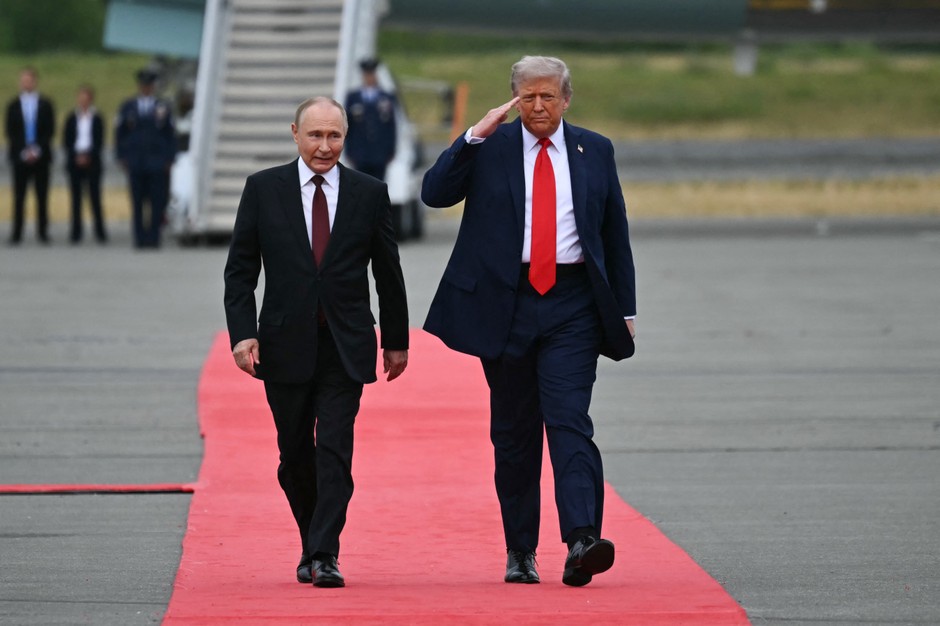
Meeting of Vladimir Putin and Donald Trump in Alaska, Anchorage, August 15, 2025.Andrew Caballero-Reynolds / AFP
In the international context, Trump naturally tends to unilateralism [koncepcja stosunków jednostronnych] And he hates bilateral rule, and even more multilateral. However, it remains an open issue or current use – and the threat of abuse – the power through the US will be effective in shaping the global landscape in accordance with American goals.
We also cannot ignore the issue of global public goods. People, nature and economy – including the American economy – already suffer bitter consequences. What happens if multilateral management really ends?
So, while Trump runs its games with Putin, Europe must be bolder so as not to become a designated victim of Trump and Putin. He must look at the wider world and determine the pragmatic program of action in the following areas:
New impulse
First, EU countries that want to include it Alliance with others countries in Europe, such as Great Britain and Norway, as well as with countries on other continents – such as Canada, Japan, Australia, New Zealand and others, including developing countries – in order to promote non -authoritarian democracy based on principles.
In addition to freeing us from the wrong assumption that the world is now Trumpowski, such an alliance should give a new impulse to free trade and multilateral management, and pay special attention to the supply of global public goods. Most importantly, however, the coalition should not be antagonistic towards the United States, as in the case of the BRICS group. On the contrary, she should be satisfied with cooperation in good faith with the United States – if Washington is ready to seek progress according to the line, which he promoted more than any other country since World War II. Cooperation with BRICS should also be supported, unless it is directed against the USA.
Then both the EU and G7 must recover autonomy in the field of own policy. Considering the unsuccessful strategy of mood relief, partners who have recently abandoned their established political positions to make concessions to the United States should politely withdraw them. Citizens and enterprises of these countries should put pressure on their rule to do so – not only to free themselves from hidden taxes, which otherwise they would have to pay to subsidize citizens and American enterprises.
This is the case with global minimum tax. During the G7 summit in Canada in June this year, all members accepted the United States application for release of American enterprises from this first modest step against tax avoidance and tax evasion by multinational enterprises. However, the formal procedure for this has not yet been completed in the organization of economic cooperation and development.
Considering that the United States used this favor during the G7 summit, but without mitigating their position on customs duties, as expected, it would be fair if the G7 and EU countries decided not to continue these activities.
Whims of the great power
If I am allowed to share personal memories, then at the beginning of the 21st century we experienced similar pressure from the United States in the European Commission. It was about the president who was afraid after he began two wars – one in Afghanistan and the other in Iraq.
The then President George W. Bush warned us not to dare to apply the EU rules of competition towards American international corporations or generally to the digital economy. However, although we politely listened to his warnings and took them into account, we continued our work.
And finally the issue of defense. I want to emphasize one thing here: I do not consider the obligation to cover most of the defense costs as concession. Several presidents in front of Trump pressed Europe in this matter – in my opinion rightly so.
Even in an unlikely case, if the United States withdrew their request, I believe that Europe should implement it. US foreign policy is becoming more and more unstable. We should not make our defense dependent on the capricious policy of the great power. Powers that, despite its history of help in saving us from Nazism and fascism, and protection against Soviet communism, currently has strategies that can be More in line with autocratic regimes than with the values we divided for 80 years.